
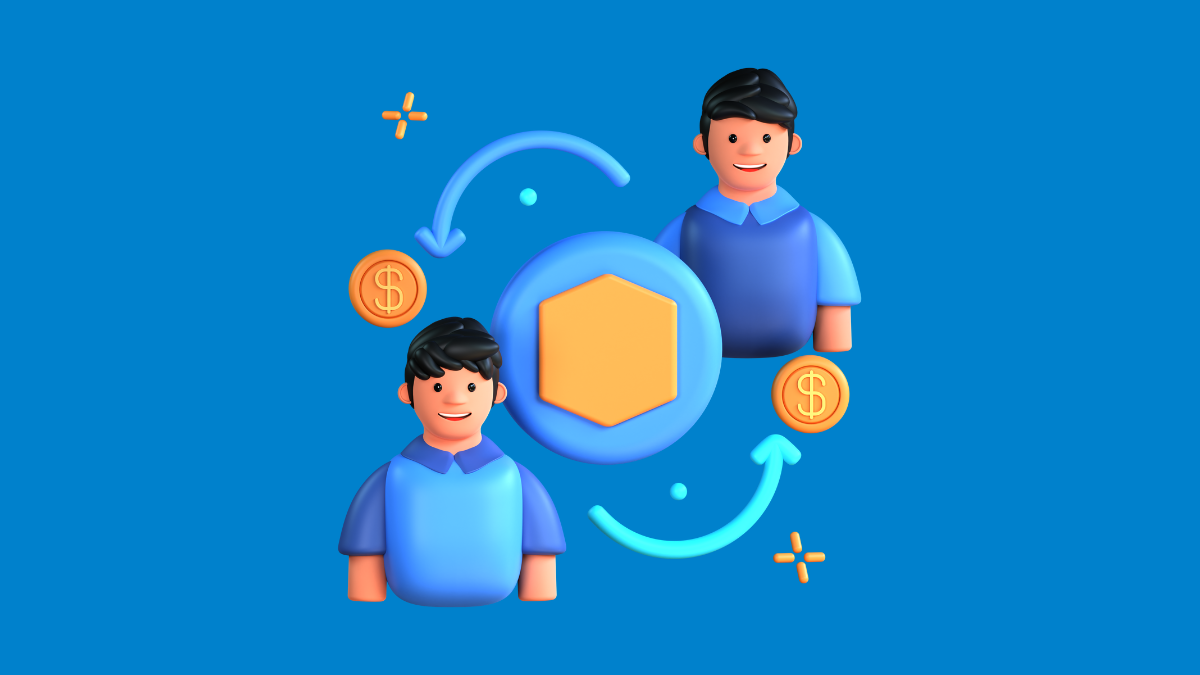
What are peer-to-peer systems?
Peer-to-peer (P2P) transactions are the most direct way to exchange value between two people; no banks, no payment processors, no middlemen. It’s how money originally worked: if you hand a friend a $10 bill, that’s a peer-to-peer transaction. The exchange is immediate, final, and requires no third party to approve or record it.
In the digital age, however, things became more complicated. When you send money through a bank or app, the transaction isn’t truly between you and the other person, it’s between your bank and theirs. Both rely on centralized systems to verify balances, process payments, and keep records. Even apps that seem peer-to-peer, like PayPal or Venmo, still use intermediaries. They hold your funds, control access, and can reverse or block transactions.
A true peer-to-peer transaction removes those layers entirely. You send value directly from your account or wallet Crypto WalletsA crypto wallet doesn’t store coins like a piggy bank. Instead, it keeps keys that let you access your crypto on the blockchain.Keep learning to another person’s, without needing approval or permission from any central authority. In the world of cryptocurrency, this is made possible through blockchain
 BlockchainThink of blockchain as a public notebook that everyone owns a copy of. Whatever gets written in it is permanent and visible to all.Keep learning technology.
Take Bitcoin as an example. When Alice sends Bob 0.01 BTC, she broadcasts a transaction to the Bitcoin network. Computers (called nodes) verify that Alice has enough balance and that her digital signature is valid. Once confirmed, the transaction is added to the blockchain; a public ledger everyone can see. There’s no bank managing it, no company taking a cut, and no middleman holding the funds. The value moves directly, peer-to-peer.
An easy analogy is sending a letter versus sending an email. Traditional financial systems are like sending a letter through a postal service, you hand it over and it travels through a network of intermediaries before reaching the destination. A blockchain-based peer-to-peer system is like sending an email: it goes straight to the recipient, almost instantly, without any central post office.
Peer-to-peer transactions have several advantages:
Speed: Transactions can happen within minutes or seconds, depending on the network.
Low cost: Without banks or payment processors, fees are often minimal.
Accessibility: Anyone with an internet connection and a digital wallet can participate.
Censorship resistance: No one can block, freeze, or reverse your payment once it’s confirmed.
However, P2P systems also introduce new responsibilities. There’s no customer support line to call if you send money to the wrong address or forget your password. You, the user, become your own bank; responsible for security, storage, and transaction accuracy.
Real-world P2P use cases are already widespread. People in countries with unstable banking systems use Bitcoin or stablecoins to send remittances home cheaply and quickly. Freelancers get paid directly in crypto without losing a percentage to payment processors. Even local communities are building decentralized marketplaces where users trade goods and services directly using digital assets.
The tags found in our glossary are there to help you better understand presented definitions. They showcase how certain concepts integrate and interact within the ecosystem.
Rectangular tags signal a concept related to BlockchainBlockchainThink of blockchain as a public notebook that everyone owns a copy of. Whatever gets written in it is permanent and visible to all.Keep learning as a technology. Whereas rounded tags represent Cryptocurrency CryptocurrencyCryptocurrency, often called “crypto,” is a form of digital currency that uses cryptography (advanced math and code) to keep it secure.Keep learning in more of a financial aspect. You’ll also see rectangular dashed tags for Web3
 Web3Web3 is the idea of a decentralized internet powered by blockchain.Keep learning and rounded dashed tags for DeFi
 DeFiDeFi stands for Decentralized Finance. It refers to a collection of applications and platforms built on blockchain that allow people to transact without banks.Keep learning specifically.
Learn more about the relationship between all the tags and their respective concept with our Free Interactive Courses.
Fiat currency
Fiat currency is government-issued money, like dollars, that is not backed by a physical commodity but derives value from trust in the issuing authority.
Keep learning
Inflation
Inflation is the increase in prices over time that reduces the purchasing power of money.
Keep learning
Digital currency
Digital currency is any form of money that exists electronically and can be used for transactions, like cryptocurrencies and government-issued digital money.
Keep learning
Deflation
Deflation is a decrease in the overall supply of money or assets, often increasing their scarcity and potential value over time.
Keep learning