
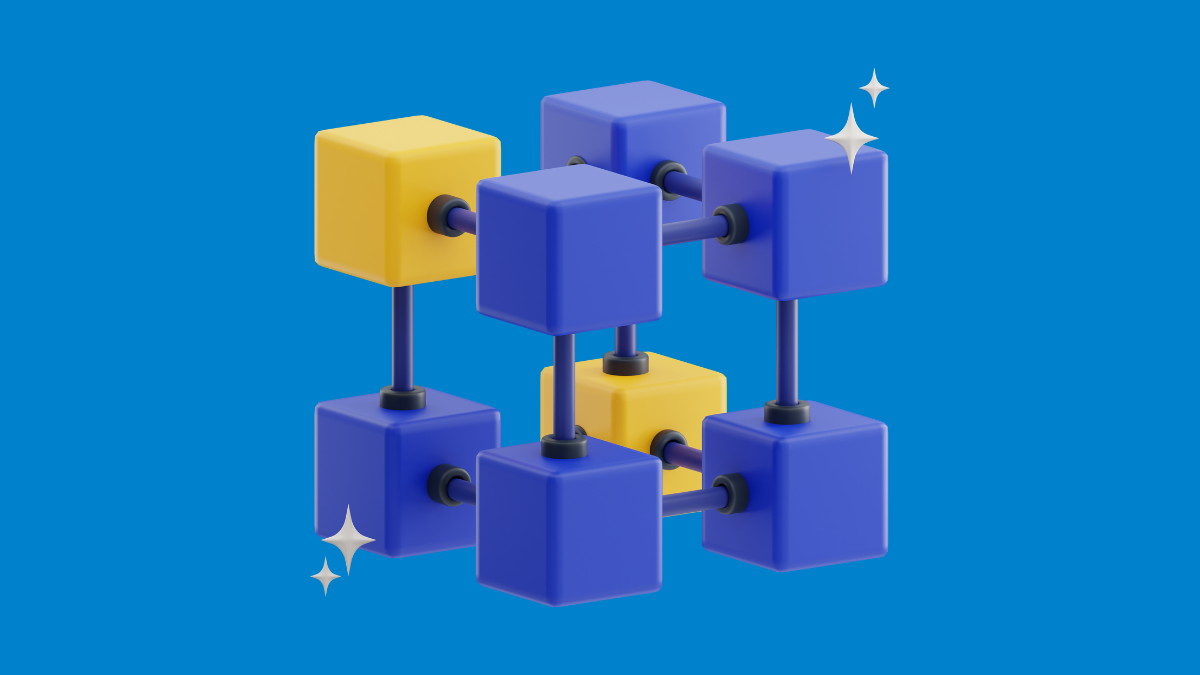
What is a Blockchain?
Blockchain technology has become one of the most talked-about innovations of the past decade, yet for many people the term remains abstract; something associated with Bitcoin BitcoinBitcoin is a decentralized digital currency that enables secure peer-to-peer transactions without relying on a central authority.Keep learning, cryptocurrency
 CryptocurrencyCryptocurrency, often called “crypto,” is a form of digital currency that uses cryptography (advanced math and code) to keep it secure.Keep learning speculation, and headlines about volatile prices, but rarely explained in plain language. This article breaks the concept down from first principles, using the Bitcoin blockchain as a working example, since it remains the clearest entry point into how the technology actually functions.
A Brief Word on Decentralization
To understand blockchain, it helps to first understand the problem it was designed to solve.
Traditional currencies are issued and controlled by central authorities; typically governments and banks. These institutions decide how much currency exists, and they maintain the official record of who owns what. This arrangement works well most of the time, but it carries an inherent vulnerability: it depends entirely on trust in a single, central party. If that party makes a poor decision, freezes accounts, mismanages the money supply, or simply fails, the people relying on it have little recourse.
Bitcoin was created as an alternative. It is decentralized DecentralizationDecentralization is the distribution of control and decision-making across a network instead of a single central authority.Keep learning, meaning no single bank, company, or government controls it. Instead, the currency and its transaction history are maintained collectively by a global network of participants. It is also finite; there will only ever be 21 million Bitcoin in existence, with new coins released on a fixed, predetermined schedule. This scarcity
 Digital ScarcityDigital scarcity is the concept of limiting the supply of digital assets so they cannot be easily duplicated or inflated, giving them value.Keep learning is part of what gives the asset its value proposition, in much the same way scarcity underpins the value of gold.
This same decentralized model is also the foundation of Ethereum EthereumEthereum is a decentralized blockchain platform that runs smart contracts and dApps, using its native cryptocurrency (ETH) for transactions and fees.Keep learning, the second-largest cryptocurrency network, which extended the idea further by allowing developers to build programmable "smart contracts
 Smart ContractsA smart contract is a self-executing computer program deployed on a blockchain. It contains rules and conditions written directly into code.Keep learning" and entirely new applications on top of its blockchain. Readers wanting to track how these and other digital assets are performing can use a market-tracking tool such as CoinMarketCap, which lists live pricing and historical data for thousands of cryptocurrencies.
But none of this; decentralization, scarcity, programmability; is possible without the underlying technology that makes it trustworthy: the blockchain itself.
Breaking Down the Term: "Chain of Blocks"
At its simplest, a blockchain is exactly what the name suggests: a chain of blocks. To understand what that means in practice, we need to look at what a "block" actually contains.
A block is essentially a bundle of transactions, recorded together in a ledger; a list of who sent what to whom, and when. This is conceptually identical to a bank statement, which records money moving in and out of an account.
Consider a simple transaction:
- Joe has 1,000 Bitcoin, held in wallet address
1FXXXXXXXXXXXXXXXXXXXXXXXXXXXXXXX - Sarah has 2,000 Bitcoin, held in wallet address
1FYYYYYYYYYYYYYYYYYYYYYYYYYYYYYYYY - Joe sends Sarah 200 Bitcoin at 12:47 PM on 9 January 2021
- Joe's wallet now holds 800 Bitcoin; Sarah's holds 2,200 Bitcoin
In a traditional banking system, two separate institutions would each update their own private records to reflect this transfer. On a blockchain, there is no single institution keeping the master record. Instead, this information is stored in a block, and identical copies of that block are distributed across thousands of independent computers around the world, known as nodes Blockchain NodesA node is simply a computer that participates in a blockchain network. Each node stores a copy of the blockchain and helps verify transactions.Keep learning.
For this system to function as a trustworthy record-keeper, it must satisfy three conditions:
- Immutability — once written, a block cannot be altered.
- Consistency — every node's copy of the ledger must match every other node's copy, or the record cannot be trusted.
- Transparency with restricted access — anyone can view the transaction history, but only the holder of a wallet
 Crypto WalletsA crypto wallet doesn’t store coins like a piggy bank. Instead, it keeps keys that let you access your crypto on the blockchain.Keep learning's private credentials can authorize outgoing transactions from it.
Achieving all three simultaneously requires cryptography CryptographyCryptography is the science of securing information using mathematical techniques to protect data, ensure privacy, and verify authenticity.Keep learning; and specifically, a technique called hashing
 HashingHashing is the process of converting data into a fixed-length code using a cryptographic function, ensuring data integrity and security.Keep learning.
Understanding Hashing
A hash function takes any input; a single character, a word, an entire book; and runs it through a fixed set of mathematical operations to produce an output of a consistent length, known as a hash. The same input will always produce the same output, but even the smallest change to the input produces a completely different result.
To illustrate the concept, imagine an extremely simple, three-step hashing process:
- Take a number and double it
- Add 6 to the result
- Divide the result by 2
Applying this to the number 20: double it to get 40, add 6 to get 46, divide by 2 to get 23. The number 20 will always hash to 23 using this method. It is crucial because if we know the exact steps involved, we could reverse the process to recover the original number if we needed to.
That reversibility is precisely the weakness real cryptographic hash functions are designed to eliminate. The algorithm actually used to secure blockchain data is called SHA-256 (Secure Hash Algorithm, 256-bit), and unlike our toy example, it is, for all practical purposes, impossible to reverse.
SHA-256 in Practice
SHA-256 converts any input using the ASCII table to translate letters and characters into numerical values through 64 rounds of mathematical transformation. Regardless of how much data is fed in, the output is always exactly 256 bits (64 hexadecimal characters) long. Hashing a single letter produces an output the same length as hashing the entire works of Shakespeare.
For example, hashing the word "Hello" with SHA-256 always produces:
185f8db32271fe25f561a6fc938b2e264306ec304eda518007d1764826381969
You can verify this yourself using any of the following free online tools:
Simply type "Hello" into any of these tools and you will get the exact same result every time. Change even a single character; capitalize a letter, add a space; and the entire output changes unpredictably.
This one-way property is what makes SHA-256 so valuable for security. It is computationally trivial to generate a hash from known data, but effectively impossible to work backward from a hash to discover the original input. Industry estimates suggest that brute-forcing a single SHA-256 hash would take even a powerful modern computer tens of trillions of years; far longer than the projected remaining lifespan of the sun. This is why a password or private key Private KeysPrivate keys are secret cryptographic codes that give users full control over their crypto assets and are used to sign and authorize transactions.Keep learning can be stored publicly as a hash without ever exposing the original value.
From Hashes to Blocks
A block on the Bitcoin blockchain is, in essence, a hashed record of multiple transactions. If you take a full set of transaction data (sender, recipient, amount, timestamp) and run it through SHA-256, you get a single, unique fingerprint for that exact set of data. Change any detail, even the timestamp by one second, and the fingerprint changes entirely. This makes it immediately obvious if a record has been tampered with.
This is also where the network Blockchain NetworkA blockchain network is a system of computers connected to each other that follow the same set of rules to record, share, and validate transactions.Keep learning reaches consensus: every node compares its hash of the ledger against every other node's hash. If they all match, the data is verified and trustworthy. If even one node reports a different hash, that node is flagged as inconsistent; and therefore unreliable; without anyone needing to know what was changed or why.
How the "Chain" is Formed
This is where the chaining mechanism comes in, and it's elegantly simple. The hash of one block is included as part of the data going into the next block, before that next block is hashed. This creates a forward-linked sequence: if anyone alters data in an earlier block, that block's hash changes, which no longer matches the hash recorded in the following block. That mismatch then cascades through every subsequent block in the chain.
In practice, this means that altering historical data on a blockchain isn't just difficult; it's detectable immediately, because it breaks the mathematical link to every block that came after it.
If you'd like to see this mechanism in action without writing any code, the Blockchain Demo by Anders Brownworth is an excellent interactive tool. It lets you enter sample transaction data, generate its SHA-256 hash in real time, and watch how changing any input; or breaking the chain; instantly invalidates everything downstream.
What Is Mining?
The final piece of the puzzle is mining Crypto MiningCrypto mining is the process of using computing power to validate blockchain transactions and earn cryptocurrency rewards.Keep learning; the process by which new blocks are validated and added to the chain.
Mining works by repeatedly hashing a block's data along with an adjustable value called a nonce (short for "number used once"). Miners increment the nonce and re-hash the block over and over, searching for a resulting hash that meets a specific target. For example, one that begins with a set number of leading zeros. This requires substantial computational effort, and finding a qualifying hash can take many thousands or millions of attempts.
Using the same Blockchain Demo tool referenced above, you can try this yourself:
- Enter a simple piece of transaction data (e.g., "Fred has 200 Bitcoin") into a block.
- Note the resulting hash — it won't begin with four zeros.
- Click "Mine" and watch the tool increment the nonce automatically until it finds a hash that does.
Once a valid hash is found, the block is considered confirmed, and its hash becomes part of the input for the next block, continuing the chain. Because mining consumes real computing power and electricity, successful miners are rewarded with newly issued Bitcoin, providing the economic incentive that keeps the network secure and operational.
The tags found in our glossary are there to help you better understand presented definitions. They showcase how certain concepts integrate and interact within the ecosystem.
Rectangular tags signal a concept related to Blockchain BlockchainThink of blockchain as a public notebook that everyone owns a copy of. Whatever gets written in it is permanent and visible to all.Keep learning as a technology. Whereas rounded tags represent CryptocurrencyCryptocurrencyCryptocurrency, often called “crypto,” is a form of digital currency that uses cryptography (advanced math and code) to keep it secure.Keep learning in more of a financial aspect. You’ll also see rectangular dashed tags for Web3
 Web3Web3 is the idea of a decentralized internet powered by blockchain.Keep learning and rounded dashed tags for DeFi
 DeFiDeFi stands for Decentralized Finance. It refers to a collection of applications and platforms built on blockchain that allow people to transact without banks.Keep learning specifically.
Learn more about the relationship between all the tags and their respective concept with our Free Interactive Courses.
Transaction fees
Transaction fees are charges paid to process and validate transactions on a blockchain network.
Keep learning
Oracles
A crypto oracle is a service that feeds external real-world data into blockchains so smart contracts can react to off-chain events.
Keep learning
Real-World Assets (RWAs)
Real-World Assets (RWAs) are physical or traditional financial assets, like real estate or bonds, represented and traded on blockchain networks.
Keep learning
Web3
Web3 is the idea of a decentralized internet powered by blockchain.
Keep learning