
Cypherock X1:
no seed phrase at all, but lose four of five pieces and it's gone forever.
We tore apart Cypherock's seedless, distributed-recovery hardware wallet across seven weighted categories; from a genuinely distinctive architecture that splits your private key across five physical components (one X1 Vault and four NFC X1 Cards) using Shamir's Secret Sharing, so any two of five can recover your wallet with no single point of failure, to the real flip side of that design: losing four of the five components means permanent, irrecoverable loss, alongside real, consistently-confirmed limitations like no mobile app support and a confusing, wide price range across an expanded three-tier lineup; and landed on a score the marketing page won't show you.
Our take, up front: Cypherock, founded by Rohan Agarwal and Vipul Saini, launched the X1 in open beta in 2022 with full commercial release in 2023, and it takes a genuinely different approach to the single biggest failure mode in this entire category: the written seed phrase. Instead, your private key is split across five physical components, one X1 Vault and four NFC X1 Cards, using Shamir's Secret Sharing cryptography in a 2-of-5 threshold model, so any two of the five can reconstruct wallet access. There's real, genuine appeal here: no single point of failure, no paper backup to lose, fire, or forget. Real, open-source firmware is hosted publicly on GitHub, and the company reports an independent audit by Keylabs, a security firm previously noted for finding vulnerabilities in other manufacturers' devices, though we couldn't independently verify the specific findings ourselves. The real, honest flip side, and the reason this deserves careful framing rather than uncritical enthusiasm: lose four of the five components, and recovery becomes permanently impossible, a genuinely different risk profile than a single seed phrase, not necessarily a safer one in every scenario. Layer on real, consistently-confirmed limitations, no mobile app support as of 2026, a plastic construction, and a confusing price range from $99 to $250 across an expanded three-tier lineup, and this is a genuinely innovative device that asks you to trade one set of risks for a different set, not to eliminate risk outright. We weighted all of it below.
The X1 splits your private key across five physical components, one X1 Vault and four NFC X1 Cards, using Shamir's Secret Sharing cryptography in a genuine 2-of-5 threshold model: any two of the five components can reconstruct wallet access, with no single point of failure. This eliminates the traditional written seed phrase entirely, a real, fundamentally different approach to key backup than virtually every other device in this series. Real, open-source firmware is hosted publicly on GitHub, allowing independent verification. The company reports an independent security audit by Keylabs, a firm previously noted for exposing vulnerabilities in other manufacturers' devices, though we could not independently verify the specific findings of that audit ourselves. We found no disclosed vulnerability or security incident specific to this device in our research. Real, important flip side of the distributed model: losing four of the five components results in permanent, irrecoverable loss, meaning the security model trades a single point of failure for a real, different requirement to safeguard multiple physical items simultaneously, arguably a harder logistical challenge than protecting one written seed phrase for some users.
Pros
- Genuinely distinctive 2-of-5 Shamir Secret Sharing model eliminates the single-seed-phrase failure point
- Open-source firmware, publicly hosted and independently verifiable
- No disclosed vulnerability or security incident found in our research
Cons
- Losing four of five components results in permanent, irrecoverable loss
- Specific findings of the reported Keylabs audit could not be independently verified
Real, broad but inconsistently-reported asset support across sources, ranging from roughly 9,000 to over 19,000 supported cryptocurrencies depending on the source and date. Real, genuine DApp access through WalletConnect, plus direct integration with MetaMask and Phantom. NFT support is included.
Pros
- Broad coin support, cited as high as 19,000-plus by the most recent source
- Direct MetaMask and Phantom integration, plus WalletConnect DApp access
Cons
- Real, wide discrepancy across sources on exact current coin count (9,000 vs. 19,000+)
A small screen paired with joystick navigation is a genuinely distinctive interface choice; at least one source frames this positively as "simple and convenient compared to a small touchscreen," while others note a real learning curve for the multi-component recovery system when first setting up. Real, consistent, notable limitation across multiple 2026-dated sources: no mobile app support at all, with the companion cySync app remaining desktop-only.
Pros
- Joystick navigation independently described as simple relative to a small touchscreen
Cons
- No mobile app support at all as of 2026; desktop-only cySync app
- Real, acknowledged learning curve for the multi-component recovery flow
Real, genuinely thoughtful included accessories: a hard-shell protective case and RFID-resistant sleeves for the NFC cards, items many competitors don't bundle in at all. Real, tamper-evident packaging (a shrink-wrapped black box). But real, independently and consistently noted plastic construction across multiple sources, a step down from metal-bodied competitors in this series.
Pros
- Included hard-shell case and RFID-resistant NFC card sleeves
- Tamper-evident, shrink-wrapped packaging
Cons
- Plastic construction, consistently noted across multiple sources
Founded by Rohan Agarwal and Vipul Saini, with the X1 progressing from a real 2022 open beta to full 2023 commercial release, a reasonable, if shorter, track record than more established competitors. We found no disclosed security incident specific to this device in our research. Real, reported third-party security audit by Keylabs, though independent verification of specific findings was not available to us. A real, expanded three-SKU lineup (Basic, Standard, Pro) by 2026 suggests active, ongoing product development.
Pros
- No disclosed security incident found in our research
- Active ongoing development, evidenced by an expanded three-SKU lineup
Cons
- Shorter track record and smaller community than the most established competitors
Real, significant price variance across sources and SKUs, ranging from a $99 Basic tier to $200-$250 for premium bundles, reflecting a real, expanded three-tier lineup introduced by 2026. At least one detailed source frames this candidly: the X1's main value proposition is distributed recovery, not the cheapest price or premium hardware feel.
Pros
- A $99 Basic tier offers a genuine lower-cost entry point
- No subscription fee
Cons
- Real, wide price variance ($99-$250) across an expanded three-SKU lineup
The 2-of-5 Shamir Secret Sharing recovery model is itself a genuinely distinctive, real advanced feature unmatched by most competitors in this series. Real, thoughtful inheritance-planning use case is explicitly supported by the multi-component design, since components can be distributed to trusted parties. Included hard case and RFID-resistant card sleeves round out a genuinely considerate accessory set.
Pros
- Genuinely distinctive distributed recovery model, one of the most innovative in this series
- Real, explicit support for inheritance-planning use cases
Cons
- None significant found in our research
Buy only through Cypherock's official store.
Given the multi-component design, buying direct matters even more than usual: a tampered Vault or card from an unofficial reseller could compromise the entire 2-of-5 recovery model. Test the recovery flow with a small amount before committing significant holdings.
A genuinely different trade-off, not a strictly safer one.
The instinct to call a seedless wallet an unambiguous upgrade is understandable, and the 2-of-5 distributed model is real, genuine innovation that solves a real problem: the single written seed phrase that gets lost, burned, or thrown away. But "no single point of failure" doesn't mean "no way to fail." Five physical items are more things to track, store, and protect than one, and losing four of them is just as permanent as losing a seed phrase, arguably harder to guard against by accident. This is a genuinely well-built answer to a real problem, best suited to people who've thought carefully about where their five components will live, not a blanket safer choice for everyone.
The scorecard above is deliberately general. Whether the Cypherock X1 is right for you depends heavily on which of these you already are.
The long-term holder planning for inheritance or estate distribution
Distributing X1 Cards to trusted family members or locations is a genuinely thoughtful use of the 2-of-5 model that a single seed phrase can't easily replicate.
The holder who has repeatedly worried about losing or damaging a written seed phrase
The distributed model genuinely solves that specific, real anxiety, provided you're equally careful about tracking five items instead of one.
The desktop-primary user who doesn't need mobile access today
The lack of a mobile app is a real, current limitation, but not a dealbreaker if you manage your portfolio from a computer.
Anyone who wants the simplest possible backup, or needs a mobile app now
Tracking five components is real, additional overhead compared to a single seed phrase, and there's no mobile app support as of 2026.
The scorecard covers the headline judgment calls. These four tables cover the specifics we didn't want to bury in prose; exactly how the 2-of-5 model works, the real, expanded SKU lineup and pricing, a real cited category score from one detailed source, and how it compares against the other wallets we've reviewed.
How the 2-of-5 Shamir Secret Sharing model works
| Components | What happens |
|---|---|
| All 5 present (Vault + 4 Cards) | Normal operation; any 2 can sign a transaction together |
| 1 component lost | Full recovery still possible using any 2 of the remaining 4 |
| 3 components lost | Recovery still possible with the remaining 2 |
| 4 components lost | Permanent, irrecoverable loss |
The real strength is tolerance for losing up to 3 of 5 components; the real, honest trade-off is that this replaces "protect one seed phrase" with "keep track of where five physical items are."
The real, expanded SKU lineup
| SKU | Price |
|---|---|
| Basic | $99 |
| Standard | Not specified in sources reviewed |
| Pro | Up to $200-$250 depending on bundle |
This three-tier expansion, introduced by 2026, explains much of the real price confusion across sources; confirm which specific SKU a quoted price refers to before comparing.
A real, cited category score
| Source | Category | Score |
|---|---|---|
| Coin Bureau | Asset and DApp Support | 4.3 / 5 |
This is a real, specifically cited category rating from one detailed source; we did not find their overall published score in our research.
How it compares to other hardware wallets we've reviewed
| Wallet | Recovery model | Price | Notable trade-off |
|---|---|---|---|
| Cypherock X1 | 2-of-5 Shamir Secret Sharing (seedless) | $99-$250 | No mobile app; lose 4 of 5 components and recovery is permanent |
| Keystone 3 Pro | Multi-seed (up to 3) plus optional Shamir Backup | $149 | Two-scan QR workflow; no native staking |
| ELLIPAL Titan 2.0 | Standard seed (5 seeds/passphrases supported) | $169 | Closed key-generation firmware |
| Trezor Model One | Standard single seed | $49-$72 | No secure element chip |
Cypherock is the only device in this series built entirely around eliminating the seed phrase rather than offering it as one option among several.
We don't just want to hand you our number; we want to show you how it sits next to what other review desks and comparison sites have published. Several sources here are genuinely enthusiastic about the novelty of the seedless model, and at least one reads as narrative-driven, testimonial-style content rather than a strictly technical review.
Our score lands meaningfully below the aggregated industry average; most sources emphasize the genuine innovation of the distributed recovery model without weighting the real "lose four of five" permanent-loss risk or the lack of a mobile app as heavily as we do.
| Source | Score | Type |
|---|
Scores compiled by our editorial team from publicly available reviews as of August 2026. "Editorial estimate" means the outlet didn't publish a single numeric score, so we converted their published verdict and sentiment into a comparable 100-point figure. Verify current figures directly with each source before citing them elsewhere.
Nothing critical. The 2-of-5 model means you can still recover full access using any 2 of the remaining 4 components (the Vault plus the other 3 cards).
If you lose 4 of the 5 components (Vault plus 4 Cards), recovery becomes permanently impossible. This is the real, honest trade-off of the distributed model: it tolerates losing several components, but not almost all of them.
Yes. There's no traditional 12 or 24-word phrase to write down at all. Your private key exists only as reconstructed fragments distributed across the Vault and four NFC cards.
No, not as of 2026. The companion cySync app remains desktop-only; mobile support is reported as still pending by at least one detailed source.
It depends on the SKU: a Basic tier starts around $99, with Standard and Pro bundles reaching $200-$250. Confirm which specific tier a quoted price refers to.
The company reports an audit by Keylabs, a firm previously noted for finding vulnerabilities in other manufacturers' devices. We could not independently verify the specific findings of that audit ourselves.
It's a genuinely different trade-off rather than a strictly safer one. It removes the single-point-of-failure risk of one written seed phrase, but introduces the real requirement of tracking five physical items instead of one, and losing four of them is just as permanent as losing a seed phrase.
Only through Cypherock's own official store. Given the multi-component design, a tampered Vault or card from an unofficial reseller could compromise the entire recovery model.
More Reviews
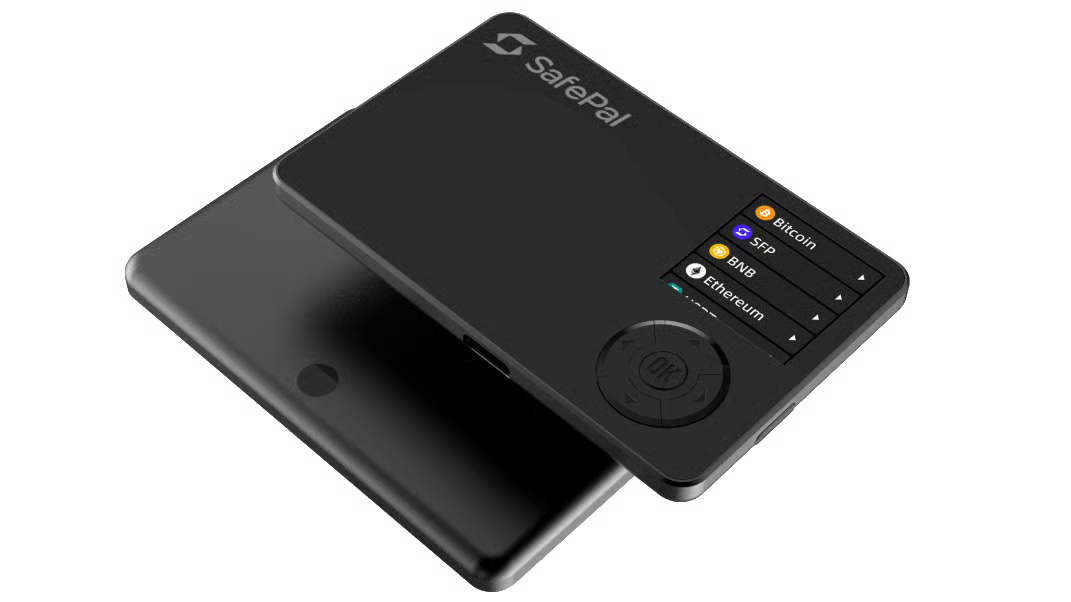
SafePal S1 Pro – Hardware Wallet Review
Score: 64/100. Genuine aluminum-and-glass upgrade over the S1, running the exact same underlying security model.
Read More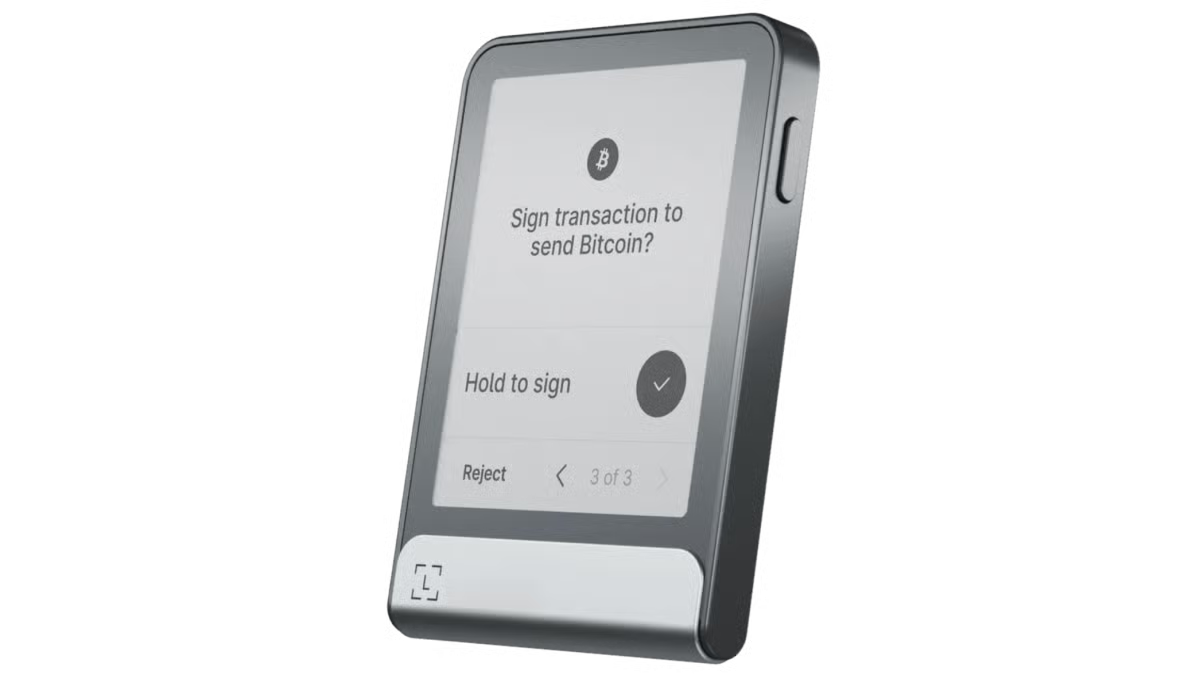
Ledger Flex – Hardware Wallet Review
Score: 76/100. Best chip Ledger makes, but closed-source firmware, the Recover controversy, and two breaches still linger.
Read More
BitBox02 – Hardware Wallet Review
Score: 71/100. Swiss-made, open-source, and genuinely clever, but sources disagree on whether multisig still works.
Read More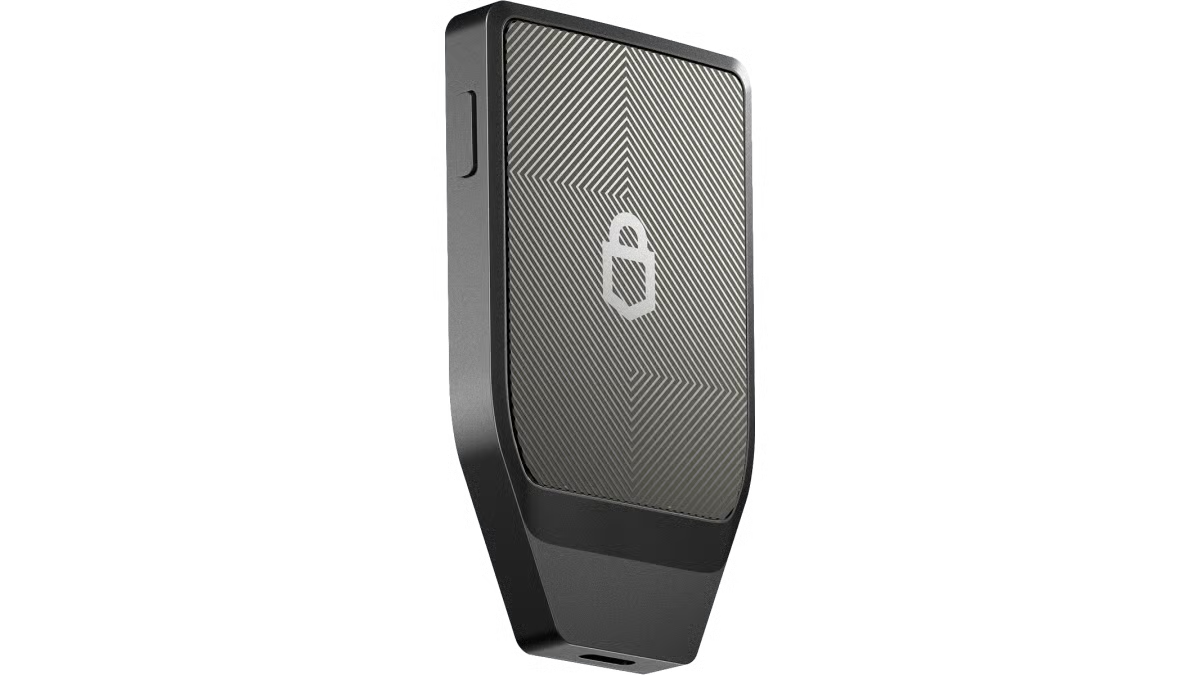
Trezor Safe 7 – Hardware Wallet Review
Score: 78/100. Fully auditable TROPIC01 chip, undercut by a real Ledger Donjon laser fault-injection disclosure.
Read More