
- May 22, 2026
- Crypto Tax Software, Summ
Summ - Crypto Tax Software Review
Disclosure: This post may contain affiliate links. If you sign up or make a purchase through our links, we may earn a commission at no extra cost to you. We only recommend products and services we believe add value.

Best for DeFi
Summ
87
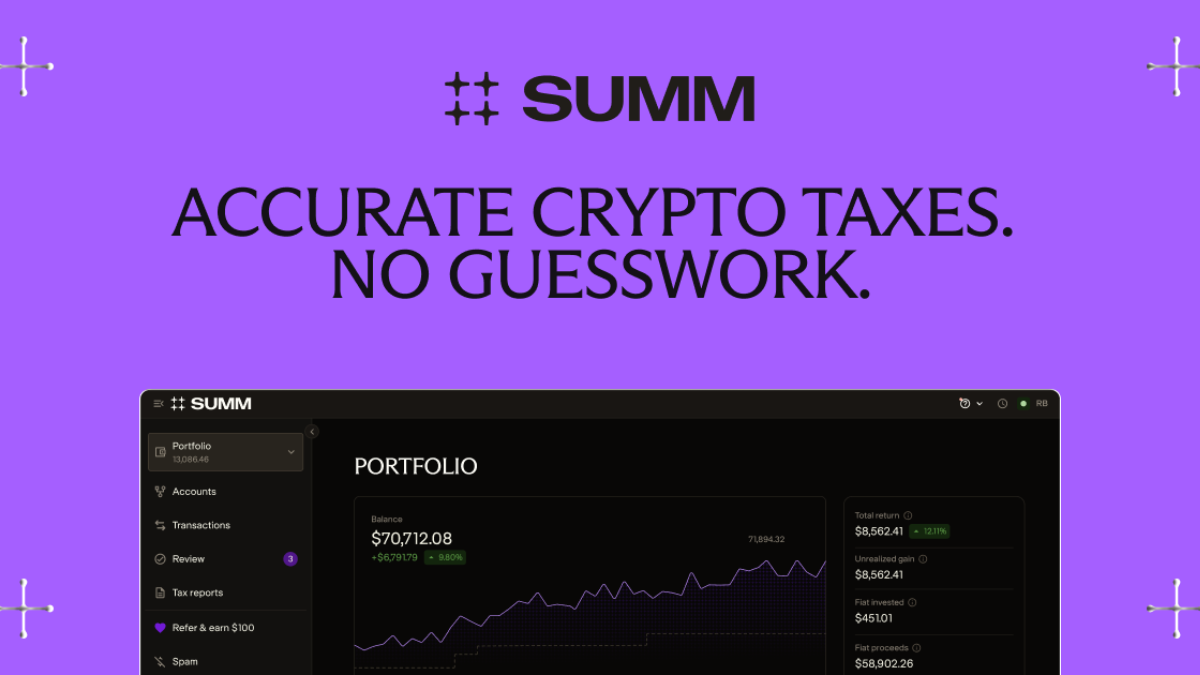
Summ is a crypto tax platform designed to track on-chain activity, calculate gains and losses, and generate simplified tax reports for digital asset investors.
Type
Crypto Tax Software
DeFi & NFT Support
Yes
Pricing
$49-499
Signup Offer
None
Integrations
3,500+ Wallets, Exchanges, On-Chain Platforms
Pros and Cons
Fast, AI‑powered transaction classification
Strong DeFi and on‑chain coverage
Clear, modern interface
Collaborative accountant workflow
Cons
Smaller exchange and wallet integration list
AI classifications may need review
Less established than long‑standing competitors
Limited advanced portfolio analytics

Overview
Summ is an emerging crypto tax software platform designed to streamline the reporting process through automation, clean design, and a modern approach to transaction reconciliation. Built with a focus on reducing user friction, Summ aims to simplify the complexities of crypto taxation by offering intuitive workflows, fast data imports, and clear visibility into gains, losses, and taxable events. Its lightweight, contemporary interface makes it approachable for users who want clarity without navigating dense accounting tools.
The platform supports integrations with major exchanges, wallets, and blockchains, enabling users to consolidate trading, staking, and on‑chain activity into a unified dashboard. Summ emphasizes transparency in calculations and provides straightforward tax reports tailored to multiple jurisdictions. While its feature set is still expanding, it already covers the core needs of most retail investors and offers tools that help users understand their tax position before filing.
A defining aspect of Summ is its commitment to simplicity and modern UX. It prioritizes speed, clean data presentation, and minimal manual intervention, though users with highly complex DeFi or cross‑chain activity may occasionally need to adjust transactions manually. This balance makes Summ particularly appealing to beginners and intermediate traders who want a smooth, frustration‑free experience.
Overall, Summ stands out as a design‑forward, efficiency‑driven tax solution that focuses on making crypto tax reporting as intuitive as possible. It is well suited for users who value ease of use, automation, and a modern interface, even if advanced power users may still prefer platforms with deeper reconciliation controls.
Pros and Cons
Fast, AI‑powered transaction classification
Summ uses AI to automatically categorize trades, transfers, and on‑chain activity, reducing manual cleanup time.
Strong DeFi and on‑chain coverage
It supports a wide range of blockchains and DeFi protocols, making it suitable for users active in Web3 ecosystems.
Clear, modern interface
The platform is visually clean and easy to navigate, helping users quickly identify issues or missing data.
Collaborative accountant workflow
Summ includes features designed for tax professionals, allowing shared access, review tools, and streamlined client management.
Cons
Smaller exchange and wallet integration list
Compared to older platforms, Summ may require more manual CSV imports for certain exchanges or wallets.
AI classifications may need review
While fast, AI‑generated labels can occasionally misclassify complex transactions, requiring manual correction.
Less established than long‑standing competitors
As a newer tool, Summ has a shorter track record and fewer third‑party reviews than platforms like Koinly or CoinLedger.
Limited advanced portfolio analytics
Summ focuses on tax workflows, so its investment analytics and performance tracking are more basic.
Scoring System
Each crypto tax software platform is evaluated on a 100-point scale using a weighted framework designed to reflect real-world usability, accuracy, and compliance with evolving crypto tax regulations. Scores are based on the following categories:
- Tax Calculation Accuracy (25 points) – Measures the reliability of transaction classification, cost-basis calculations, handling of complex DeFi/NFT activity, and support for multiple accounting methods such as FIFO, LIFO, and HIFO.
- Integrations & Data Import (20 points) – Evaluates the number of supported exchanges, wallets, blockchains, and APIs, as well as the ease of syncing transaction histories automatically.
- Compliance & Regional Tax Support (15 points) – Considers support for different tax jurisdictions, generation of country-specific tax forms, audit-ready reports, and alignment with evolving regulatory standards.
- Features & Reporting Tools (15 points) – Assesses available reporting tools such as capital gains summaries, income tracking, portfolio insights, DeFi/NFT reporting, and export compatibility with accounting software.
- User Experience & Interface (10 points) – Reviews onboarding, dashboard clarity, workflow simplicity, and the ability for both beginners and advanced users to navigate the platform efficiently.
- Customer Support & Documentation (10 points) – Evaluates the availability and quality of support channels, response times, knowledge bases, tutorials, and tax guidance resources.
- Pricing & Value for Money (5 points) – Examines subscription tiers, transaction limits, upgrade costs, and whether the features provided justify the price.
Each category contributes a defined portion of the total score. Higher-scoring platforms demonstrate a strong balance of accuracy, integrations, usability, and compliance; not just the ability to import transactions or generate basic tax reports.
Tax Calculation Accuracy
23
Calculation Methodology
Summ’s tax engine is built around direct on‑chain interpretation, allowing it to deliver highly accurate capital gains and income calculations even in complex multi‑chain environments. Instead of relying primarily on exchange APIs or user‑uploaded CSVs, Summ reconstructs transactions from blockchain data and interprets the underlying economic intent of each smart‑contract interaction. This approach enables Summ to determine cost basis, proceeds, and holding periods with a level of precision that traditional platforms often struggle to match.
Summ supports jurisdiction‑specific accounting methods; including FIFO, LIFO, HIFO, ACB, and share pooling; and applies them consistently across all disposals. Each transaction includes a transparent audit trail showing how Summ derived its interpretation, which tokens were considered part of the disposal, and how the cost basis was allocated. This transparency is especially valuable for users with complex DeFi activity, where traditional tools often obscure or misinterpret the underlying logic.
Summ also excels at accurate transfer matching. Because it reads wallet activity directly from the chain, it can reliably distinguish between taxable disposals and non‑taxable internal transfers, significantly reducing the risk of phantom gains or duplicated cost basis.
Handling of Complex Transactions
Where Summ differentiates itself most clearly is in its handling of advanced DeFi interactions. The platform automatically interprets multi‑step swaps, liquidity pool deposits and withdrawals, vault auto‑compounding, bridging, wrapping, and protocol‑level income flows. Instead of treating these as opaque token movements, Summ reconstructs the full sequence of events and identifies the taxable components within each interaction.
This reduces the need for manual tagging dramatically. Users who frequently interact with DEX aggregators, yield optimizers, or cross‑chain bridges typically find that Summ interprets these transactions correctly on the first pass. While edge‑case protocols may still require review, Summ’s on‑chain‑native approach results in far fewer reconciliation issues than traditional tax tools.
NFT activity is handled with similar precision. Summ identifies mints, purchases, sales, listings, and royalties directly from contract events, ensuring that gains and income are classified correctly without requiring extensive manual cleanup.
Income Classification
Summ automatically detects and categorizes staking rewards, validator income, airdrops, incentive distributions, interest, and protocol‑based rewards as income at the moment they occur on‑chain. Because Summ reads the raw contract events, it can distinguish between income and capital gains even in complex scenarios such as auto‑compounding vaults or reward‑bearing LP tokens.
Valuations are applied using accurate historical pricing at the timestamp of each event, ensuring that income is reported correctly for tax purposes. For most users; especially those active in DeFi; Summ’s income classification is significantly more reliable than platforms that depend on exchange‑reported data.
International Tax Accuracy
Summ supports tax rules for major jurisdictions including the US, UK, Canada, Australia, and several EU regions. It adapts its calculations to local requirements such as short‑term vs long‑term gains, share pooling, adjusted cost basis, and jurisdiction‑specific income treatments. Because Summ reconstructs transactions at the contract level, it can apply these rules accurately even when dealing with complex DeFi or NFT activity.
Users in regions with highly nuanced tax frameworks may still need to review certain classifications, but Summ’s global‑first design makes it one of the most internationally adaptable crypto tax engines available.
Integrations & Data Import
17
Exchange, Wallet, and Blockchain Coverage
Summ takes a fundamentally different approach to integrations compared to traditional crypto tax platforms. Instead of relying primarily on exchange APIs, Summ is built around direct on‑chain indexing, which allows it to pull complete transaction histories straight from the blockchain. Users simply enter a wallet address, and Summ automatically reconstructs activity across supported chains without requiring manual setup or protocol‑specific integrations. This makes Summ particularly strong for users who operate across multiple L1s, L2s, and emerging ecosystems, since the platform interprets smart‑contract interactions natively rather than depending on third‑party data feeds.
Exchange support is still available through API and CSV imports, and Summ handles these cleanly. However, the platform clearly prioritizes wallet‑based activity. For users who trade primarily on centralized exchanges, Summ performs reliably, but its real advantage becomes apparent as soon as on‑chain activity is introduced.
API Syncing and Automation
Summ’s automation is strongest when dealing with blockchain data. Because it reads transactions directly from the chain, it does not rely on exchange‑reported metadata, which can often be incomplete or inconsistent. This reduces the risk of missing trades, incorrect timestamps, or misclassified transfers. API syncing for centralized exchanges works as expected, but Summ’s design philosophy means that even if an exchange API is limited, the platform can still reconstruct the user’s activity accurately once assets move on‑chain.
CSV Import and Manual Adjustments
Summ supports CSV imports for exchanges or platforms that do not offer reliable APIs. The CSV uploader validates file structure and highlights formatting issues before processing, which helps prevent errors from propagating into the user’s tax report. Manual adjustments are possible, but Summ’s goal is to minimize the need for them by interpreting transactions directly from the blockchain whenever possible.
DeFi, NFT, and Multi‑Chain Support
This is where Summ’s integration model stands out most clearly. Because Summ is on‑chain‑native, it does not require protocol‑specific integrations to understand DeFi activity. Liquidity pool movements, multi‑hop swaps, vault interactions, NFT mints and sales, and cross‑chain bridging are all interpreted from contract events rather than from exchange‑style trade logs. This allows Summ to support a wide range of protocols automatically, even those that are new, niche, or not yet documented by other tax tools.
For NFT users, Summ identifies mints, purchases, listings, sales, and royalties directly from contract calls, ensuring that activity is captured accurately without requiring marketplace‑specific integrations.
Compliance & Regional Tax Support
13
U.S.‑Focused and Internationally Aware Framework
Summ is designed as a global‑first tax engine, meaning it does not treat the U.S. as the default and then retrofit other countries on top. Instead, Summ applies tax rules based on the user’s selected jurisdiction from the start, adapting its calculations to match local requirements. This includes short‑term vs long‑term gains, share pooling, adjusted cost basis, and other region‑specific treatments that differ significantly across tax systems. Because Summ reconstructs transactions directly from on‑chain data, it can apply these rules accurately even when dealing with complex DeFi or NFT activity.
For U.S. users, Summ aligns with IRS expectations around disposals, income recognition, and cost‑basis tracking. It produces audit‑ready documentation that clearly shows how each transaction was interpreted and how valuations were applied. This transparency is particularly valuable for users with multi‑chain or protocol‑level activity, where traditional tools often produce opaque or inconsistent results.
Handling of DeFi and Smart‑Contract Activity Under Local Rules
Where Summ stands out most clearly is in its ability to apply jurisdiction‑specific tax logic to complex on‑chain interactions. Liquidity pool deposits, multi‑hop swaps, vault auto‑compounding, bridging, wrapping, and protocol‑based income are all interpreted at the contract level before tax rules are applied. This ensures that the tax treatment reflects the economic substance of the transaction rather than the superficial token movements.
For example, Summ can distinguish between a taxable disposal and a non‑taxable transfer even when both appear as similar token flows on the blockchain. It can also identify when a vault interaction generates income versus when it simply adjusts a user’s position. These distinctions are essential for accurate compliance, and Summ handles them with a level of precision that traditional platforms rarely achieve.
Support for Major Global Jurisdictions
Summ currently supports detailed tax logic for the U.S., UK, Canada, Australia, and several EU regions. This includes:
- UK share pooling
- Canada’s Adjusted Cost Base (ACB)
- Australia’s CGT framework
- EU‑specific income and disposal treatments
Because Summ interprets transactions natively, it can apply these rules consistently even when dealing with advanced DeFi ecosystems. Users in less common jurisdictions can still generate accurate summaries, but they may need to adapt the reports to local filing formats.
Audit‑Ready Transparency
Every transaction in Summ includes a clear explanation of how it was interpreted, how cost basis was assigned, and why it was classified as a gain, loss, or income event. This level of detail is invaluable for accountants and users who may face regulatory scrutiny. Summ’s audit trail is not an afterthought; it is built into the core of the platform’s design.
Features & Reporting Tools
13
Core Reporting Capabilities
Summ’s reporting engine is built around the idea that crypto tax software should not simply list token movements but should explain the economic meaning behind each transaction. As a result, its core reports feel more precise and more transparent than those of traditional platforms. Summ generates detailed capital gains summaries, income reports, full transaction logs, and jurisdiction‑specific tax outputs, all backed by on‑chain‑derived interpretations rather than exchange‑reported approximations. Each transaction can be expanded to show how Summ understood the underlying smart‑contract interaction, how cost basis was assigned, and why the event was classified as a gain, loss, or income item. This level of clarity is especially valuable for users with complex DeFi activity, where traditional tools often obscure or misinterpret the underlying logic.
Portfolio Tracking and Analytics
Summ includes a modern portfolio dashboard that provides real‑time insights into holdings, unrealized gains, historical performance, and asset‑level cost basis. Because Summ reads data directly from the blockchain, these analytics tend to be more accurate than those of platforms that rely heavily on exchange APIs. The dashboard updates automatically as new on‑chain activity occurs, giving users a clear view of their positions across multiple chains and protocols. While the analytics are not designed to replace a dedicated portfolio tracker, they are significantly more detailed and reliable than what most tax platforms offer.
DeFi and NFT Interpretation
This is where Summ’s feature set stands out most clearly. The platform is capable of interpreting complex DeFi interactions; including liquidity pool deposits and withdrawals, multi‑hop swaps, vault auto‑compounding, bridging, wrapping, and protocol‑level income; without requiring extensive manual tagging. Summ reads contract events directly and reconstructs the full sequence of actions, ensuring that each step is classified correctly for tax purposes. NFT activity receives the same level of attention. Summ identifies mints, purchases, listings, sales, and royalties directly from contract calls, allowing it to produce accurate gain and income calculations even for users active across multiple marketplaces.
Reconciliation and Error Detection
Summ’s reconciliation tools are designed to reduce the amount of manual cleanup typically required in crypto tax software. Because the platform interprets transactions natively, it produces fewer false positives and fewer ambiguous warnings than traditional tools. When issues do arise; such as missing cost basis, unmatched transfers, or incomplete exchange data; Summ highlights them clearly and provides context for how to resolve them. The reconciliation process feels more like a guided review than a troubleshooting session, which is a noticeable improvement for users accustomed to wrestling with misclassified DeFi transactions.
Export Options and Accountant‑Friendly Outputs
Summ offers a full suite of export formats, including CSVs, jurisdiction‑specific summaries, and audit‑ready documentation. The exports are structured to be readable by accountants and tax professionals, with clear explanations of how each transaction was interpreted and how valuations were applied. For users who need to provide documentation during an audit or to a tax preparer, Summ’s transparency is a major advantage. The platform does not hide its logic behind opaque labels or generic categories; instead, it shows exactly how each event was understood and why.
User Experience & Interface
9
Overall Design Philosophy
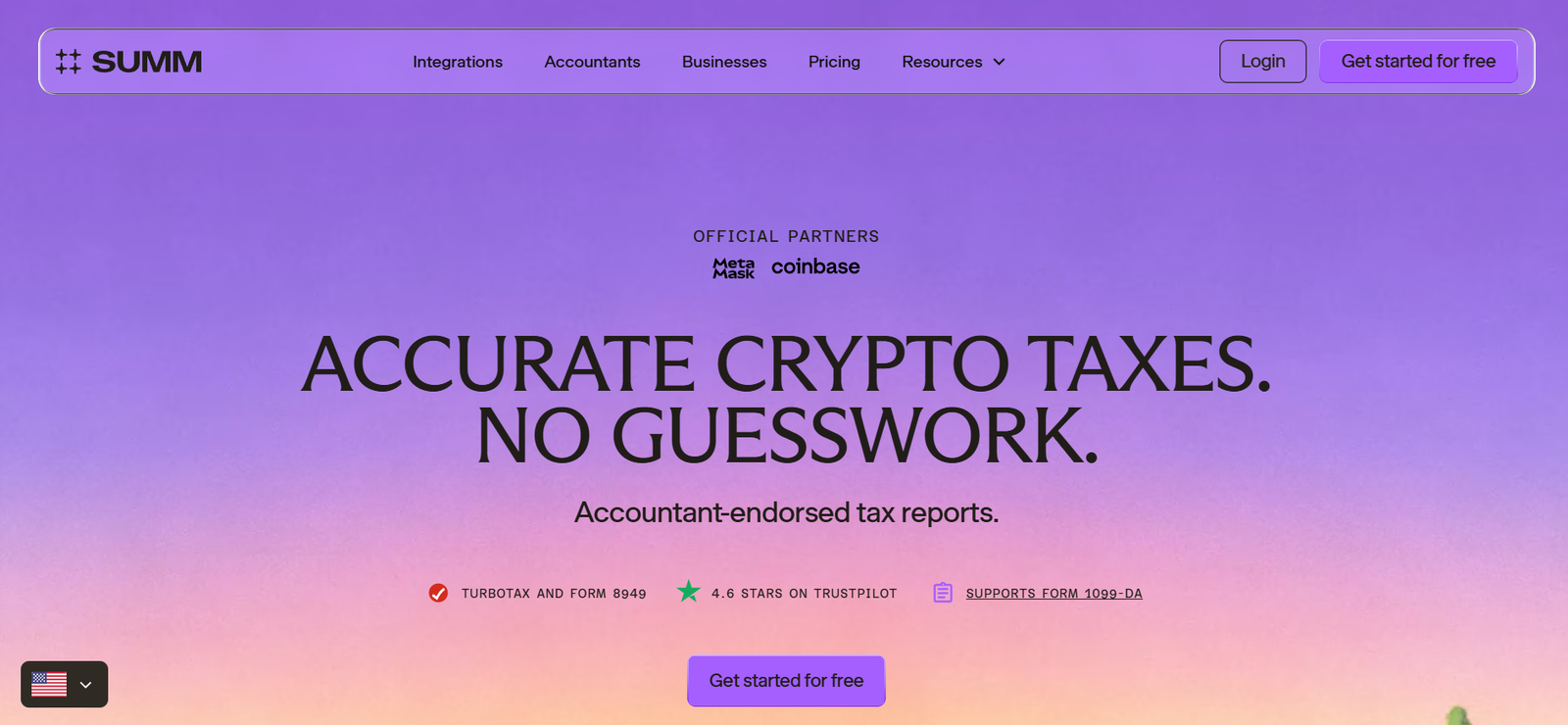
Summ’s interface is built around clarity, transparency, and a modern understanding of how crypto users actually interact with their data. Rather than presenting long tables of token movements or forcing users to decipher ambiguous labels, Summ focuses on showing the meaning behind each transaction. The design feels clean and contemporary, with an emphasis on readability and structured information. Even when dealing with complex DeFi activity, the interface avoids overwhelming the user, instead guiding them through each interpretation in a way that feels intuitive and approachable.
Layout and Navigation
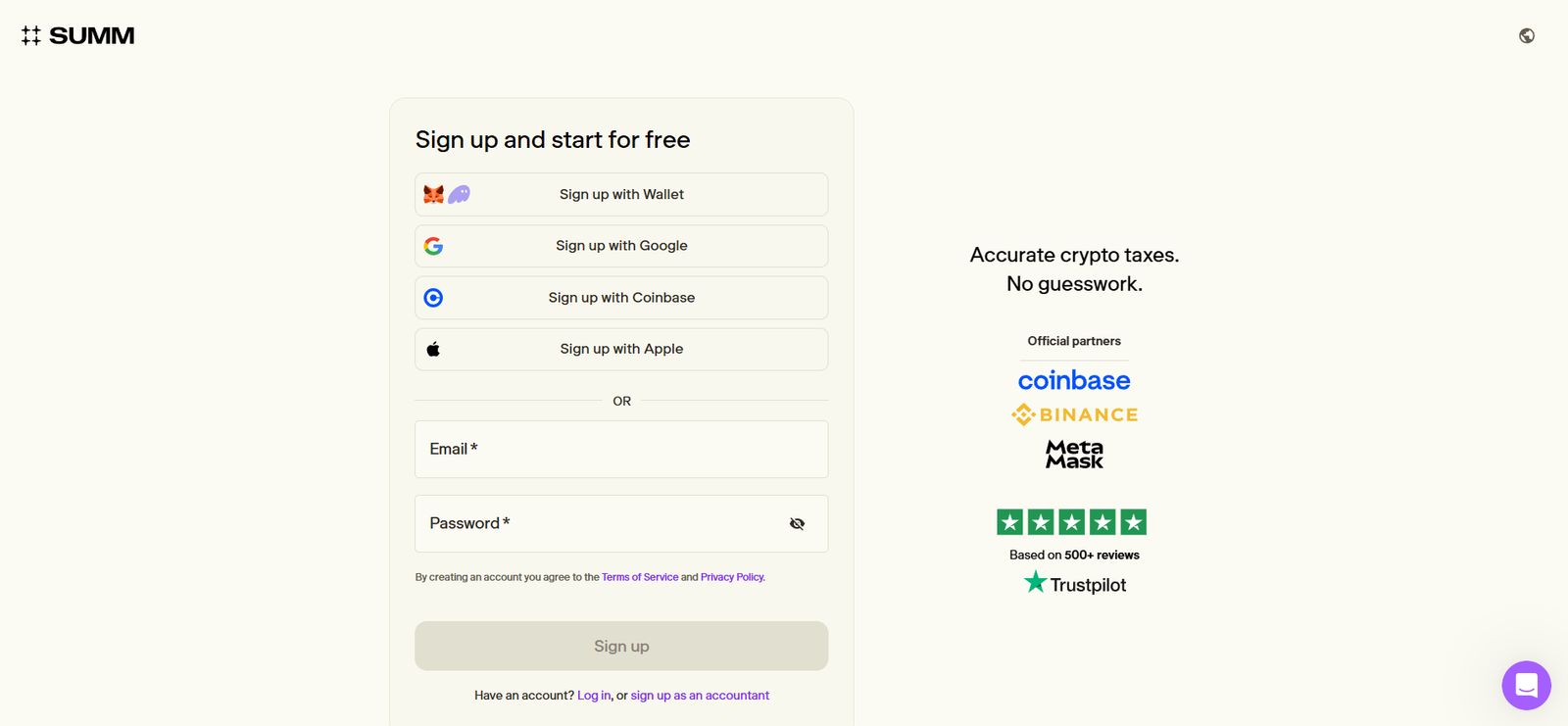
Navigation in Summ is straightforward. The platform organizes activity into clear sections for wallets, transactions, reconciliation, analytics, and tax reports. Each area is designed to help users understand what they are looking at without requiring deep technical knowledge. The transaction view is particularly strong: users can expand any event to see the underlying smart‑contract interpretation, token flows, and Summ’s reasoning behind the classification. This level of visibility is rare among tax platforms and makes troubleshooting significantly easier.
The interface feels fast and responsive, and the workflow from import to review to final reporting is smooth. Users who have struggled with cluttered or outdated tax tools will immediately notice the difference in how Summ presents information.
Visual Clarity and Data Presentation
Summ’s visual presentation is one of its standout qualities. The platform uses clean typography, thoughtful spacing, and structured panels to make even dense information easy to digest. Historical performance charts, unrealized gains, and asset‑level summaries are presented in a way that feels more like a modern portfolio tracker than a traditional tax tool. Because Summ reads data directly from the blockchain, the analytics are both accurate and timely, giving users a clear view of their positions across multiple chains.
The transaction detail view is especially effective. Instead of showing only token inflows and outflows, Summ explains what actually happened; whether a swap was routed through multiple pools, whether a vault auto‑compounded rewards, or whether a bridge wrapped and unwrapped assets. This level of clarity is invaluable for users who want to understand their tax outcomes without digging through raw blockchain data.
Workflow Efficiency
Summ’s workflow is designed to minimize friction. Wallet imports are nearly instantaneous, reconciliation alerts are precise rather than noisy, and the platform rarely requires manual tagging thanks to its on‑chain‑native interpretation. Users who have spent hours fixing DeFi transactions in other platforms often find that Summ reduces their cleanup time dramatically.
Even when issues arise; such as missing exchange data or incomplete CSVs; Summ highlights them clearly and provides context for how to resolve them. The platform feels like it is working with the user rather than against them, which is a refreshing change from the trial‑and‑error experience common in crypto tax software.
Accessibility and Device Support
Summ is optimized for desktop use, where its structured layout and detailed transaction views are easiest to navigate. The platform is fully responsive and works well on tablets and larger mobile screens, though the depth of information makes desktop the preferred environment for full reconciliation and reporting. There is no dedicated mobile app, but the web interface remains functional for reviewing activity or checking analytics on the go.
Customer Support & Documentation
8
Support Channels and Responsiveness
Summ provides a support experience that feels tailored to the realities of modern crypto activity. Instead of relying on scripted responses or generic troubleshooting steps, the support team is technically knowledgeable and capable of addressing questions involving multi‑chain portfolios, DeFi protocols, and complex smart‑contract interactions. Response times are generally fast, and users often receive detailed explanations rather than surface‑level replies. This is a noticeable contrast to traditional tax platforms, where support teams frequently struggle to interpret DeFi‑related issues or provide meaningful guidance beyond CSV formatting tips.
Summ’s support is available through in‑app messaging and email, and the quality of responses tends to be consistently high. Users who have dealt with misclassified liquidity pool transactions or confusing aggregator swaps in other platforms often find that Summ’s team understands these scenarios intuitively and can explain how the platform interpreted them.
Knowledge Base and Documentation
Summ maintains a growing documentation library that covers onboarding, chain‑specific instructions, DeFi concepts, reconciliation workflows, and tax‑related explanations. The articles are written clearly and avoid unnecessary jargon, but they still offer enough depth for advanced users who want to understand how Summ interprets certain types of smart‑contract activity. The documentation is not as extensive as that of older platforms, but it is more focused, more accurate, and more aligned with the needs of users who operate across multiple chains.
The platform also includes contextual help throughout the interface. Tooltips, inline explanations, and expandable transaction details make it easy for users to understand how Summ arrived at a particular interpretation without needing to consult external guides.
In‑App Guidance and Self‑Help Tools
Summ’s in‑app guidance is one of its strongest support features. Because the platform interprets transactions directly from the blockchain, it produces fewer ambiguous warnings and fewer false positives than traditional tools. When issues do arise; such as missing exchange data or incomplete cost basis; Summ highlights them clearly and provides context for how to resolve them. The reconciliation process feels more like a guided review than a troubleshooting session, which significantly reduces user frustration.
The platform’s transaction detail view also serves as a form of self‑help. Users can expand any event to see the contract‑level interpretation, token flows, and Summ’s reasoning behind the classification. This transparency makes it easier to understand and resolve discrepancies without needing to contact support.
Community and Professional Ecosystem
Summ benefits from an active community of power users, accountants, and developers who share insights and best practices. This ecosystem is particularly valuable for users with advanced DeFi activity, since community discussions often cover protocol‑specific nuances that traditional tax platforms do not address. Summ also collaborates with tax professionals who are familiar with the platform’s on‑chain‑native approach, making it easier for users to work with accountants who understand their reports.
Pricing & Value for Money
4
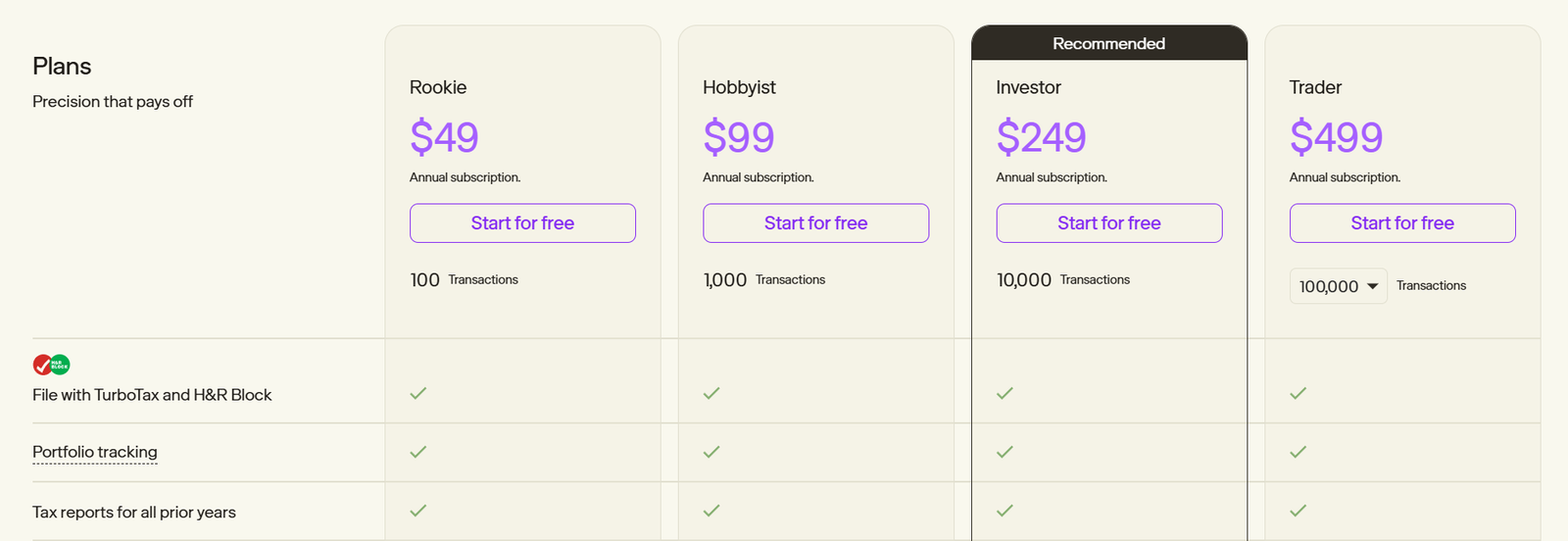
Pricing Table extract – Find all exact numbers regarding the platform’s prices here.
Pricing Structure
Summ uses a usage‑based pricing model rather than the traditional tiered plans common in older crypto tax platforms. Instead of locking features behind higher‑priced packages, Summ gives every user access to the full platform; including multi‑chain support, DeFi interpretation, NFT parsing, reconciliation tools, and jurisdiction‑specific tax logic; and scales pricing based on transaction volume. This structure tends to feel more transparent because users pay for the size of their portfolio rather than for access to specific features.
For users with moderate activity, especially those who interact with DeFi protocols or multiple chains, this model often results in better value than fixed‑tier systems. Traditional platforms frequently require users to upgrade to higher tiers simply to unlock DeFi support or to accommodate the large number of micro‑transactions generated by yield farming or liquidity provision. Summ avoids this problem entirely by treating all features as standard.
Value for DeFi, NFT, and Multi‑Chain Users
Summ’s pricing is particularly favorable for users with complex on‑chain activity. Because the platform interprets smart‑contract interactions natively, it dramatically reduces the amount of manual cleanup typically required in other tools. This saves time; often hours or days; and reduces the risk of errors that could affect tax outcomes. For users who operate across multiple chains, interact with vaults, or trade NFTs, Summ’s ability to automatically reconstruct transactions provides value that goes beyond the cost of the software itself.
Users who have previously paid for higher‑tier plans on traditional platforms simply to handle DeFi or NFT activity often find that Summ delivers more accurate results at a comparable or lower effective cost.
Value for CEX‑Only Users
For users with simple, exchange‑only activity, Summ remains competitively priced, though its advanced capabilities may feel like more than they need. These users still benefit from Summ’s clean interface, accurate calculations, and global tax logic, but they may not fully utilize the platform’s on‑chain intelligence. Even so, the usage‑based model ensures that light users do not pay disproportionately for features they rarely use.
The Block Note's Score
Aggregated Score
23
17
13
13
9
8
4
Total Score
Who is Summ Best for
Best for DeFi
Ideal Users and Portfolio Types
Summ is best suited for crypto users whose activity extends beyond simple exchange trading and into the real complexity of modern on‑chain ecosystems. Its on‑chain‑native architecture makes it especially valuable for users who interact with multiple L1s and L2s, participate in DeFi protocols, or trade NFTs. These users typically struggle with traditional tax platforms because older systems rely heavily on exchange APIs and simplistic token‑movement logs. Summ, by contrast, interprets smart‑contract interactions directly, allowing it to handle the full spectrum of blockchain activity with far fewer manual adjustments.
Users who engage in liquidity provision, yield farming, vault auto‑compounding, cross‑chain bridging, or aggregator‑routed swaps will find that Summ understands these transactions with a level of precision that other platforms rarely achieve. The same is true for NFT traders and creators, since Summ identifies mints, listings, sales, and royalties directly from contract events rather than depending on marketplace‑specific integrations. For these groups, Summ offers not just accuracy but a dramatic reduction in cleanup time, which is often the most frustrating part of crypto tax preparation.
Best Fit by Experience Level
Summ is also a strong fit for users who value clarity and transparency. Its interface explains the meaning behind each transaction, making it easier for both beginners and advanced users to understand how their tax outcomes were determined. Beginners benefit from the guided workflow and clean design, while experienced users appreciate the ability to inspect contract‑level interpretations and audit trails. This dual appeal makes Summ accessible without sacrificing depth.
Regional Suitability
From a jurisdictional standpoint, Summ is well‑suited for users in the US, UK, Canada, Australia, and major EU regions, where it applies local tax rules such as share pooling, adjusted cost basis, and short‑term vs long‑term gains. Because Summ reconstructs transactions directly from the chain, it can apply these rules accurately even when dealing with complex DeFi or NFT activity. Users in less common jurisdictions can still generate accurate summaries, though they may need to adapt the outputs to local filing formats.
Who Might Not Need Summ
Users with extremely simple, exchange‑only activity can still use Summ effectively, but they may not fully benefit from its advanced capabilities. For these users, Summ remains accurate and easy to use, but its on‑chain intelligence may feel like more than they require. However, the usage‑based pricing model ensures that light users do not pay disproportionately for features they rarely use.
Final Verdict
Best for DeFi
Summ
87
Summ is a crypto tax platform designed to track on-chain activity, calculate gains and losses, and generate simplified tax reports for digital asset investors.
Type
Crypto Tax Software
DeFi & NFT Support
Yes
Pricing
$49-499
Signup Offer
None
Integrations
3,500+ Wallets, Exchanges, On-Chain Platforms
Pros and Cons
Fast, AI‑powered transaction classification
Strong DeFi and on‑chain coverage
Clear, modern interface
Collaborative accountant workflow
Cons
Smaller exchange and wallet integration list
AI classifications may need review
Less established than long‑standing competitors
Limited advanced portfolio analytics
Frequently Asked Questions
What is a crypto tax software?
A crypto tax software is a tool that automatically gathers your cryptocurrency transactions from exchanges, wallets, and blockchains. It organizes this data to calculate your gains, losses, and taxable income so you can prepare accurate tax reports without relying on manual spreadsheets.
How does a crypto tax software make tax reporting easier?
The software automates the most complex parts of crypto taxation. It tracks cost basis, identifies taxable events, matches transfers between wallets, and classifies income such as staking or airdrops. This reduces manual work and helps ensure your tax calculations are correct.
What types of crypto activity can a tax software handle?
Most platforms support a wide range of activity, including:
centralized exchange trades
wallet‑to‑wallet transfers
DeFi swaps and liquidity pools
staking and yield rewards
mining income
NFT mints, purchases, and sales
futures and margin trading
Some tools also decode advanced smart‑contract interactions.
Do I need a crypto tax software if I only made a few trades?
Yes. Even small amounts of crypto activity can create taxable events. Software helps you avoid mistakes, ensures accurate cost‑basis tracking, and saves time; especially if you used more than one exchange or wallet.
Are crypto tax softwares beginner‑friendly?
Most platforms are designed for all experience levels. Beginners can rely on automated imports, simple dashboards, and guided workflows, while advanced users can manage complex DeFi, NFT, and multi‑chain activity with more detailed tools.
Why isn’t pricing the main scoring factor?
Pricing matters, but it doesn’t determine how well a crypto tax tool performs. Accuracy, automation, DeFi support, integrations, and reliability have a much bigger impact on the user experience. A cheaper tool that miscalculates taxes or requires hours of manual cleanup ultimately costs more in time, stress, and potential filing errors.
Can a crypto tax software’s score change over time?
Yes. Crypto tax platforms evolve quickly; new integrations are added, DeFi support improves, bugs get fixed, and pricing models change. Scores are updated to reflect current performance, not past reputation, so you always get an up‑to‑date evaluation.
Do you receive compensation for higher scores?
No. Scores are independent of partnerships or affiliate relationships.
More Reviews

Koinly – Crypto Software Review
Koinly simplifies crypto tax reporting with automated tracking, smart reconciliation, and clear summaries for investors managing multi‑chain activity.
Read More
CoinLedger – Crypto Tax Software
CoinLedger makes crypto taxes easier by consolidating trades, detecting gains, and generating compliant reports in minutes.
Read More
ZenLedger – Crypto Tax Software Review
ZenLedger simplifies crypto tax filing with fast imports, smart gain tracking, and clear IRS‑ready reports for active traders.
Read More
TokenTax – Crypto Tax Software Review
TokenTax combines automated crypto tracking with expert review options, delivering accurate, compliant tax reports for complex portfolios.
Read More