
- May 21, 2026
- Crypto Tax Software, Koinly
Koinly - Crypto Tax Software Review

Disclosure: This post may contain affiliate links. If you sign up or make a purchase through our links, we may earn a commission at no extra cost to you. We only recommend products and services we believe add value.

Best Overall
91
Koinly is a crypto tax platform that tracks trades across exchanges, wallets, and blockchains, automatically calculating gains, losses, and generating tax reports.
Crypto Tax Software
DeFi & NFT Support
Yes
Pricing
$0-199
Signup Offer
None
Integrations
800+ Wallets, Exchanges, Blockchains
Pros and Cons
Easy tax report generation
Wide exchange and wallet support
Clean and beginner‑friendly interface
Strong reconciliation tools
Cons
Higher cost for large transaction volumes
Occasional API sync issues
Limited DeFi and NFT handling
No fully free tax report
Overview
Koinly is a widely used crypto tax platform recognized for its clean interface, extensive exchange integrations, and strong emphasis on accuracy in capital gains reporting. Launched in 2018, it has grown into one of the most trusted tools for individuals and accountants who need to consolidate transactions across centralized exchanges, wallets, and DeFi protocols. Its automated data‑syncing and reconciliation features reduce manual workload, making it accessible even for users with complex trading histories.
The software supports a broad range of taxable events, including spot trades, staking rewards, mining income, liquidity provision, and cross‑chain activity. Koinly’s tax engine generates detailed reports aligned with multiple jurisdictions, offering formats suitable for self‑filing or submission to tax professionals. While beginners benefit from its guided setup and intuitive dashboards, advanced users can leverage granular transaction editing, cost‑basis customization, and audit‑ready documentation.
A defining strength of Koinly is its balance between usability and depth. It prioritizes compliance, maintains transparent calculation methods, and integrates with hundreds of platforms, though some advanced DeFi or niche protocols may still require manual adjustments. This focus on reliability makes it particularly appealing to long‑term investors, active traders, and professionals who need consistent, regulator‑friendly reporting.
Overall, Koinly stands out as a precision‑driven, integration‑heavy tax solution that simplifies crypto accounting without sacrificing sophistication. It is best suited for users who value accuracy, automation, and clear documentation, even if those with highly experimental on‑chain activity may need to perform occasional manual reviews.
Pros and Cons
Easy tax report generation
Koinly automates capital gains, income, and cost‑basis calculations, producing ready‑to‑file tax reports for multiple jurisdictions.
Wide exchange and wallet support
It connects with hundreds of exchanges, wallets, and blockchains through API or CSV, making portfolio syncing straightforward.
Clean and beginner‑friendly interface
The dashboard is intuitive, helping users quickly identify missing data, errors, or unmatched transactions.
Strong reconciliation tools
Koinly highlights inconsistencies such as missing cost basis, duplicate entries, or incorrect labels, improving tax accuracy.
Cons
Higher cost for large transaction volumes
Plans become expensive for users with tens of thousands of transactions, especially active traders or bots.
Occasional API sync issues
Some exchanges or chains may fail to sync reliably, requiring manual CSV uploads or corrections.
Limited DeFi and NFT handling
Complex DeFi protocols, liquidity pools, or NFT trades may not always import or classify correctly.
No fully free tax report
While portfolio tracking is free, generating official tax reports requires a paid plan.
Scoring System
Each crypto tax software platform is evaluated on a 100-point scale using a weighted framework designed to reflect real-world usability, accuracy, and compliance with evolving crypto tax regulations. Scores are based on the following categories:
- Tax Calculation Accuracy (25 points) – Measures the reliability of transaction classification, cost-basis calculations, handling of complex DeFi/NFT activity, and support for multiple accounting methods such as FIFO, LIFO, and HIFO.
- Integrations & Data Import (20 points) – Evaluates the number of supported exchanges, wallets, blockchains, and APIs, as well as the ease of syncing transaction histories automatically.
- Compliance & Regional Tax Support (15 points) – Considers support for different tax jurisdictions, generation of country-specific tax forms, audit-ready reports, and alignment with evolving regulatory standards.
- Features & Reporting Tools (15 points) – Assesses available reporting tools such as capital gains summaries, income tracking, portfolio insights, DeFi/NFT reporting, and export compatibility with accounting software.
- User Experience & Interface (10 points) – Reviews onboarding, dashboard clarity, workflow simplicity, and the ability for both beginners and advanced users to navigate the platform efficiently.
- Customer Support & Documentation (10 points) – Evaluates the availability and quality of support channels, response times, knowledge bases, tutorials, and tax guidance resources.
- Pricing & Value for Money (5 points) – Examines subscription tiers, transaction limits, upgrade costs, and whether the features provided justify the price.
Each category contributes a defined portion of the total score. Higher-scoring platforms demonstrate a strong balance of accuracy, integrations, usability, and compliance; not just the ability to import transactions or generate basic tax reports.
Tax Calculation Accuracy
24
Calculation Methodology
Koinly’s tax engine is designed to deliver high‑precision capital gains and income calculations across centralized exchanges, wallets, and on‑chain activity. It supports multiple accounting methods; including FIFO, LIFO, HIFO, ACB, and Share Pooling; allowing users to align their reports with the rules of their specific jurisdiction. Each transaction includes a detailed audit trail, showing how cost basis, proceeds, and holding periods were determined. This level of transparency helps users verify the logic behind every gain or loss calculation.
Koinly also emphasizes accurate transfer matching. When assets move between a user’s own wallets, the platform attempts to automatically pair deposits and withdrawals to prevent them from being treated as taxable events. This reduces the risk of “phantom gains,” a common issue in crypto tax reporting when transfers are misinterpreted as disposals.
Handling of Complex Transactions
Koinly performs reliably with standard trading activity, but its accuracy extends into more advanced scenarios through its reconciliation engine, which flags missing cost basis, duplicate entries, or untagged transfers. These alerts guide users toward correcting issues before generating final reports.
Accuracy can vary when dealing with complex DeFi interactions, such as multi‑step swaps, liquidity pool movements, bridging, wrapping, or yield aggregator transactions. While Koinly supports many major protocols, some on‑chain actions may require manual tagging to ensure proper tax treatment. Users who frequently interact with advanced DeFi ecosystems may need to review and adjust certain entries to maintain accuracy.
Income Classification
Koinly automatically identifies and categorizes staking rewards, airdrops, mining income, interest, and other reward‑based events. These are separated from capital gains and included in income reports according to the user’s jurisdiction. For most centralized platforms and straightforward on‑chain rewards, classification is highly accurate. More complex income flows; such as rewards distributed through smart contracts or rebasing tokens; may require manual review to ensure they are correctly labeled as income rather than capital gains.
International Tax Accuracy
Koinly supports tax rules for 20+ countries, adapting its calculations to local requirements such as short‑term vs long‑term gains, share pooling, and specific income treatments. This makes it suitable for users in regions with detailed or unique tax frameworks, including the US, UK, Canada, Australia, and several EU countries. In jurisdictions with more nuanced rules around staking or DeFi income, users may need to apply manual adjustments to fully align their reports with local regulations.
Integrations & Data Import
18
Exchange, Wallet, and Blockchain Coverage
Koinly is designed to streamline tax reporting by supporting a wide ecosystem of exchanges, wallets, and blockchains. The platform integrates with hundreds of services, including major centralized exchanges, hardware wallets, and popular Layer‑1 and Layer‑2 networks. This broad coverage allows users to consolidate their entire transaction history in one place without relying on manual data entry.
Most integrations support automatic API syncing, enabling Koinly to pull in trades, deposits, withdrawals, staking rewards, and on‑chain activity directly from the source. For blockchains, Koinly uses public address tracking, which lets users import all historical transactions simply by entering their wallet address. This approach ensures that even if an exchange API is limited, on‑chain activity remains fully traceable.
API Syncing and Automation
Koinly’s API connections are built to reduce manual work by continuously updating transaction data. When an API is connected, the platform attempts to automatically classify events, match transfers across wallets, and detect missing or inconsistent entries. This automation is especially useful for users who trade frequently or interact with multiple platforms.
However, API reliability can vary depending on the exchange or blockchain. Some platforms provide incomplete historical data or restrict access to certain transaction types. In these cases, Koinly may require users to upload CSV files to fill in gaps. The platform provides templates and guides to help users format these files correctly.
CSV Import and Manual Adjustments
For exchanges or wallets without API support, Koinly allows users to upload CSV transaction files. This method is flexible and supports a wide range of data types, including trades, transfers, income events, and mining payouts. Koinly’s interface highlights any issues that arise during import, such as missing fields or unrecognized formats, allowing users to correct them before finalizing their data.
Manual adjustments are also available for scenarios where data needs refinement. Users can edit, merge, or reclassify transactions, add missing cost basis, or tag specific events such as gifts, swaps, or liquidity pool interactions. These tools help maintain accuracy even when dealing with complex or incomplete datasets.
Multi‑Chain and DeFi Support
Koinly supports a growing number of blockchains and DeFi protocols, enabling users to import on‑chain activity directly from networks like Ethereum, BNB Chain, Polygon, Avalanche, and others. The platform attempts to interpret DeFi transactions, including swaps, liquidity pool movements, and staking interactions. While many protocols are supported natively, some advanced or emerging DeFi platforms may require manual tagging to ensure proper tax treatment.
Compliance & Regional Tax Support
14
Regulatory Alignment and Reporting Standards
Koinly is built to align with the tax reporting requirements of multiple jurisdictions, offering structured reports that follow the formats used by tax authorities around the world. The platform supports standardized documents such as capital gains summaries, income reports, end‑of‑year holdings statements, and audit‑ready transaction logs. These reports are designed to integrate smoothly with local filing systems, whether users are submitting returns manually or through tax software.
To maintain compliance, Koinly applies jurisdiction‑specific accounting rules, including cost‑basis methods like FIFO, LIFO, HIFO, ACB, and Share Pooling. This ensures that users in countries such as the US, UK, Canada, Australia, and several EU regions can generate reports that reflect local tax law. Koinly also distinguishes between capital gains and taxable income, adapting its calculations to match regional definitions of staking rewards, airdrops, mining payouts, and other crypto‑related income.
Country‑Specific Tax Treatment
Koinly provides tailored support for 20+ countries, each with its own tax framework. For example, the platform accounts for short‑term vs long‑term capital gains in the US, share pooling rules in the UK, and adjusted cost basis (ACB) in Canada. These localized rules help ensure that users receive accurate tax calculations without needing to manually adjust their accounting method.
In addition to standardized reports, Koinly offers country‑specific tax guides that explain how crypto is treated in each jurisdiction. These guides help users understand how their transactions will be classified and what documentation they may need to provide during filing or audits.
Treatment of DeFi, NFTs, and Emerging Assets
As crypto tax regulations evolve, Koinly adapts its system to reflect new guidance on DeFi, NFTs, staking, and cross‑chain activity. While many jurisdictions have not yet issued complete rules for these categories, Koinly provides flexible tagging options that allow users to classify transactions according to the most widely accepted interpretations.
For regions with clearer guidance, Koinly applies specific tax treatments automatically. In countries where rules are still developing, users may need to apply manual adjustments to ensure compliance with local expectations.
Regional Limitations and Considerations
Although Koinly supports a wide range of countries, some jurisdictions have unique or highly nuanced tax rules that may require additional user input. This is especially true for regions with evolving guidance on staking rewards, liquidity pool tokens, or wrapped assets. In these cases, Koinly provides the tools needed to adjust classifications, but users may need to consult local tax professionals to ensure full compliance.
Features & Reporting Tools
14
Core Reporting Capabilities
Koinly provides a comprehensive suite of crypto‑specific reporting tools designed to simplify tax preparation across multiple jurisdictions. The platform generates detailed capital gains reports, income summaries, end‑of‑year holdings statements, and audit‑ready transaction logs, all structured to meet the expectations of tax authorities. Each report is built from Koinly’s underlying transaction engine, which tracks cost basis, proceeds, and holding periods with precision.
Users can also export data in formats compatible with popular tax‑filing software. These exports include Form 8949‑style reports, Schedule D summaries, and country‑specific documents for regions such as the UK, Canada, and Australia. The reporting system is designed to give users and accountants full visibility into how each figure was calculated.
Portfolio Tracking and Analytics
Beyond tax reporting, Koinly includes a set of portfolio tracking tools that help users monitor their crypto activity throughout the year. The dashboard displays real‑time gains and losses, unrealized performance, cost basis per asset, and historical portfolio value. These insights allow users to understand their tax exposure before the end of the fiscal year, making it easier to plan strategies such as tax‑loss harvesting.
Koinly also provides asset‑level analytics, showing how each coin or token has performed over time. This includes acquisition history, disposal events, and income‑generating activity such as staking or rewards. These tools give users a clearer picture of their overall crypto position, not just their tax liability.
Transaction Tagging and Classification Tools
To ensure accurate reporting, Koinly offers a robust set of transaction tagging options. Users can label events as swaps, transfers, gifts, airdrops, staking rewards, mining income, or liquidity pool interactions. These tags help Koinly apply the correct tax treatment and ensure that income and capital gains are separated appropriately.
The platform also includes bulk editing tools, allowing users to adjust multiple transactions at once. This is especially useful for DeFi users who may need to reclassify large sets of on‑chain interactions. Koinly’s tagging system is flexible enough to accommodate emerging crypto activities, even when tax guidance is still evolving.
Error Detection and Reconciliation Tools
Koinly’s reporting accuracy is supported by its reconciliation engine, which identifies issues such as missing cost basis, duplicate entries, or untagged transfers. These alerts appear directly in the dashboard, guiding users toward resolving inconsistencies before generating final reports. This system helps prevent common tax errors, such as phantom gains or misclassified income.
The platform also highlights unmatched deposits and withdrawals, prompting users to confirm whether they represent transfers, income, or disposals. This level of detail ensures that users maintain clean, audit‑ready records across all their wallets and exchanges.
User Experience & Interface
9
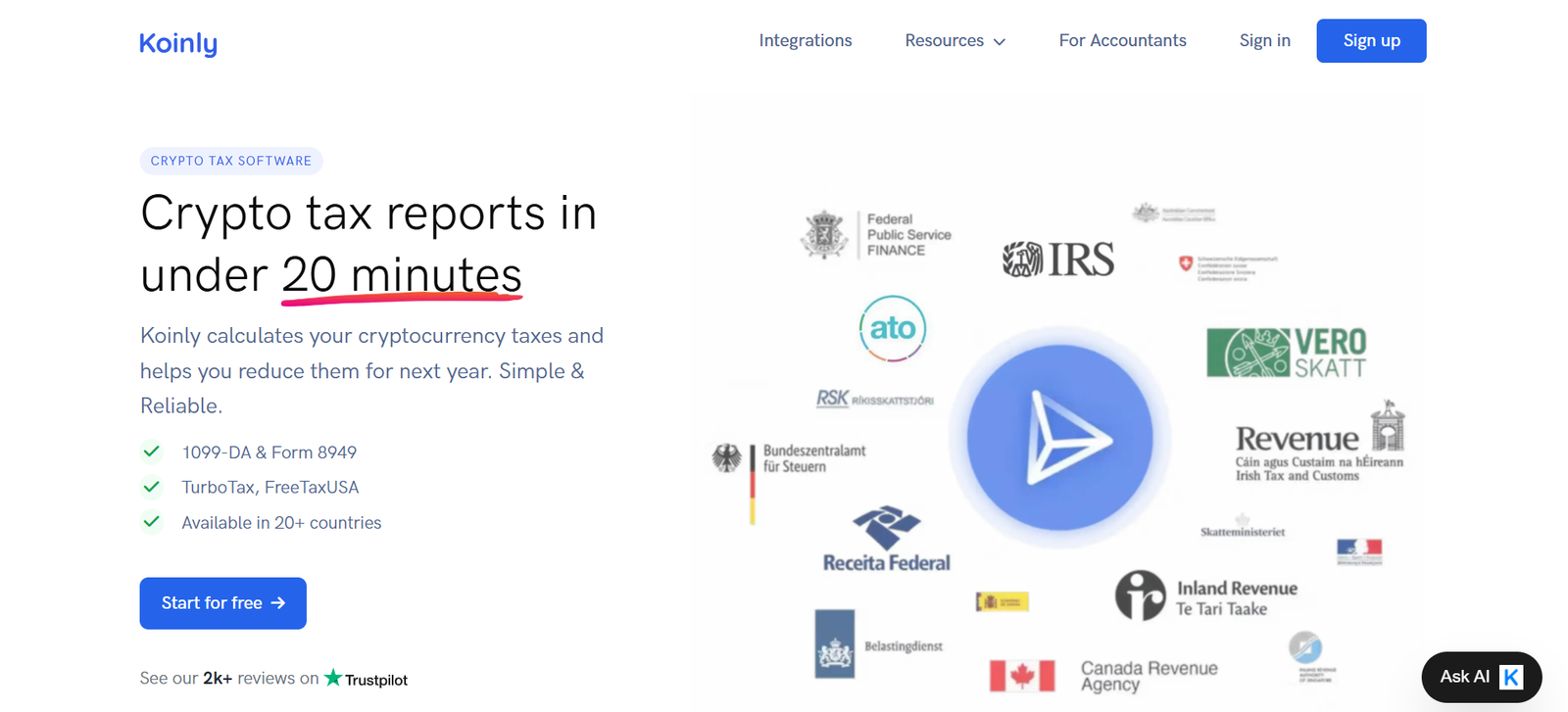

Layout and Navigation
Koinly’s interface is designed to make complex tax data easy to navigate, even for users with multiple wallets, exchanges, and on‑chain activities. The dashboard presents a clear overview of portfolio value, gains and losses, income, and outstanding reconciliation issues, allowing users to understand their tax position at a glance. Navigation is organized into intuitive sections; Dashboard, Transactions, Tax Reports, and Settings; so users can move between tasks without feeling overwhelmed.
The transaction view is particularly structured, offering filters, search tools, and bulk‑editing options that help users manage large datasets efficiently. Each transaction can be expanded to reveal cost basis, proceeds, and tax treatment, giving users full transparency into how Koinly interprets their activity.
Visual Clarity and Data Presentation
Koinly emphasizes clean visual design, using charts, summaries, and color‑coded indicators to highlight key information. Gains and losses are displayed in easy‑to‑read graphs, while reconciliation warnings appear as clear prompts that guide users toward resolving issues. This visual clarity helps users quickly identify discrepancies, missing data, or misclassified transactions.
The platform also provides asset‑level breakdowns, showing acquisition history, disposal events, and income‑generating activity for each token. These views help users understand not only their tax obligations but also their broader portfolio performance.
Workflow Efficiency
Koinly’s interface is optimized for users who need to process large volumes of transactions. Features such as bulk tagging, automated matching, and real‑time syncing reduce the amount of manual work required. When issues arise, Koinly highlights them directly in the interface, allowing users to correct errors without navigating through multiple menus.
The platform also supports step‑by‑step workflows for generating tax reports. Users can review their transactions, resolve warnings, and preview their tax summary before exporting final documents. This structured approach helps ensure accuracy and reduces the likelihood of mistakes.
Accessibility and Device Support
Koinly is fully web‑based, making it accessible from any modern browser. The interface is responsive and works well on tablets and smaller screens, though the platform does not currently offer a dedicated mobile app. Despite this, the web interface remains functional for users who need to make quick edits or review data on the go.
Customer Support & Documentation
8
Support Channels and Responsiveness
Koinly provides several customer support channels designed to help users resolve issues related to data imports, tax calculations, and report generation. The primary method of support is through its email‑based ticket system, where users can submit detailed inquiries and receive responses from the support team. Response times are generally reasonable, though they can vary during peak tax season when demand increases.
For users on higher‑tier plans, Koinly offers priority support, which shortens wait times and provides faster escalation for complex issues. While Koinly does not offer live chat or phone support, its ticketing system is structured to handle both technical questions and tax‑related clarifications efficiently.
The platform also includes in‑app prompts and contextual help, guiding users through common tasks such as fixing reconciliation errors, tagging transactions, or connecting APIs. These built‑in tools reduce the need to contact support for routine questions.
Knowledge Base and Educational Resources
Koinly maintains an extensive documentation library, including step‑by‑step guides, troubleshooting articles, and platform‑specific import instructions. The knowledge base covers a wide range of topics, from connecting exchanges and wallets to understanding how Koinly interprets DeFi transactions. These resources are written in a clear, accessible style, making them useful for both beginners and experienced users.
In addition to documentation, Koinly publishes country‑specific tax guides that explain how different jurisdictions treat crypto activity. These guides help users understand the tax implications of their transactions and how Koinly applies local rules when generating reports.
The platform also offers video tutorials, blog posts, and educational content that cover broader crypto tax concepts. These materials help users navigate complex topics such as cost‑basis methods, staking income, and NFT taxation.
Community and Self‑Help Tools
Koinly supports a growing community forum where users can ask questions, share solutions, and discuss tax scenarios. This community‑driven environment provides additional support for edge cases or emerging crypto activities that may not yet be fully documented.
The platform’s interface includes automated error detection, which acts as a self‑help tool by identifying missing cost basis, duplicate entries, or untagged transfers. These alerts guide users toward resolving issues independently, reducing reliance on customer support.
Pricing & Value for Money
4
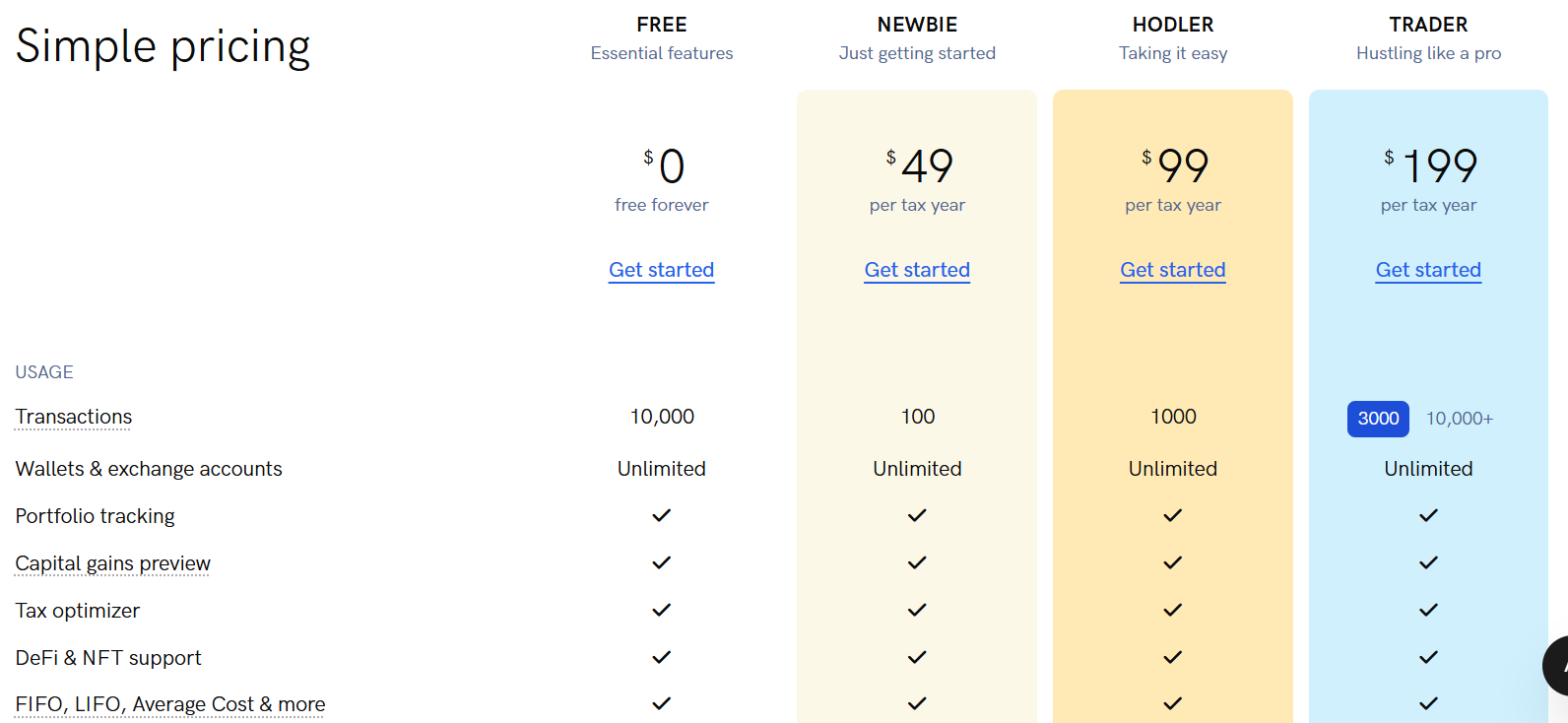
Pricing Table extract – Find all exact numbers regarding the platform’s prices here.
Plan Structure and Cost Breakdown
Koinly offers a tiered pricing model designed to accommodate users with different levels of trading activity. Plans are based primarily on transaction volume, which means users with higher activity; especially those interacting with multiple chains or DeFi protocols; may need to upgrade to access full reporting features. All paid plans include capital gains reports, income summaries, and export options for tax software, while the free tier allows users to import data and preview their tax position without generating downloadable reports.
The pricing structure is straightforward, with each tier unlocking additional transaction capacity and priority support. This makes it easy for users to estimate which plan they need before committing. While Koinly’s pricing is competitive within the crypto tax software market, users with very large or complex portfolios may find themselves moving into higher tiers more quickly than expected.
Included Features vs. Cost
Each paid plan includes access to Koinly’s full suite of reporting tools, reconciliation features, and portfolio analytics, ensuring that users receive consistent functionality regardless of tier. The main differentiator is the number of transactions allowed. This approach provides strong value for users with moderate trading activity, as they gain access to all advanced features without needing the highest-tier plan.
Koinly also includes automatic API syncing, multi‑chain support, and detailed audit logs at all paid levels, which enhances the overall value. Users who rely heavily on centralized exchanges or maintain a smaller number of wallets often find that Koinly’s mid‑range plans offer an efficient balance between cost and functionality.
Cost Considerations for High‑Volume or DeFi Users
For users with high transaction volumes, such as active traders, bot users, or DeFi participants, pricing can increase significantly. Complex on‑chain activity often generates a large number of micro‑transactions, which can push users into higher tiers even if their overall portfolio size is modest. While Koinly’s tools are capable of handling this complexity, the cost may be higher compared to users with simpler trading patterns.
Additionally, users who frequently interact with yield aggregators, liquidity pools, or cross‑chain bridges may need to spend extra time on manual adjustments, which can affect perceived value depending on the complexity of their activity.
Overall Value Proposition
Koinly provides strong value for users seeking a comprehensive, automated, and globally compatible crypto tax solution. Its pricing aligns with the depth of its features, especially for users with moderate activity who benefit from full access to reporting tools without needing the highest-tier plan. High‑volume traders and advanced DeFi users may face higher costs, but they also gain access to one of the most robust reconciliation and reporting engines available.
The Block Note's Score
Aggregated Score
24
18
14
14
9
8
4
Total Score
Who is Koinly Best for
Best Overall
1. Everyday Crypto Investors
Koinly is well‑suited for users who buy, sell, and hold crypto across a mix of centralized exchanges and personal wallets. Its automated API syncing, clear portfolio dashboard, and straightforward reporting tools make it easy for casual investors to stay compliant without needing deep tax knowledge. Users who primarily interact with major exchanges will find that Koinly handles most of their activity with minimal manual adjustments.
2. Multi‑Platform and Multi‑Wallet Users
Because Koinly supports a wide range of exchanges, wallets, and blockchains, it’s an excellent fit for users who manage assets across multiple platforms. The system’s ability to match transfers, detect missing data, and consolidate activity into a single tax report is especially valuable for people who move assets between wallets or maintain a diverse crypto footprint.
3. International Users With Varying Tax Requirements
Koinly’s support for 20+ countries makes it a strong choice for users outside the United States. Its ability to apply region‑specific rules; such as share pooling in the UK, ACB in Canada, or short‑term vs long‑term gains in the US; helps ensure that users receive reports aligned with local tax expectations. This makes Koinly particularly useful for individuals who live in countries with well‑defined crypto tax frameworks.
4. Users With Moderate DeFi Activity
Koinly is a good match for users who participate in mainstream DeFi protocols, such as swapping tokens, staking, or providing liquidity on major networks. The platform can interpret many common on‑chain interactions and offers tagging tools for more complex cases. While heavy DeFi users may need to make manual adjustments, those with moderate activity will find Koinly’s automation sufficient for accurate reporting.
5. Investors Seeking Clear, Audit‑Ready Documentation
Koinly’s detailed audit trails, transaction logs, and cost‑basis breakdowns make it ideal for users who want transparent, verifiable records. This is especially helpful for individuals who work with accountants or need to maintain documentation for regulatory or audit purposes. The platform’s structured reports help ensure that every calculation can be traced and explained.
Final Verdict
Best Overall
91
Koinly is a crypto tax platform that tracks trades across exchanges, wallets, and blockchains, automatically calculating gains, losses, and generating tax reports.
Crypto Tax Software
DeFi & NFT Support
Yes
Pricing
$0-199
Signup Offer
None
Integrations
800+ Wallets, Exchanges, Blockchains
Pros and Cons
Easy tax report generation
Wide exchange and wallet support
Clean and beginner‑friendly interface
Strong reconciliation tools
Cons
Higher cost for large transaction volumes
Occasional API sync issues
Limited DeFi and NFT handling
No fully free tax report
Frequently Asked Questions
What is a crypto tax software?
A crypto tax software is a tool that automatically gathers your cryptocurrency transactions from exchanges, wallets, and blockchains. It organizes this data to calculate your gains, losses, and taxable income so you can prepare accurate tax reports without relying on manual spreadsheets.
How does a crypto tax software make tax reporting easier?
The software automates the most complex parts of crypto taxation. It tracks cost basis, identifies taxable events, matches transfers between wallets, and classifies income such as staking or airdrops. This reduces manual work and helps ensure your tax calculations are correct.
What types of crypto activity can a tax software handle?
Most platforms support a wide range of activity, including:
centralized exchange trades
wallet‑to‑wallet transfers
DeFi swaps and liquidity pools
staking and yield rewards
mining income
NFT mints, purchases, and sales
futures and margin trading
Some tools also decode advanced smart‑contract interactions.
Do I need a crypto tax software if I only made a few trades?
Yes. Even small amounts of crypto activity can create taxable events. Software helps you avoid mistakes, ensures accurate cost‑basis tracking, and saves time; especially if you used more than one exchange or wallet.
Are crypto tax softwares beginner‑friendly?
Most platforms are designed for all experience levels. Beginners can rely on automated imports, simple dashboards, and guided workflows, while advanced users can manage complex DeFi, NFT, and multi‑chain activity with more detailed tools.
Why isn’t pricing the main scoring factor?
Pricing matters, but it doesn’t determine how well a crypto tax tool performs. Accuracy, automation, DeFi support, integrations, and reliability have a much bigger impact on the user experience. A cheaper tool that miscalculates taxes or requires hours of manual cleanup ultimately costs more in time, stress, and potential filing errors.
Can a crypto tax software’s score change over time?
Yes. Crypto tax platforms evolve quickly; new integrations are added, DeFi support improves, bugs get fixed, and pricing models change. Scores are updated to reflect current performance, not past reputation, so you always get an up‑to‑date evaluation.
Do you receive compensation for higher scores?
No. Scores are independent of partnerships or affiliate relationships.
More Reviews

CoinLedger – Crypto Tax Software
CoinLedger makes crypto taxes easier by consolidating trades, detecting gains, and generating compliant reports in minutes.
Read More
Summ – Crypto Tax Software Review
Summ offers fast, automated crypto tax calculations with smart reconciliation and clear reports built for active multi‑chain users.
Read More
ZenLedger – Crypto Tax Software Review
ZenLedger simplifies crypto tax filing with fast imports, smart gain tracking, and clear IRS‑ready reports for active traders.
Read More
TokenTax – Crypto Tax Software Review
TokenTax combines automated crypto tracking with expert review options, delivering accurate, compliant tax reports for complex portfolios.
Read More