
Gnosis Pay Card:
the most self-custodial card we've reviewed, on paper.
We tore apart Gnosis Pay's Safe-wallet Visa card across seven weighted categories; from a custody model you can literally verify on a block explorer to a Trustpilot score that tells a much rougher story; and landed on a score the marketing page won't show you.
Our take, up front: Gnosis Pay has the strongest custody architecture of any card in this series, full stop. Your funds sit in your own Safe smart-contract wallet on Gnosis Chain, never held by Gnosis Pay itself, and you can verify your own balance on a public block explorer at any moment; no dashboard, no "trust us," just a chain anyone can read. That's genuinely rare. What sits uncomfortably next to it is a real, documented support and onboarding track record that multiple independent aggregators rate poorly, a shrinking rather than growing country footprint, and a distribution model where direct sign-ups have reportedly narrowed in favor of third-party partners. The architecture is the best we've seen; the experience of actually using it hasn't caught up. We weighted all of it below.
Your funds live in your own Safe smart-contract wallet on Gnosis Chain, and Gnosis Pay itself never takes custody; the company only holds permission to debit specific stablecoins within limits you set yourself. You can independently verify your balance on a public block explorer at any time, a level of verifiability none of the other custody claims in this series can match. A 3-minute on-chain delay module adds a security buffer for withdrawals initiated outside normal card spending, and the fiat rails run through Monavate, an FCA-regulated Electronic Money Institution.
Pros
- Funds independently verifiable on a public block explorer at any time; the strongest verifiability claim in this series
- Built on Gnosis Safe, widely audited infrastructure trusted by major institutions and DAOs since 2017
- A 3-minute on-chain delay module adds a real security buffer against unauthorized withdrawals
Cons
- On-chain security depends on your own wallet hygiene; a compromised device or key is still a real risk
- Single-chain reliance on Gnosis Chain concentrates smart-contract risk in one ecosystem
- No significant publicly disclosed card-related fund losses, but the card's operational track record is still comparatively short
Cashback scales with how much GNO you simply hold, not stake or lock, from 1% at the base up to 4% for 100+ GNO, plus a further 1% for holders of the non-transferable "OG NFT," for a 5% maximum. You need at least 0.1 GNO to earn anything at all; hold less and you earn 0%. Rewards pay out weekly, directly to your Safe wallet as an on-chain GNO airdrop, faster than the monthly cycle most other cards in this series use.
Pros
- Weekly payout cadence, faster than the monthly cycle most competitors use
- Cashback tier is based on simply holding GNO, not staking or locking it
- No spending minimum required to start earning at the base rate
Cons
- A minimum 0.1 GNO holding is required to earn any cashback at all; zero GNO means zero rewards
- The current rewards program has a stated end date (September 30, 2026), a concrete continuity risk
- Reaching the top tier requires holding 100+ GNO, a real capital commitment in a volatile token
No subscription, no annual fee, and no markup on the core Visa interbank exchange rate for purchases; genuinely one of the lowest headline fee structures in this series. A real 0.2% to 0.4% spread applies on cross-currency transactions specifically, and ATM withdrawals cost 2% once you exceed your monthly free allowance. The one real trap: signing up without going through an official partner (like Monerium, Zeal, or Picnic) can trigger a €30 digital card fee that isn't obvious from the headline marketing.
Pros
- No subscription or annual fee of any kind
- No markup on the core Visa interbank rate for standard purchases
- Monthly free ATM allowance before the 2% fee kicks in
Cons
- A real €30 digital card fee applies for sign-ups that don't go through an official partner
- 0.2% to 0.4% cross-currency spread means "zero FX fee" is slightly oversold for non-domestic spend
- 2% ATM fee applies once your monthly free withdrawal allowance is used up
The card currently ships to 32 European countries (the full EEA), the UK, Argentina, and Brazil; the US is blocked entirely. That footprint is smaller than it used to be: Gnosis Pay originally shipped to 40+ countries before regulatory changes and a reported shift toward B2B partnerships narrowed direct coverage. Multiple sources also describe Gnosis Pay no longer accepting straightforward direct sign-ups, with new users instead routed through partner wallets like Zeal or, for Brazil, Picnic.
Pros
- Full EEA coverage plus the UK, Argentina, and Brazil; broader than several cards limited to a single country
- No credit check required; this is a self-custodial debit-style card, not revolving credit
- Accepted anywhere Visa works globally, even though sign-up itself is regionally gated
Cons
- Original 40+ country footprint has shrunk to 32 European countries plus three others
- US applicants are blocked entirely, with no announced timeline despite past "planned expansion" mentions
- Direct sign-up is reportedly limited; new users are often routed through third-party partner wallets
Spending instantly converts your regional stablecoin (EURe, GBPe, or USDCe) to the transaction currency at the point of sale, with no pre-loading required. A genuinely distinctive touch: ENS domain holders can have their card printed with their domain (like "alice.eth") instead of a legal name. The catch is that everything runs exclusively on Gnosis Chain; assets on other networks need to be bridged in first, and there's no staking or yield layer on idle balances the way ether.fi offers on its collateral.
Pros
- Instant stablecoin-to-fiat conversion at the point of sale with no pre-loading needed
- Genuinely unique ENS domain printing on the physical card for a crypto-native identity touch
- Accepted at 80 million-plus Visa merchants in 200+ countries once you have the card
Cons
- Single-chain reliance on Gnosis Chain requires bridging assets from other networks first
- No staking or yield mechanism on idle balances, unlike restaking-based competitors
- Merchant category restrictions apply to car rentals, automated fuel pumps, gambling, and pawn shops
Apple Pay and Google Pay are supported for the virtual card, and instant conversion at spend removes the need to pre-load funds. But real onboarding friction shows up in independent user reviews: one documented case describes a Safe-wallet mismatch during activation that silently blocked the card with no warning given during the process, and account setup can involve navigating the partner-routed sign-up flow described in Availability above.
Pros
- Apple Pay and Google Pay support for contactless mobile spending
- No pre-loading required; conversion happens instantly at the point of sale
Cons
- Documented cases of wallet-mismatch activation issues silently blocking the card with no upfront warning
- No independently cited app-store rating found for the card specifically
- Onboarding can require navigating a partner wallet's flow rather than a single direct sign-up
This is the card's clearest weakness. Trustpilot scores cited across different aggregators and dates range from roughly 2.2 to 2.9 out of 5, consistently poor. One independent meta-review aggregating 39 sources describes support as "the ecosystem's critical failure point," with users reporting weeks-long waits for responses, including a documented case of a customer's balance dropping after a failed payment with no resolution after 24+ hours. To Gnosis Pay's credit, the company does respond constructively to public Trustpilot complaints rather than ignoring them.
Pros
- Company responds directly and constructively to public Trustpilot complaints
- No significant publicly disclosed card-related fund losses or security scandals
- Backed by Gnosis's broader Ethereum-ecosystem credibility since 2017
Cons
- Trustpilot scores cited between 2.2 and 2.9 out of 5 across different sources and dates, consistently poor
- Independent meta-review explicitly calls support "the ecosystem's critical failure point"
- Documented cases of multi-week response times and unresolved stuck-funds disputes
Sign up through an official partner to skip the €30 fee.
Direct sign-up isn't as straightforward as it used to be; going through an official partner wallet (like Monerium or Zeal) typically waives the digital card fee that applies otherwise. Check current partner options before you start the application.
The strongest architecture in this series; the roughest edges around it.
Gnosis Pay's custody model is the real deal: funds you can verify yourself, on-chain, without trusting anyone's dashboard. That alone makes it worth taking seriously. But architecture isn't the whole product. A shrinking country footprint, a sign-up process that's grown more complicated rather than simpler, and a support track record that multiple independent sources describe as a genuine failure point all pull the overall picture down substantially. This is a strong pick for someone who already understands self-custody and is prepared to navigate some friction to get it; it's a harder sell as a first crypto card for anyone who isn't.
The scorecard above is deliberately general. Whether the Gnosis Pay Card is right for you depends heavily on which of these you already are.
The EEA/UK-based self-custody purist
You specifically want a card where the provider never holds your funds, and you're willing to verify that claim yourself on-chain rather than take a company's word for it. No other card in this series proves its custody model this directly.
The existing GNO holder
You already hold GNO for other reasons. Earning weekly cashback just for holding it, no staking or locking required, is close to free upside on an asset you'd own anyway.
The Gnosis Chain-native user
You're already comfortable operating on Gnosis Chain and don't mind bridging assets in from elsewhere. The single-chain limitation that frustrates newcomers is a non-issue if you're already there.
Anyone outside the EEA/UK/Argentina/Brazil, or who wants simple sign-up
US residents are blocked entirely, and even eligible applicants may need to navigate a partner-wallet sign-up flow rather than a direct one. If you want the simplest possible onboarding, look elsewhere in this series first.
The scorecard covers the headline judgment calls. These four tables cover the specifics we didn't want to bury in prose; the cashback tiers by GNO holding, the real sign-up paths and what they cost, the fee picture, and how this card compares against every other card we've reviewed in this series.
Cashback tiers by GNO holding
| GNO held | Base cashback | With OG NFT |
|---|---|---|
| Under 0.1 GNO | 0% | 0% |
| 0.1+ GNO | 1% | 2% |
| Mid-tier holdings | 2%-3% | 3%-4% |
| 100+ GNO | 4% | 5% |
GNO only needs to be held, not staked or locked, and cashback pays out weekly directly to your Safe wallet. Each tier also carries its own weekly spending cap; high spenders may find the caps more limiting than the headline rate suggests. The program itself is funded by Gnosis Ltd on an interim basis through September 30, 2026.
Sign-up paths and what they cost
| Path | Cost | Notes |
|---|---|---|
| Direct sign-up | €30 digital card fee | Reportedly less straightforward than it used to be; availability varies |
| Via Monerium | Fee typically waived | Official partner path for EEA users with IBAN needs |
| Via Zeal wallet | Fee typically waived | Official partner wallet integration |
| Via Picnic | Fee typically waived | Regional partner path specifically for Brazil |
Check current partner terms before applying; fee waivers and partner availability can change, and this table reflects what we found at time of writing, not a guarantee.
Fee schedule
| Fee | Amount |
|---|---|
| Subscription / annual fee | $0 |
| Standard purchase fee | $0; Visa interbank rate, no markup |
| Cross-currency spread | 0.2%-0.4% |
| ATM withdrawal (over monthly allowance) | 2% |
| Non-partner digital card issuance | €30, typically waived via official partners |
This is one of the lowest headline fee structures in this series when accessed through a partner path; the real cost to watch for is the non-partner €30 issuance fee, which isn't prominent in most marketing copy.
How it compares to the other cards we've reviewed
| Card | Card type | Custody model | Reward asset | Region |
|---|---|---|---|---|
| Gnosis Pay | Self-custodial debit | On-chain verifiable Safe wallet | 1%-5% GNO | EEA, UK, Argentina, Brazil |
| Ready Metal | Self-custodial debit | Non-custodial Starknet wallet | 3% STRK (historical) | Discontinued (issuer wind-down) |
| ether.fi Cash | Debit against collateral | Non-custodial Safe vault | Up to 3% wETH | ~20 US states, UK, EEA, HK, UAE |
| Uphold Essential | Multi-asset debit | Custodial exchange balance | 2% XRP | US & UK only |
| Venmo Credit Card | Revolving credit | Custodial; crypto is optional | 1%-3% cash, optional crypto | US only |
| Coinbase One Card | Revolving credit | Custodial exchange wallet | 2%-4% BTC | US only |
| Gemini Credit Card | Revolving credit | Custodial exchange wallet | 1%-4%, 50+ assets | US only |
| Crypto.com Visa | Prepaid | Custodial; CRO staking drives tiers | 0%-8% CRO | 90+ countries (US excl. NY) |
Gnosis Pay and ether.fi are the two genuinely non-custodial cards still operating in this series; Ready Metal was the third until its issuer collapsed. Between the two survivors, Gnosis Pay's on-chain verifiability is arguably stronger, while ether.fi's broader regional reach and yield-bearing collateral give it the edge on pure day-to-day usability.
We don't just want to hand you our number; we want to show you how it sits next to what other review desks, app-store users, and comparison sites have published. Where we could find a real cited figure, we used it; everything else is a clearly-flagged editorial estimate based on that outlet's published sentiment.
Our score lands meaningfully above the aggregated industry average, and that's largely because most aggregators let a genuinely poor Trustpilot signal drag their overall number down further than we do. We still penalize support as its own weighted category, but we give real, separate credit for a custody architecture that's independently verifiable on-chain, something most comparison sites don't weight as heavily as we do.
| Source | Score | Type |
|---|
Scores compiled by our editorial team from publicly available reviews as of August 2026. "Editorial estimate" means the outlet didn't publish a single numeric score, so we converted their published verdict and sentiment into a comparable 100-point figure. Verify current figures directly with each source before citing them elsewhere.
It's genuinely non-custodial. Your funds sit in your own Safe smart-contract wallet on Gnosis Chain, and Gnosis Pay only holds permission to debit specific stablecoins within limits you set. You can verify your own balance on a public block explorer at any time, independent of anything Gnosis Pay itself tells you.
Direct sign-up is reportedly still possible but comes with a €30 digital card fee. Going through an official partner, such as Monerium or the Zeal wallet (or Picnic for Brazil), typically waives that fee. Confirm current partner options before applying, since availability changes.
Gnosis Pay originally shipped to 40+ countries. Sources point to regulatory changes and a shift toward B2B partnerships as the reasons behind the narrower current footprint of 32 European countries plus the UK, Argentina, and Brazil. Planned expansions to the US and elsewhere have been mentioned but not confirmed with a timeline.
No, you can use the card with zero GNO; you simply won't earn any cashback. You need at least 0.1 GNO held (not staked or locked) to start earning at the base 1% rate, scaling up to 4% at 100+ GNO.
If you own an ENS domain (like alice.eth), you can have it printed on your physical card instead of your legal name. It's purely cosmetic and the card still functions normally at every Visa merchant, but it's a distinctive touch no other card in this series offers.
This is the card's clearest weakness. Trustpilot scores cited across different sources range from roughly 2.2 to 2.9 out of 5, and one independent aggregator describes support as the ecosystem's "critical failure point," citing multi-week response times in some cases.
At least one documented user report describes the card being silently blocked when the assigned Safe wallet didn't match their existing account, with no warning given during activation. If your card stops working unexpectedly after setup, this mismatch is worth checking with support directly.
US expansion has been mentioned as a future possibility in some coverage, but nothing is confirmed, and the US is explicitly blocked today. If you're US-based and want a genuinely self-custodial card right now, ether.fi Cash is the closer, currently-available option.
More Reviews
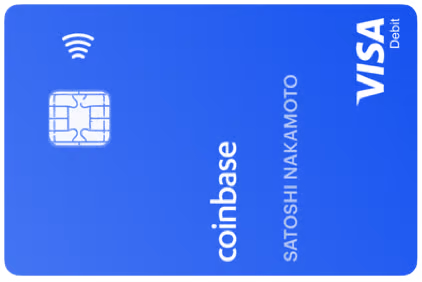
Coinbase Card – Crypto Card Review
Coinbase Card review: 59/100. Frictionless for existing users, but Coinbase won't publish a fixed cashback rate anywhere. Details inside.
Read More
Ether.fi – Crypto Cash Card Review
ether.fi Cash Card review: 76/100. Strong borrow-to-spend model and real yield, but regulatory gaps limit it to ~20 US states. Full breakdown inside.
Read More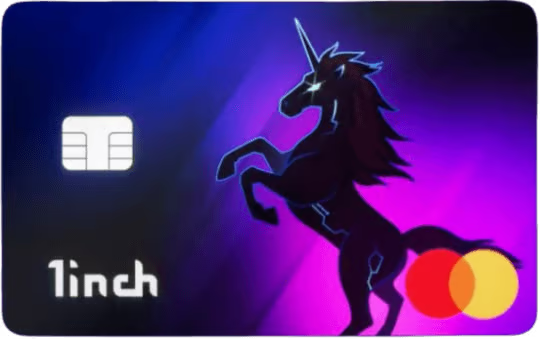
1inch Card – Crypto Card Review
1inch Card review: 50/100. Real DEX-aggregator ties, but it's custodial despite the name, and the wrong cashback pick can lose you money.
Read More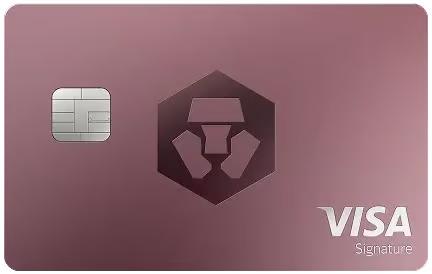
Crypto.com – Crypto Card Review
Crypto.com Visa Card review: 60/100. Broad card tiers and merchant perks, but CRO staking lock-ups and a 1.3/5 Trustpilot score hold it back.
Read More