
Coinbase One Card:
4% bitcoin back, if you can afford the balance it takes.
We tore apart Coinbase's Amex-network card across seven weighted categories; from what it actually takes to hit the 4% tier to what "custodial" means for a company that just disclosed a real data breach; and landed on a score the marketing page won't show you.
Our take, up front: the Coinbase One Card is the most exclusive product in this series; you can't even apply without first paying for a Coinbase One membership, and the headline 4% rate requires keeping $200,000 in assets on the exchange. What you get for that gate is real: the strongest regulatory and public-company track record of any exchange we've reviewed, genuine American Express purchase protections, and a rewards model that scales with your total balance rather than locking you into a single volatile token. What you're also getting is a brand-new product (launched Fall 2025) from a company that disclosed a real customer data breach in 2025, wrapped around the same mandatory-membership dependency that can get your card closed if you stop paying. We weighted all of it below.
Rewards land in your Coinbase Digital Asset Wallet; a custodial account, same as the other cards in this series. What's different is the institution behind it: Coinbase is a Nasdaq-listed public company with audited financial reporting, an NYDFS BitLicense, a MiCA license covering all 27 EU states, and conditional OCC approval for a national trust charter. It has never had a hack result in lost customer crypto funds. It also disclosed a real 2025 data breach, where bribed contractors accessed customer data, an incident some estimates put at up to $400 million in remediation costs.
Pros
- Public-company disclosure and audited financials most crypto platforms don't have
- Never suffered a hack resulting in lost customer crypto funds
- Layered regulatory footprint: NYDFS BitLicense, MiCA (EU-wide), conditional OCC national trust charter
Cons
- 2025 data breach via bribed contractors exposed customer information; estimated cost up to $400 million
- Card rewards still sit in a custodial exchange wallet, not a wallet you control
- Active Nevada lawsuit (Feb 2026) over unlicensed prediction markets adds ongoing regulatory friction
Rewards scale with your 30-day average asset balance on Coinbase (any assets, including plain USD and USDC): 2% under $10,000, 2.5% from $10,000, 3% from $50,000, and 4% from $200,000. The enhanced rates above 2% apply only to the first $10,000 in purchases each calendar month; everything beyond that, and everyone below the $10,000 asset threshold, earns a flat 2%. Travel booked through Coinbase's own travel portal earns an uncapped 5%. All rewards pay out in Bitcoin only.
Pros
- Any asset balance counts toward your tier, including plain USD; no need to hold a specific token
- Flat, uncapped 5% on travel booked through Coinbase's own portal
- Soft-pull prequalification shows your likely tier before you apply
Cons
- The 4% top tier requires $200,000 in Coinbase assets; unreachable for the large majority of applicants
- Enhanced rates cap at $10,000 in monthly purchases; spend beyond that reverts to 2%
- Rewards pay out in Bitcoin only, versus 50+ asset choice on the Gemini card
The card itself carries no annual fee and no foreign transaction fee. But you cannot get or keep the card without an active, paid Coinbase One membership; Basic at $4.99/month or $49.99/year is the minimum, with Preferred ($29.99/mo or $299.99/yr) and Premium ($299.99/mo or $2,999.99/yr) tiers above it. Let your membership lapse, and Coinbase says the card can be closed. Coinbase has not published a specific APR range for the card; confirm your rate directly during the application, since it's set based on individual creditworthiness like any Amex product.
Pros
- No fee or foreign transaction fee on the card itself
- Soft-pull prequalification with no impact to your credit score
- Balance can be repaid directly using crypto held on Coinbase, a genuinely unusual flexibility
Cons
- Card access requires a paid Coinbase One membership starting at $49.99/year, effectively a hidden minimum cost
- Membership lapsing can result in the card being closed
- Coinbase has not published a specific APR range for the card in the sources we reviewed; confirm directly before applying
US residents only, excluding territories; the same simple, single-rule eligibility as the Gemini card. Coinbase hasn't published an official minimum credit score, but because the card runs on the American Express network, a score of roughly 670 or higher is generally recommended for the best approval odds. On top of creditworthiness, eligibility is gated a second way: you must already hold, or be willing to pay for, an active Coinbase One membership just to apply.
Pros
- Single, simple US-only eligibility rule; no state-by-state exclusions to track
- Soft-pull prequalification lets you check your approval odds and likely tier before a hard inquiry
- 135 million-plus Amex merchant locations worldwide accept the card once approved
Cons
- US-only; no international availability
- Double-gated eligibility: creditworthiness and a paid Coinbase One membership are both required
- Amex acceptance runs narrower than Visa or Mastercard in some regions and at smaller merchants
Your reward tier is based on total assets held on Coinbase, not a specific staked token; a meaningfully lower-risk mechanic than locking CRO or ETHFI, since a diversified balance or plain cash counts just as much as crypto does. You can also repay your card balance directly with crypto held on Coinbase, a genuinely unusual convenience. The catch is that reaching the top tiers still requires very large balances, and Coinbase One's higher membership tiers (Preferred, Premium) add perks like 24/7 concierge support and free wires that have nothing to do with the card itself.
Pros
- Reward tier is based on total assets, not a specific volatile token; genuinely lower collateral risk
- Repaying your card balance with Coinbase-held crypto is a rare, useful flexibility
- USD and USDC count toward your tier, not just crypto holdings
Cons
- Reaching the top two tiers still requires $50,000 to $200,000 parked on a single exchange
- Higher Coinbase One membership tiers add unrelated perks (concierge, free wires) that pad the price without touching the card's core rewards
- No deep protocol, staking, or yield integration comparable to a restaking-based card
The card is fully managed through the Coinbase mobile app, with a virtual card available for digital wallets immediately after approval, ahead of the physical stainless-steel card (etched with Bitcoin's Genesis Block) arriving by mail. Prequalification is a soft pull with no credit-score impact, and a hard inquiry only reports if you accept the offer. Because the card only launched in fall 2025, independent long-term usage reviews are still thin compared to the more established cards in this series.
Pros
- Virtual card available instantly on approval, ahead of physical card delivery
- Soft-pull prequalification with a hard inquiry only reported if you accept
- Distinctive stainless-steel design etched with Bitcoin's Genesis Block
Cons
- Launched fall 2025; independent long-term review volume is still thin
- Managing card, membership tier, and exchange balance all in one app adds real complexity versus a standalone card app
Coinbase sits at roughly 4.0/5 on Trustpilot across more than 20,000 reviews, by a wide margin the best-rated exchange in this series (Crypto.com sits near 1.3/5). That said, the pattern of complaints is familiar: account restrictions, verification loops, and slow support during compliance reviews, not fund loss. Support is layered by American Express network protections too, which is a genuine structural advantage the debit-style cards in this category don't have.
Pros
- ~4.0/5 Trustpilot rating across 20,000+ reviews; the strongest of any exchange in this series
- American Express network protections add a real support and dispute-resolution layer
- Complaints concentrate on account access and verification delays, not lost funds
Cons
- Recurring complaints about restricted accounts and slow verification during compliance reviews
- The card itself is too new (fall 2025 launch) to have an independent support track record separate from Coinbase's general reputation
- 2025 data breach involved bribed contractors accessing customer support systems specifically
Check your tier before you commit to membership.
Prequalification uses a soft credit pull, so checking your odds and likely reward tier doesn't touch your score. Remember: you'll need an active Coinbase One membership (from $49.99/year) to actually hold the card, so factor that into the math before applying.
The strongest institution behind it; the narrowest door into it.
The Coinbase One Card earns its marks from the company standing behind it: the best regulatory footprint, the best Trustpilot sentiment, and the cleanest fund-security track record of any exchange in this series, wrapped in real American Express purchase protections. It loses ground on access: you can't even apply without paying for a membership first, and the reward rate that makes the card interesting requires a balance most people will never hold on a single exchange. This is a strong pick for an existing, well-capitalized Coinbase user; it's an expensive way to earn 2% for almost everyone else.
The scorecard above is deliberately general. Whether the Coinbase One Card is right for you depends heavily on which of these you already are.
The already-large Coinbase balance holder
You already keep $50,000 to $200,000 or more on Coinbase for other reasons, entirely separate from this card. On that basis, the 3% to 4% tier is close to free upside on spending you'd be doing anyway.
The Coinbase One subscriber who already pays for it
You already pay for a Coinbase One membership for its other perks; zero trading fees, boosted staking rewards. The card adds real value on top of a cost you're already absorbing.
The Amex loyalist who wants a bitcoin angle
You value Amex's purchase protections and travel perks specifically, and the flat 5% uncapped travel-portal rate and stainless-steel design are a genuine draw independent of the crypto rewards math.
Anyone comparing this to a simple 2% cash-back card
If you don't hold $10,000 or more on Coinbase, you're paying at least $49.99/year for a card that earns the same 2% as free cash-back cards already on the market, just paid in a volatile asset instead of cash.
The scorecard covers the headline judgment calls. These four tables cover the specifics we didn't want to bury in prose; the Coinbase One membership tiers gating the card, the reward-tier math, the fee schedule, and how it stacks up against every other card we've reviewed in this series.
Coinbase One membership tiers
| Tier | Cost | What it adds beyond card access |
|---|---|---|
| Basic | $4.99/mo or $49.99/yr | Minimum tier required to hold the card; zero trading fees, boosted staking rewards |
| Preferred | $29.99/mo or $299.99/yr | Adds free wires and enhanced support on top of Basic perks |
| Premium | $299.99/mo or $2,999.99/yr | Adds 24/7 priority concierge support on top of lower tiers |
You do not need Preferred or Premium to hold the card; Basic is sufficient. Those higher tiers add perks unrelated to the card itself, and none of them change your reward tier, which is based purely on your Coinbase asset balance.
Reward tiers, by Coinbase asset balance
| Asset balance (30-day avg.) | Reward rate | Monthly spend cap for enhanced rate |
|---|---|---|
| Under $10,000 | 2% | None; flat rate on all spend |
| $10,000–$49,999 | 2.5% | First $10,000 in purchases; then 2% |
| $50,000–$199,999 | 3% | First $10,000 in purchases; then 2% |
| $200,000+ | 4% | First $10,000 in purchases; then 2% |
| Travel (Coinbase portal) | 5% | Uncapped; doesn't count toward the $10,000 cap |
For your first 60 days, your tier is based on your real-time balance at each purchase; after that, it switches to a 30-day rolling average. All Coinbase assets count toward your balance, including plain USD and USDC, not just crypto.
Fee schedule
| Fee | Amount |
|---|---|
| Card annual fee | $0 |
| Foreign transaction fee | 0% |
| Coinbase One membership (required) | From $49.99/year (Basic) |
| Purchase APR | Not published; varies by creditworthiness, confirm during application |
We could not find a published APR range for this card in the sources we reviewed, unlike Gemini's clearly stated 18.49%-34.49%. Treat this as an open question to confirm directly before applying, not a $0 cost; it is a real credit card with a real interest rate.
How it compares to the other cards we've reviewed
| Card | Card type | Base cashback | Access gate | Region |
|---|---|---|---|---|
| Coinbase One Card | Revolving credit | 2%-4%, paid in BTC only | Paid Coinbase One membership + credit check | US only |
| Gemini Credit Card | Revolving credit | 1%-4%, paid in 50+ assets | Credit check only; no membership required | US only |
| Crypto.com Visa | Prepaid | 0%-8%, paid in CRO | Free tier available; higher tiers need CRO stake | 90+ countries (US excl. NY) |
| ether.fi Cash | Debit against collateral | Up to 3%, paid in wETH | Non-custodial vault; no credit check | ~20 US states, UK, EEA, HK, UAE |
Coinbase is the only card in this series that gates access behind a paid subscription on top of a credit check; Gemini's equivalent card is free to hold. Where Coinbase wins is the underlying institution: strongest regulatory footprint and best Trustpilot sentiment of the three exchanges behind these cards, even after accounting for its 2025 data breach.
We don't just want to hand you our number; we want to show you how it sits next to what other review desks, app-store users, and comparison sites have published. Where we could find a real cited figure, we used it; everything else is a clearly-flagged editorial estimate based on that outlet's published sentiment.
Our score lands meaningfully below the aggregated industry average; most mainstream card-comparison sites focus on the headline 4% rate and Amex protections, while giving the $200,000 balance requirement and mandatory membership a passing mention rather than a real deduction. We weight how few cardholders can actually reach the advertised rate more heavily than that.
| Source | Score | Type |
|---|
Scores compiled by our editorial team from publicly available reviews as of August 2026. "Editorial estimate" means the outlet didn't publish a single numeric score, so we converted their published verdict and sentiment into a comparable 100-point figure. Verify current figures directly with each source before citing them elsewhere.
Yes. An active Coinbase One membership, Basic at minimum ($4.99/month or $49.99/year), is required just to apply for and hold the card. If your membership lapses, Coinbase says the card can be closed. This is a real, mandatory cost that sits underneath the card's advertised $0 annual fee.
For most people, not very. The 4% tier requires a 30-day average balance of $200,000 or more on Coinbase, and even then only applies to your first $10,000 in monthly purchases. Most cardholders will realistically land at the base 2% rate.
Any assets held on Coinbase count, not just crypto; plain USD and USDC balances qualify too. For your first 60 days, tier calculation uses your real-time balance at the moment of each purchase; after that, it switches to a 30-day rolling average.
Bribed contractors accessed customer support data without authorization; some estimates put the total remediation cost at up to $400 million. It's a real, serious incident, but distinct from a hack of customer crypto funds; Coinbase has never had a breach result in lost customer crypto, which is a different (and better) track record than losing custody of funds outright.
No. Rewards pay out exclusively in Bitcoin, deposited into your Coinbase Digital Asset Wallet. This is less flexible than the Gemini Credit Card, which lets you choose from more than 50 reward assets.
Yes, and this is a genuinely unusual feature among the cards we've reviewed. You can repay your statement balance directly using crypto held on Coinbase, rather than needing a separate fiat bank transfer.
We couldn't find a clearly published APR range in the sources we reviewed; Coinbase describes it as based on individual creditworthiness, similar to any American Express product. Confirm your specific rate during the application process before assuming this card is free to carry a balance on.
They're different products entirely. The older Coinbase Card is a Visa debit card linked to your existing crypto balance, spending funds you already hold. The Coinbase One Card is a true Amex-network credit card with a credit line, a required paid membership, and tiered bitcoin-back rewards based on your total assets, not what's preloaded on a debit card.
More Reviews
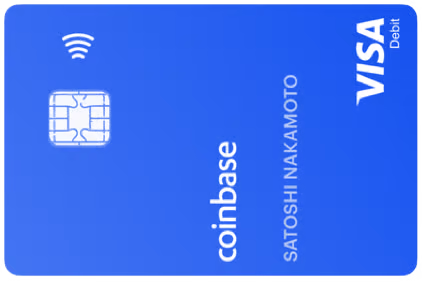
Coinbase Card – Crypto Card Review
Coinbase Card review: 59/100. Frictionless for existing users, but Coinbase won't publish a fixed cashback rate anywhere. Details inside.
Read More
Ether.fi – Crypto Cash Card Review
ether.fi Cash Card review: 76/100. Strong borrow-to-spend model and real yield, but regulatory gaps limit it to ~20 US states. Full breakdown inside.
Read More
1inch Card – Crypto Card Review
1inch Card review: 50/100. Real DEX-aggregator ties, but it's custodial despite the name, and the wrong cashback pick can lose you money.
Read More
Crypto.com – Crypto Card Review
Crypto.com Visa Card review: 60/100. Broad card tiers and merchant perks, but CRO staking lock-ups and a 1.3/5 Trustpilot score hold it back.
Read More