What the Blockchain Trilemma Is
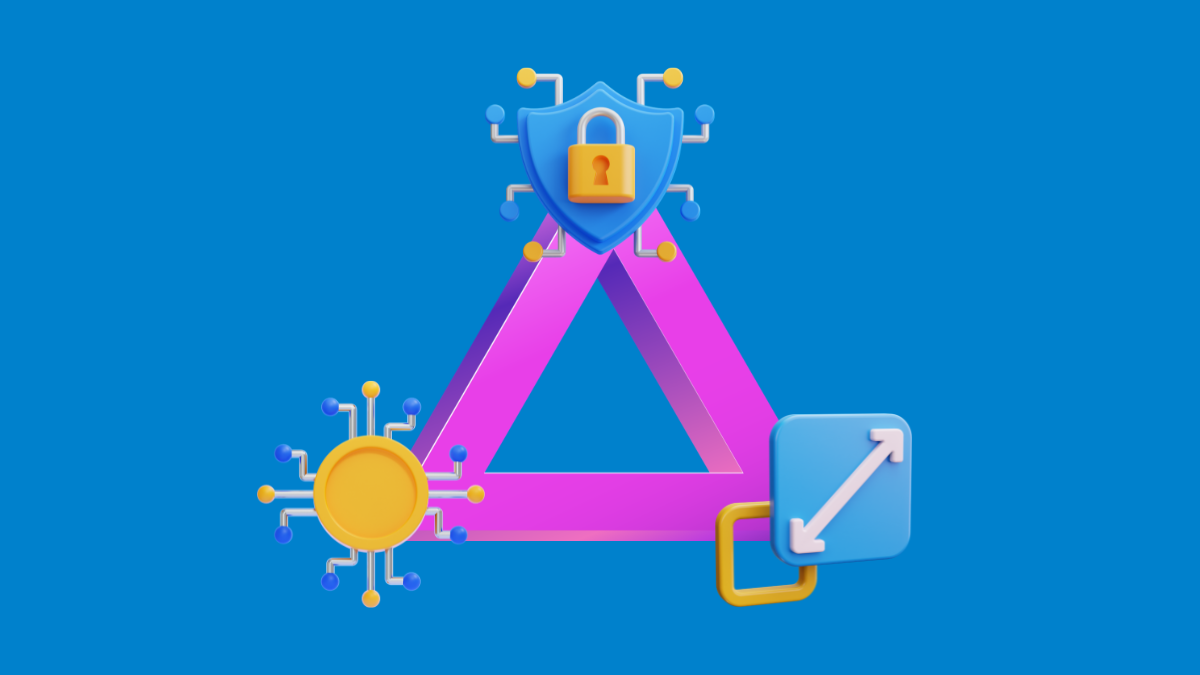
The trilemma; proposed by Vitalik Buterin; states that a blockchain BlockchainThink of blockchain as a public notebook that everyone owns a copy of. Whatever gets written in it is permanent and visible to all.Keep learning can only excel at two of the following three properties:
- Decentralization
- Security
- Scalability
Trying to maximize all three at once creates trade‑offs in performance, cost, or trust assumptions.
The Three Pillars
1. Decentralization
A decentralized DecentralizationDecentralization is the distribution of control and decision-making across a network instead of a single central authority.Keep learning network has many independent nodes verifying transactions.
Benefits:
- Censorship resistance
- Community ownership
 OwnershipOwnership in crypto means control over assets via private keys, allowing users to hold, transfer, or manage funds without intermediaries.Keep learning
 - No single point of failure

Trade‑off:
- More nodes = slower consensus
2. Security
A secure blockchain protects against attacks, double‑spends, and validator collusion.
Benefits:
- Strong economic guarantees
- Immutable ledger
- High trustworthiness
Trade‑off:
- Strong security often requires high resource costs
3. Scalability
A scalable blockchain processes many transactions quickly and cheaply.
Benefits:
- High throughput
- Low fees
- Smooth user experience
Trade‑off:
- Scaling often requires centralization or weaker security assumptions
Why the Trilemma Exists
Blockchains rely on distributed consensus.
The more distributed the network, the harder it is to:
- Reach agreement quickly
- Process many transactions
- Maintain strong security guarantees
Optimizing one dimension usually weakens another.
Examples of Trilemma Trade‑offs
Bitcoin
- Strong security
- Strong decentralization
- Limited scalability
Solana
- High scalability
- Strong security
- Lower decentralization (higher hardware requirements)
Ethereum (pre‑L2)
- Strong security
- Strong decentralization
- Limited scalability
Layer 2 Rollups
- Improve scalability
- Inherit security from L1
- Maintain decentralization at the base layer
Rollups are the industry’s best attempt at “solving” the trilemma.
Approaches to Solving the Trilemma
Modern blockchain design uses modularity to break the trilemma:
- Layer 2 rollups — scale execution off‑chain
- Data availability layers — separate data from execution
- Sharding — parallelize the network
- Modular blockchains — split consensus, DA, and execution
- App‑specific chains — optimize for one use case
These architectures aim to maximize all three pillars through specialization.
The Trilemma in One Table
| Pillar | Meaning | Trade‑off |
|---|---|---|
| Decentralization | Many independent validators | Slower throughput |
| Security | Strong protection against attacks | High resource cost |
| Scalability | Fast, cheap transactions | Centralization risk |
Why the Trilemma Matters
The trilemma explains why:
- No blockchain is perfect
- Different chains make different trade‑offs
- L2s and modular designs are rising
- “One chain to rule them all” is unlikely
- Decentralization and performance are always in tension
Understanding the trilemma helps you evaluate any blockchain’s design choices.
The tags found in our glossary are there to help you better understand presented definitions. They showcase how certain concepts integrate and interact within the ecosystem.
Rectangular tags signal a concept related to BlockchainBlockchainThink of blockchain as a public notebook that everyone owns a copy of. Whatever gets written in it is permanent and visible to all.Keep learning as a technology. Whereas rounded tags represent Cryptocurrency CryptocurrencyCryptocurrency, often called “crypto,” is a form of digital currency that uses cryptography (advanced math and code) to keep it secure.Keep learning in more of a financial aspect. You’ll also see rectangular dashed tags for Web3
 Web3Web3 is the idea of a decentralized internet powered by blockchain.Keep learning and rounded dashed tags for DeFi
 DeFiDeFi stands for Decentralized Finance. It refers to a collection of applications and platforms built on blockchain that allow people to transact without banks.Keep learning specifically.
Learn more about the relationship between all the tags and their respective concept with our Free Interactive Courses.

Proof of Work
Proof of Work (PoW) is a consensus mechanism where miners use computing power to validate transactions and secure the blockchain.
Keep learning
Tokenomics
Tokenomics refers to a cryptocurrency’s economic design, including supply, distribution, utility, and incentives that influence its value and behavior.
Keep learning
Play-to-Earn (P2E)
Play-to-Earn (P2E) is a gaming model where players earn crypto or tokens by playing games and completing in-game activities.
Keep learning
Blockchain
Think of blockchain as a public notebook that everyone owns a copy of. Whatever gets written in it is permanent and visible to all.
Keep learning