
Disclosure: This post may contain affiliate links. If you sign up or make a purchase through our links, we may earn a commission at no extra cost to you. We only recommend products and services we believe add value.

Bybit
86
Bybit is a fast-growing crypto exchange known for its powerful derivatives platform, deep liquidity, and trader-focused tools.
Type
Spot + Perps
Trading Pairs
2,000+
Leverage
Up to 100x
Signup Offer
Up to 5,100 USDT
Pros and Cons
Low and Competitive Fees
Strong Derivatives & Liquidity
Advanced Features & Tools
Proof of Reserves & Transparency Efforts
Cons
Not Available in Some Major Countries
Complex for Beginners
Security & Incident History
High Risk from Leverage Trading

Overview
Coinbase is a leading U.S.-based cryptocurrency exchange known for its strong regulatory positioning, user-friendly design, and role as a primary on-ramp for new crypto participants. Founded in 2012, Coinbase has become one of the most recognized names in the digital asset industry and is publicly traded, which subjects it to higher disclosure and compliance standards than most competitors.
The platform offers spot trading for a curated selection of cryptocurrencies, along with staking, custodial services, and institutional-grade products through Coinbase Prime. Coinbase also provides derivatives trading in select jurisdictions and a self-custody wallet that integrates with decentralized applications. Its interface is designed to accommodate beginners, while advanced users can access more sophisticated tools through Coinbase Advanced Trade.
A key differentiator for Coinbase is its regulatory-first approach. The exchange works closely with U.S. and international regulators, prioritizes compliance, and maintains strong relationships with traditional financial institutions. This conservative posture limits the number of supported assets and features compared to offshore exchanges, but it also reduces operational and legal uncertainty for users in regulated markets.
Overall, Coinbase is best characterized as a compliance-driven, accessibility-focused exchange that bridges traditional finance and the crypto economy. It is particularly well suited for beginners, long-term investors, and institutions seeking a familiar and regulated environment, even if more active traders may find its fees higher and product range more limited than global competitors.
Pros and Cons
Low and Competitive Fees
Bybit offers very competitive trading fees (around ~0.1% spot, even lower for derivatives), making it attractive for active traders.
Strong Derivatives & Liquidity
It’s one of the top platforms for futures and perpetual contracts, with deep liquidity and fast execution—ideal for professional traders.
Advanced Features & Tools
Includes copy trading, trading bots, options, Earn products, and a Web3 wallet; basically a full trading ecosystem.
Proof of Reserves & Transparency Efforts
Bybit provides audited proof-of-reserves and has emphasized transparency after past incidents, boosting user trust.
Cons
Not Available in Some Major Countries
Restricted in regions like the U.S., U.K., and others due to regulatory issues.
Complex for Beginners
The interface and advanced tools can feel overwhelming for new users.
Security & Incident History
Despite improvements, the platform experienced a major hack in 2025, highlighting ongoing risks in centralized exchanges.
High Risk from Leverage Trading
Offers very high leverage (up to 100x–200x), which can lead to significant losses if misused.
Scoring System
Each centralized crypto exchange is evaluated on a 100-point scale using a weighted framework that reflects real-world usability, security, and service reliability. Scores are based on the following categories:
- Security & Compliance (25 points) – Measures platform security practices, regulatory compliance, insurance coverage, history of breaches, and adherence to KYC/AML standards.
- Liquidity & Market Depth (20 points) – Evaluates trading volume, order book depth, slippage, and the ability to execute large trades efficiently across spot and derivatives markets.
- Asset Support & Listings (15 points) – Considers the range of supported cryptocurrencies and tokens, fiat gateways, and access to niche or newly listed assets.
- Trading Features & Tools (15 points) – Assesses the quality of spot, margin, and derivatives trading, staking, lending, advanced charting, and order types.
- User Experience & Interface (10 points) – Reviews onboarding, platform navigation, mobile and desktop app usability, and overall ease of use.
- Customer Support & Reliability (10 points) – Evaluates responsiveness, support channels, dispute resolution, and platform uptime/stability.
- Fees & Value for Money (5 points) – Examines trading fees, withdrawal costs, and competitive pricing relative to available features and services.
Each category contributes a defined portion of the total score. Higher-scoring exchanges demonstrate a strong balance of security, liquidity, usability, and trading features; not just flashy interfaces or a large coin list.
Security and Compliance
23
Security Infrastructure
Bybit employs a conventional centralized exchange security architecture designed to protect user funds and platform integrity. The majority of assets are held in cold wallets, minimizing exposure to online threats. Withdrawals are governed through multi-signature authorization, reducing the risk of single-point failure.
On the user side, the platform supports two-factor authentication, withdrawal whitelisting, and anti-phishing measures. In addition, Bybit integrates real-time monitoring systems intended to detect suspicious activity and mitigate potential breaches.
Despite these safeguards, the platform experienced a critical failure in February 2025, when attackers compromised a cold wallet and extracted approximately $1.4–$1.5 billion in Ethereum. The breach demonstrated that even advanced custody solutions can be vulnerable to sophisticated, multi-layered attacks targeting infrastructure and transaction validation processes.
Incident Response and Resilience
Bybit’s response to the 2025 breach is widely regarded as a defining moment for the platform. Rather than triggering a liquidity crisis, the exchange restored full backing of user assets within roughly 72 hours, relying on external liquidity and internal reserves.
Withdrawals remained operational throughout the incident, which helped maintain user confidence during a period of extreme uncertainty. The company also coordinated with blockchain analytics firms to trace stolen funds and launched public recovery initiatives, including bounty programs and ongoing transparency updates.
This response highlighted operational resilience and crisis management capabilities that are not always evident until tested under extreme conditions.
Transparency and Proof of Reserves
A central pillar of Bybit’s post-incident positioning is its emphasis on transparency through Proof of Reserves. The exchange publishes regular audits conducted by third-party firms and maintains reserve ratios exceeding 100 percent, indicating that user liabilities are fully backed by on-chain assets.
Bybit utilizes Merkle tree verification systems, allowing users to independently confirm that their balances are included in the platform’s reported reserves. This approach moves beyond trust-based assurances and provides a verifiable framework for solvency.
The continuation of these disclosures after the 2025 incident reinforced the platform’s claim that user funds remained fully backed despite the scale of the breach.
Regulatory and Compliance Position
Bybit operates within a fragmented regulatory landscape. It is not licensed in several major jurisdictions, including the United States and the United Kingdom, which limits its accessibility in highly regulated markets.
Compared to exchanges that prioritize regulatory alignment, Bybit adopts a more flexible approach, tailoring compliance efforts to specific regions rather than adhering to a single, unified regulatory framework. While this allows for broader global reach and faster product innovation, it may raise concerns for users who prioritize strict oversight and legal clarity.
Liquidity & Market Depth
19
Overall Liquidity Profile
Bybit maintains high liquidity across both spot and derivatives markets, with particularly strong performance in perpetual futures. Major pairs such as BTC/USDT and ETH/USDT typically exhibit tight bid-ask spreads and large order book volumes, enabling efficient trade execution even during periods of elevated market activity.
This depth is supported by a global user base and significant participation from institutional and high-frequency trading firms, which contribute to consistent market activity and tighter pricing.
Market Depth and Order Book Quality
Market depth on Bybit is generally robust, especially within its core derivatives products. Large orders can often be executed with minimal slippage under normal market conditions, which is critical for traders operating with size or using leverage.
The exchange also benefits from an active market maker ecosystem that helps stabilize spreads and maintain order book density. As a result, price impact tends to remain low compared to smaller or less liquid platforms.
However, depth can vary significantly outside of major pairs. Smaller altcoins and newly listed tokens may experience thinner liquidity, wider spreads, and higher volatility, particularly during off-peak trading hours.
Performance During Volatility
Bybit has demonstrated relatively strong liquidity resilience during periods of market stress. Even during sharp price movements, order books tend to remain functional, and the platform is generally able to process high trading volumes without severe degradation in execution quality.
That said, like all centralized exchanges, extreme volatility can still lead to temporary spread widening and increased slippage. In highly leveraged environments, rapid price movements may also trigger cascading liquidations, which can further amplify short-term liquidity imbalances.
Derivatives Dominance
A key differentiator is Bybit’s dominance in derivatives trading. Liquidity in perpetual contracts often surpasses that of its spot markets, making it particularly attractive for traders seeking leverage and advanced strategies.
This focus creates a more mature and efficient derivatives market but also means that spot liquidity, while strong, is not always the platform’s primary strength relative to competitors that emphasize spot trading.
Asset Support & Listings
13
Range of Supported Assets
Bybit supports hundreds of cryptocurrencies across its spot and derivatives markets. This includes all major assets such as Bitcoin, Ethereum, and other high-cap tokens, alongside a wide selection of mid-cap and emerging altcoins.
The platform also provides access to multiple trading pairs, typically denominated in USDT, USDC, and occasionally other base currencies. This ensures flexibility for traders operating across different strategies and capital bases.
While the overall selection is extensive, it is not as large as some competitors that prioritize sheer volume of listings. Instead, Bybit tends to focus on assets with sufficient liquidity and trading interest.
Listing Strategy and Speed
One of Bybit’s distinguishing features is the speed at which it lists new tokens. The exchange is often among the early platforms to introduce trending or high-demand assets, particularly those gaining traction in sectors such as DeFi, AI-related tokens, and meme coins.
This approach allows users to access new market opportunities relatively early, which can be advantageous for traders seeking high-growth assets. However, faster listings can also introduce higher-risk tokens, including those with limited track records or increased volatility.
To mitigate this, Bybit conducts internal due diligence before listing, though the depth and strictness of these evaluations may not match more heavily regulated exchanges.
Derivatives Coverage
Asset support on Bybit is especially strong in derivatives markets. Many listed tokens are available not only for spot trading but also as perpetual futures contracts, often with leverage options.
This dual availability enhances trading flexibility, allowing users to take both long and short positions across a wide range of assets. It also reinforces Bybit’s identity as a derivatives-first platform.
However, not all spot-listed assets receive derivatives support, and coverage tends to prioritize tokens with higher trading volume and demand.
Delisting and Risk Management
Bybit periodically reviews listed assets and may delist tokens that fail to meet criteria related to liquidity, trading volume, or project reliability. This helps maintain overall market quality and reduces exposure to inactive or potentially problematic assets.
That said, compared to more conservative exchanges, Bybit may tolerate a higher level of risk in its listings, particularly in fast-moving sectors. Users should therefore conduct independent research when trading newer or less established tokens.
Trading Features & Tools
13
Bybit offers one of the most comprehensive toolsets among centralized exchanges, with a strong emphasis on derivatives, automation, and strategy execution. Its ecosystem is designed to support everything from simple spot trading to complex, multi-layered trading strategies.
Spot Trading & Order Types
Bybit provides a full-featured spot market with hundreds of cryptocurrencies and trading pairs. Users can execute standard market and limit orders, as well as more advanced order types, including:
Conditional orders
Take-profit / stop-loss
Trailing stops
In addition, Bybit includes risk management mechanisms such as insurance funds and auto-deleveraging systems, designed to reduce systemic risk in leveraged markets.
Derivatives & Futures
Derivatives are the core of Bybit’s platform. It offers:
Perpetual contracts (no expiry)
Expiry futures contracts
Options trading
These products support high leverage and are backed by deep liquidity, making them suitable for advanced strategies such as hedging and short-term speculation.
Margin & Leverage Trading
Bybit supports both cross and isolated margin modes, allowing users to manage risk more precisely. Traders can borrow funds against collateral to amplify positions, with built-in liquidation thresholds and risk monitoring tools.
This feature is particularly relevant for traders transitioning from spot to more advanced strategies.
Staking & Earn Features
Bybit integrates yield-generating and structured products directly into its ecosystem, including:
Staking and savings products
Launchpool (token farming)
Dual-asset structured products
These tools allow users to generate passive income or implement directional strategies tied to price outcomes.
API & Algorithmic Trading
Bybit provides a robust API infrastructure that supports automation and advanced trading:
- Programmatic trade execution
- Real-time market data access
- Automated position and risk management
- Integration with custom bots and quantitative strategies
This makes it suitable for high-frequency and algorithmic traders.
Advanced Charting & Interface
Bybit offers advanced charting powered by TradingView, supporting detailed analysis through:
- Indicators such as RSI, MACD, and Bollinger Bands
- Multiple timeframes and chart types
- Drawing tools for trendlines and patterns
- Market data like open interest, funding rates, and long/short ratios
These tools enable both technical and sentiment-based trading strategies.
Copy Trading
Bybit’s copy trading system allows users to replicate experienced traders with built-in transparency and control:
- Access to trader performance metrics (ROI, drawdown, win rate)
- Automatic trade replication
- Adjustable risk and allocation settings
- Ability to follow multiple traders simultaneously
This feature is ideal for beginners and passive investors seeking simplified exposure to active trading.
Trading Bots & Automation
Bybit offers built-in trading bots that automate strategies without requiring external software. These include:
Spot Grid bots
Futures Grid bots
DCA (Dollar-Cost Averaging) bots
These tools allow users to execute systematic strategies continuously, removing emotional decision-making and enabling 24/7 trading.
Additional Tools & Ecosystem Features
Beyond core trading, Bybit offers a broader ecosystem of supporting tools:
Demo Trading for strategy testing with virtual funds
Convert (instant swaps) for quick asset exchanges without order books
P2P Trading for fiat on/off-ramps with multiple payment methods
OTC Desk for large block trades outside public markets
Web3 Wallet and DEX access, bridging centralized and decentralized finance
Bybit Pay for internal crypto transfers and payments
These features extend the platform beyond trading into a more complete crypto ecosystem.
User Experience & Interface
8
Platform Design and Navigation
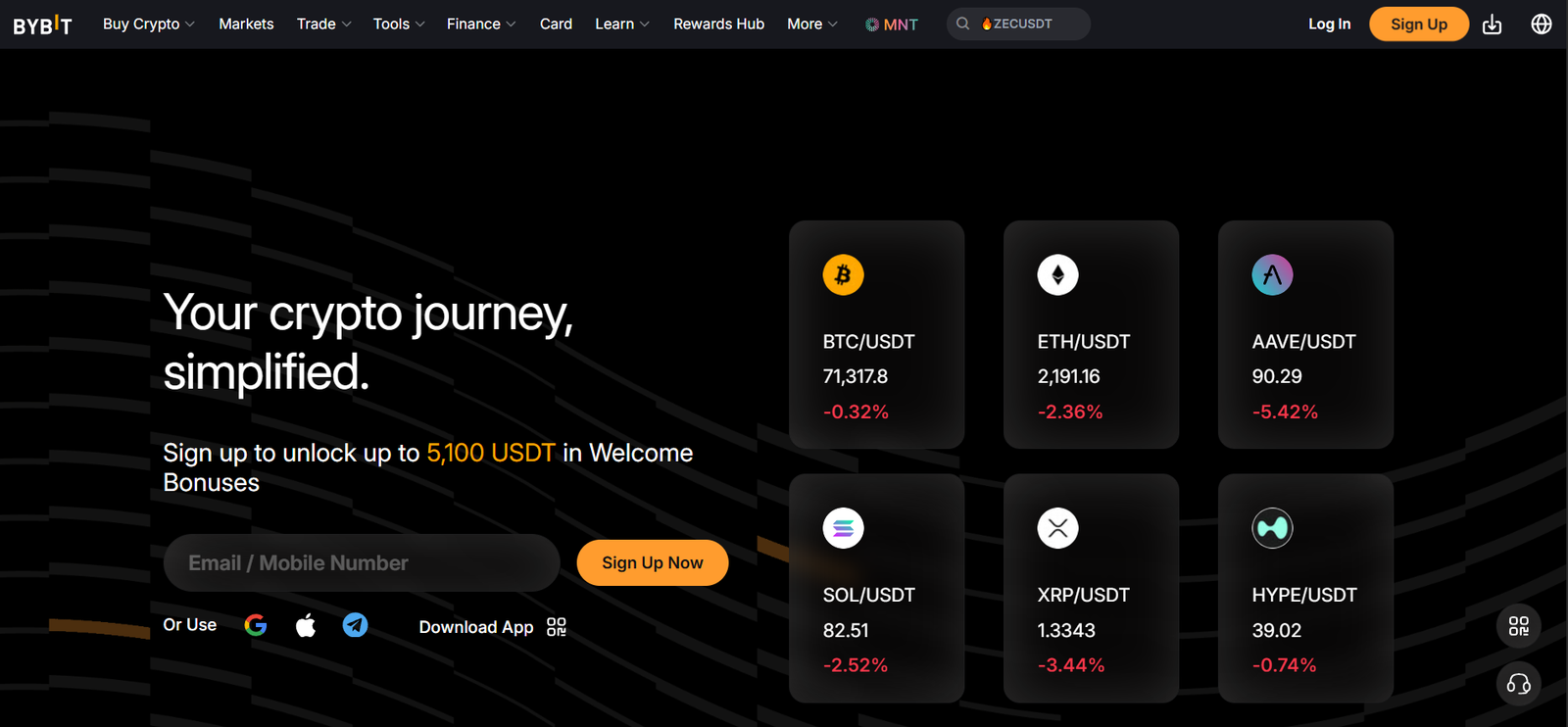
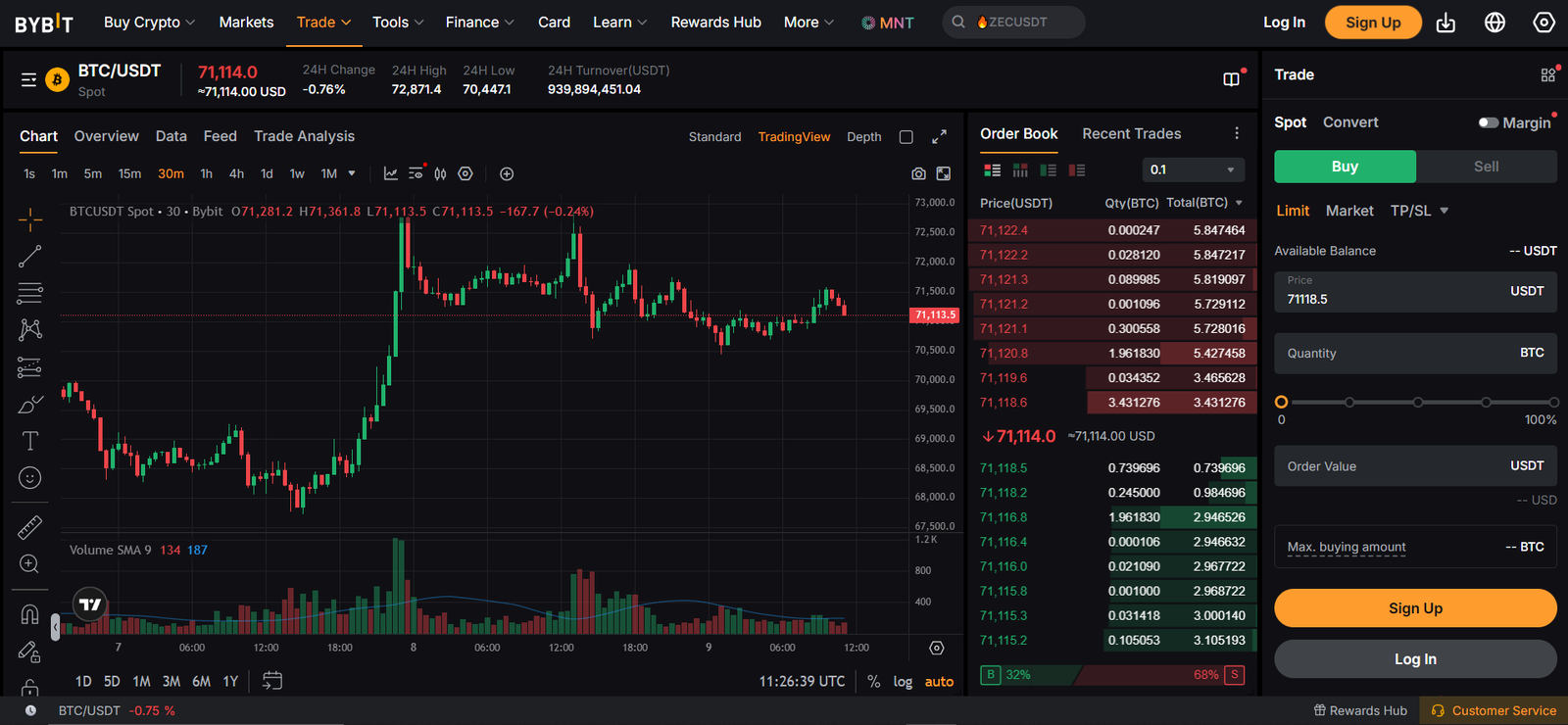
The interface is modern, responsive, and highly functional. Navigation is generally intuitive once users become familiar with the layout, with clear separation between spot trading, derivatives, earn products, and account management.
The trading dashboard is information-dense, featuring order books, recent trades, charts, and position data within a single view. This design is efficient for experienced users who require real-time data, but it can feel overwhelming for beginners encountering multiple data streams simultaneously.
Bybit also allows a degree of customization, enabling users to adjust chart layouts and interface components to better suit their workflow.
Trading Experience
Execution speed is one of Bybit’s strongest usability advantages. Orders are processed quickly, and the platform maintains stability even during periods of high market activity. This is particularly important for derivatives traders who rely on precise entry and exit points.
The integration of advanced order types—such as conditional orders, take-profit/stop-loss settings, and trailing stops—enhances strategic flexibility. These features are seamlessly embedded into the interface, reducing the need for external tools.
Charting is powered by TradingView, providing professional-grade technical analysis tools directly within the exchange. This includes indicators, drawing tools, and multiple timeframes, making it suitable for both technical traders and analysts.
Mobile Experience
Bybit’s mobile application closely mirrors the functionality of its desktop platform. It supports full trading capabilities, account management, and access to most features available on the web interface.
The app is well-optimized for performance and retains a clean layout despite the complexity of available tools. However, as with the desktop version, the density of information may be challenging for newer users navigating on smaller screens.
Onboarding and Accessibility
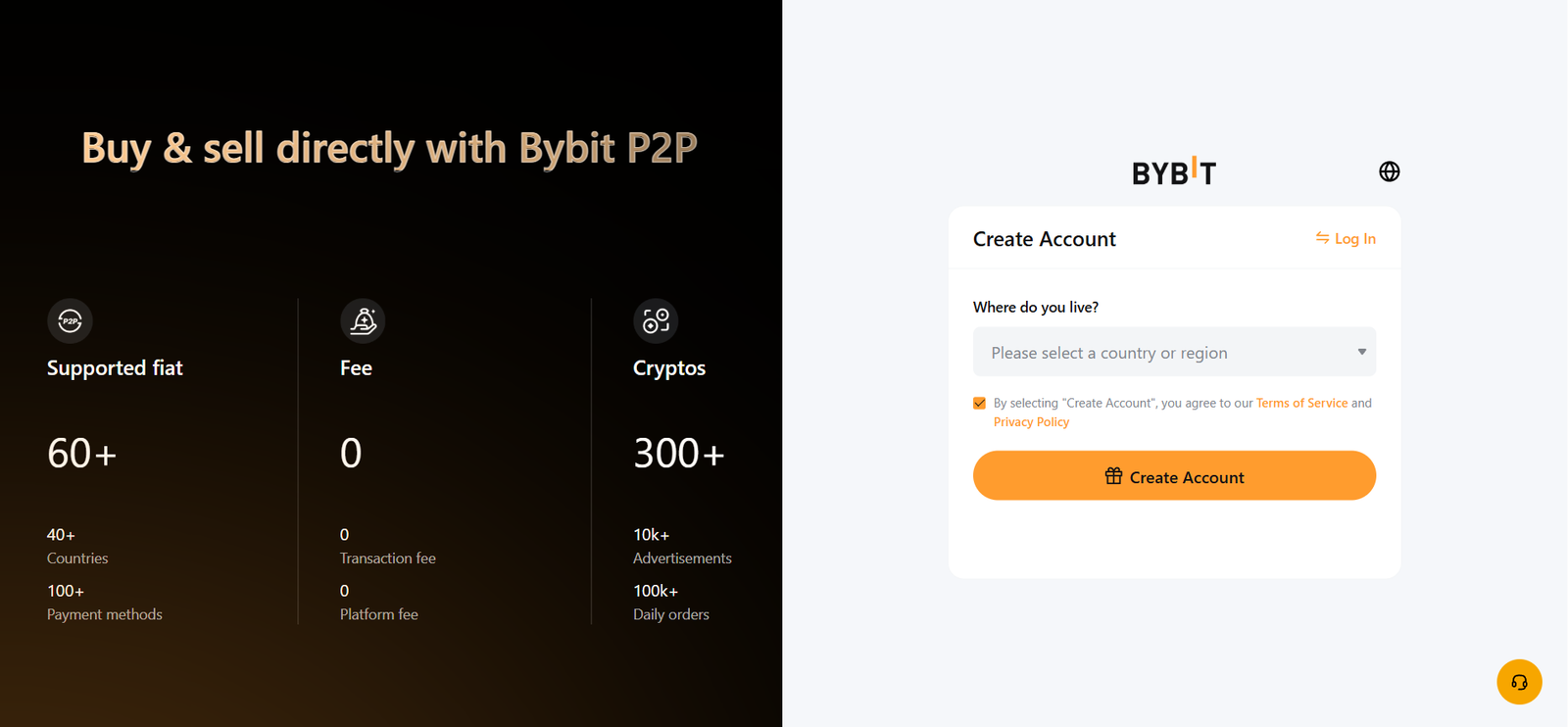
Account creation is straightforward, and the platform guides users through initial setup steps such as security configuration and identity verification where required.
However, onboarding into actual trading is less beginner-friendly. The platform assumes a basic understanding of trading concepts, particularly in derivatives. Features like leverage, margin modes, and funding rates are not always explained in-depth within the interface, requiring users to seek external education.
To address this, Bybit offers demo trading environments and educational resources, though these are somewhat secondary to the core trading experience.
Customer Support & Reliability
6
Customer Support Channels
Bybit provides multiple support channels, including 24/7 live chat, email-based ticketing, and an extensive help center. The live chat function is typically the fastest way to reach support, with response times that are generally quick for standard inquiries.
The help center includes detailed guides covering account setup, trading mechanics, security settings, and troubleshooting. For common issues, users can often find answers without needing to contact support directly.
In addition, Bybit maintains active communication through social media and community platforms, which can be useful for updates during system events or market disruptions.
Quality and Responsiveness
Support quality is generally consistent for routine issues such as account access, deposits, and basic platform usage. However, response times and depth of assistance can vary depending on the complexity of the request.
For more technical or account-specific problems; such as liquidation disputes or transaction investigations; resolution may take longer and involve multiple support interactions. This is a common limitation across large exchanges but remains a point of friction for users dealing with urgent issues.
Platform Reliability and Uptime
Bybit has built a reputation for strong platform stability, particularly in high-volume trading environments. The exchange is designed to handle significant transaction throughput, and outages are relatively infrequent compared to some competitors.
During periods of extreme market volatility, the platform generally remains operational, with trading engines continuing to process orders efficiently. This reliability is especially important for derivatives traders who depend on continuous market access.
That said, no centralized exchange is immune to performance degradation under extreme conditions. Temporary slowdowns, latency spikes, or brief interruptions can occur during major market events, potentially impacting execution quality.
Performance Under Stress
Bybit’s handling of high-stress scenarios, including sharp market movements and the 2025 security incident, demonstrated a level of operational resilience. The platform maintained core functionality, including withdrawals, even during periods of heightened uncertainty.
This ability to remain functional under pressure contributes significantly to user confidence, particularly for those managing large or leveraged positions.
Fees & Value for Money
4
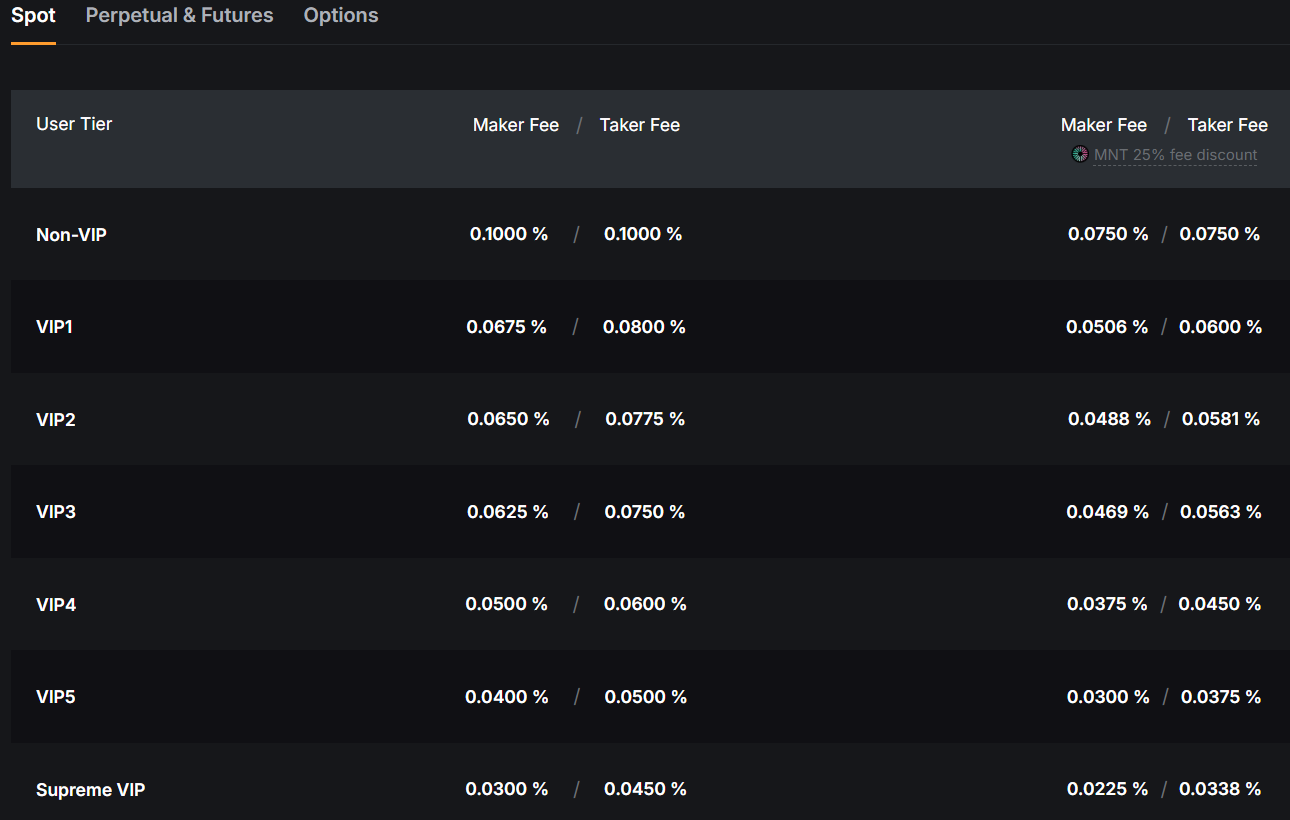
Spot Trading Fees Table – Find all exact numbers regarding the platform’s fees here.
Trading Fees
Bybit uses a standard maker-taker model across both spot and derivatives markets.
For spot trading, fees for non-VIP users are typically around 0.1% for both makers and takers, which is in line with or slightly better than the industry average.
In derivatives markets, where Bybit is strongest, fees are significantly lower. Non-VIP users generally pay approximately 0.01%–0.02% for makers and 0.055%–0.06% for takers, making it highly competitive for leveraged trading.
This structure strongly favors high-frequency and professional traders, particularly those placing limit orders and acting as liquidity providers.
VIP Program and Discounts
Bybit operates a tiered VIP system based on 30-day trading volume or account balance. As users move up tiers, fees decrease substantially.
At higher tiers, maker fees can drop close to zero, and taker fees are significantly reduced.
This creates a clear incentive structure:
Casual traders pay standard market rates
High-volume traders benefit from materially lower costs
In practice, this means Bybit becomes progressively more cost-efficient the more it is used.
Non-Trading Fees
Bybit’s non-trading fee structure is relatively favorable:
Crypto deposits are free
P2P trading carries zero platform fees
Withdrawal fees are network-based, varying by asset and blockchain
Fiat transactions may include third-party processing fees depending on the payment method
There are also additional costs to consider in derivatives trading, such as funding rates, which are not fixed fees but can impact profitability depending on market conditions.
Hidden Costs and Considerations
While headline fees are low, actual trading costs can vary due to:
Funding rates in perpetual futures
Slippage in lower-liquidity markets
Spread differences during volatile conditions
These factors are not unique to Bybit but are especially relevant for leveraged traders, where small cost differences can compound quickly.
Value for Money
From a cost perspective, Bybit offers strong value, particularly for:
Active traders
Derivatives users
High-volume participants benefiting from VIP discounts
For casual or beginner traders, the advantage is less pronounced, as the standard fee level is competitive but not uniquely low compared to the broader market.
The Block Note's Score
Aggregated Score
23
19
13
13
8
6
4
Total Score
Who is Bybit Best for
1. Active and High-Frequency Traders
Bybit is best suited for traders who execute frequent trades and rely on fast execution. The platform’s high liquidity, tight spreads, and efficient matching engine make it particularly effective for strategies that depend on speed and precision.
This includes:
Day traders
Scalpers
High-frequency traders
For these users, Bybit offers a trading environment optimized for performance rather than simplicity.
2. Derivatives and Leverage Traders
Bybit’s core strength lies in derivatives trading. It is especially well suited for users trading perpetual futures, options, and leveraged positions.
The platform provides:
Advanced order types
High leverage options
Deep derivatives liquidity
This makes it ideal for traders running complex strategies such as hedging, arbitrage, or short-term speculation.
3. Intermediate to Advanced Users
Bybit is not designed as a beginner-first platform. Its interface, product range, and risk exposure assume a working knowledge of trading concepts.
It is best for:
Users transitioning from basic exchanges
Traders familiar with margin and leverage
Users comfortable managing risk independently
While beginners can use the platform, the learning curve is noticeably steeper compared to simpler exchanges.
4. Crypto-Native Users
Bybit is particularly suitable for users who operate primarily within the crypto ecosystem rather than relying on traditional banking rails.
It works well for:
Users funding accounts with crypto or stablecoins
Traders moving assets between exchanges
Participants in DeFi or multi-platform strategies
Fiat support exists but is often dependent on third-party providers and varies by region.
5. Copy Trading and Strategy Followers
Bybit has built a strong ecosystem around copy trading and automated strategies. This makes it appealing to users who want exposure to trading without fully managing positions themselves.
It is a good fit for:
Passive traders following experienced traders
Users experimenting with trading bots
Strategy-driven investors
Final Verdict
Bybit
86
Bybit is a fast-growing crypto exchange known for its powerful derivatives platform, deep liquidity, and trader-focused tools.
Type
Spot + Perps
Trading Pairs
2,000+
Leverage
Up to 100x
Signup Offer
Up to 5,100 USDT
Pros and Cons
Low and Competitive Fees
Strong Derivatives & Liquidity
Advanced Features & Tools
Proof of Reserves & Transparency Efforts
Cons
Not Available in Some Major Countries
Complex for Beginners
Security & Incident History
High Risk from Leverage Trading

Frequently Asked Questions
What is a centralized crypto exchange (CEX)?
A CEX is a platform that facilitates buying, selling, and trading cryptocurrencies through a company that holds custody of your funds.
How do I create an account on a centralized exchange?
Most exchanges require email verification, identity checks (KYC), and sometimes phone verification. Once verified, you can deposit funds and start trading.
What happens if the exchange gets hacked?
Your funds could be at risk, though some platforms offer insurance or compensation. Always follow best practices and avoid leaving large balances on a CEX.
Can I trade on mobile?
Most exchanges offer mobile apps with full functionality for trading, portfolio tracking, and security management.
How is security measured for these exchanges?
Security includes platform safeguards, regulatory compliance, insurance coverage, and past incidents. Exchanges with strong security practices and transparency score higher.
Why aren’t fees the main scoring factor?
Fees are important, but we weigh them alongside usability, liquidity, support, and asset variety. A low-fee platform with poor security or unreliable support will score lower.
Can an exchange’s score change over time?
Yes. Scores are updated based on security updates, liquidity changes, new features, or regulatory developments.
Do you receive compensation for higher scores?
No. Scores are independent of partnerships or affiliate relationships.
More Reviews
Binance – CEX Review
Binance leads centralized crypto exchanges with high liquidity, low fees, and vast token support; setting the benchmark for speed, security, and global access.
Read More
Coinbase – CEX Review
Coinbase is a beginner-friendly centralized exchange known for its simplicity, compliance, and secure platform; making crypto accessible to millions worldwide.
Read More
Crypto.com – CEX Review
Crypto.com is a centralized exchange blending trading, DeFi, and crypto rewards, offering a secure platform with user-friendly tools for all experience levels.
Read More
Kraken – CEX Review
Kraken stands out among centralized exchanges for its strong security, regulatory focus, and advanced trading tools trusted by professionals worldwide.
Read More