
Disclosure: This post may contain affiliate links. If you sign up or make a purchase through our links, we may earn a commission at no extra cost to you. We only recommend products and services we believe add value.
Best for Derivatives
Kraken
88
Kraken is a trusted, security-focused crypto exchange offering regulated spot and derivatives trading with advanced tools for both beginners and pros.
Type
Spot + Perps
Trading Pairs
1,000+
Leverage
Up to 50x
Signup Offer
€50
Pros and Cons
Strong security and transparency
Competitive and transparent fees
Large range of cryptocurrencies
Advanced trading features and tools
Cons
Higher fees for instant purchases
Limited availability and regional restrictions
Withdrawal fees and minimums can be high
Interface and product structure can be confusing

Overview
Kraken is a well-established cryptocurrency exchange known for its emphasis on security, regulatory compliance, and transparency. Founded in 2011, it is one of the longest-operating digital asset exchanges in the industry and has built a reputation as a reliable platform for both retail and institutional users. Kraken serves customers across numerous countries and is frequently cited for its conservative operational approach compared to many newer competitors.
The platform offers spot trading for a wide range of cryptocurrencies, as well as margin trading and derivatives products such as futures. Kraken also provides staking services for select assets, custodial solutions for institutions, and over-the-counter (OTC) trading for high-volume clients. While its asset selection and product breadth are generally narrower than some larger global exchanges, Kraken prioritizes liquidity quality, system stability, and risk controls.
A core differentiator for Kraken is its focus on compliance and security. The exchange has historically maintained strong relationships with regulators and financial institutions, publishes regular proof-of-reserves attestations, and emphasizes user protections such as robust custody practices and account-level security features. This has made Kraken particularly attractive to users who value regulatory clarity and operational trust over rapid feature expansion.
Overall, Kraken positions itself as a security-first, professionally oriented exchange. It is often favored by long-term investors, institutions, and users operating in regulated markets, even if it may feel less feature-dense or beginner-friendly than some high-growth competitors. Its longevity and conservative posture make it a notable counterpoint to more aggressive, ecosystem-driven crypto platforms.
Pros and Cons
Strong security and transparency
Kraken is widely regarded as a security-focused exchange, with cold storage and regular proof-of-reserves audits.
Competitive and transparent fees
The platform offers relatively low and clearly displayed fees, particularly for users trading on Kraken Pro.
Large range of cryptocurrencies
Kraken supports 400–550+ crypto assets and many trading pairs, giving users strong portfolio diversification options.
Advanced trading features and tools
It provides margin trading, futures, staking, and API access, making it suitable for both intermediate and advanced traders.
Cons
Higher fees for instant purchases
Using the simplified “Instant Buy” feature can involve higher spreads and fees compared to the pro trading interface.
Limited availability and regional restrictions
Kraken is not available in all regions (e.g., some U.S. states) and certain features depend on location.
Withdrawal fees and minimums can be high
Some assets (e.g., BTC) have relatively high withdrawal fees or minimum thresholds, especially for small transactions.
Interface and product structure can be confusing
The split between Kraken, Kraken Pro, and regional features can make the platform less intuitive for beginners.
Scoring System
Each centralized crypto exchange is evaluated on a 100-point scale using a weighted framework that reflects real-world usability, security, and service reliability. Scores are based on the following categories:
- Security & Compliance (25 points) – Measures platform security practices, regulatory compliance, insurance coverage, history of breaches, and adherence to KYC/AML standards.
- Liquidity & Market Depth (20 points) – Evaluates trading volume, order book depth, slippage, and the ability to execute large trades efficiently across spot and derivatives markets.
- Asset Support & Listings (15 points) – Considers the range of supported cryptocurrencies and tokens, fiat gateways, and access to niche or newly listed assets.
- Trading Features & Tools (15 points) – Assesses the quality of spot, margin, and derivatives trading, staking, lending, advanced charting, and order types.
- User Experience & Interface (10 points) – Reviews onboarding, platform navigation, mobile and desktop app usability, and overall ease of use.
- Customer Support & Reliability (10 points) – Evaluates responsiveness, support channels, dispute resolution, and platform uptime/stability.
- Fees & Value for Money (5 points) – Examines trading fees, withdrawal costs, and competitive pricing relative to available features and services.
Each category contributes a defined portion of the total score. Higher-scoring exchanges demonstrate a strong balance of security, liquidity, usability, and trading features; not just flashy interfaces or a large coin list.
Security and Compliance
24
Security Measures
Kraken is widely regarded as one of the most security-focused centralized exchanges, with a strong emphasis on both technical safeguards and transparency.
A key feature of Kraken’s security model is its Proof of Reserves (PoR) system, which involves independent third-party audits verifying that customer assets are fully backed. These audits use cryptographic methods (such as Merkle trees) and allow users to independently verify that their balances are included, providing a higher level of transparency than simple self-reported reserves.
In addition to transparency, Kraken employs advanced custody practices, including cold storage for the majority of funds and secure hot wallet infrastructure for operational liquidity.
At the account level, Kraken offers robust security controls, including:
Advanced two-factor authentication (including hardware/FIDO2 support)
Withdrawal confirmations and address whitelisting
Granular API key permissions
Continuous monitoring for suspicious activity
These measures significantly reduce risks such as unauthorized access and phishing attacks.
Kraken also meets high international security standards, holding certifications such as ISO/IEC 27001:2022 and completing SOC 2 examinations, demonstrating strong information security practices.
Notably, Kraken is often highlighted for having no major exchange hacks resulting in loss of user funds, reinforcing its reputation for strong operational security.
Transparency and Proof of Reserves
Kraken is considered an industry leader in proof-of-reserves transparency, having pioneered regular PoR audits earlier than many competitors. These audits are conducted semi-annually by independent accounting firms and aim to verify both:
Customer assets held by the exchange
Customer liabilities (account balances)
This dual verification provides a more complete picture of solvency compared to exchanges that only show assets.
Recent reports indicate that Kraken has maintained reserve ratios above 100% for major assets, meaning it holds more assets than required to cover user balances.
However, it is important to note that proof-of-reserves audits are not full financial audits and only represent a snapshot in time rather than continuous verification of the exchange’s financial health.
Compliance and Regulation
Kraken operates under a strict compliance framework, with strong implementation of Know Your Customer (KYC) and Anti-Money Laundering (AML) procedures.
All users are required to complete identity verification during onboarding, which helps:
Prevent fraud and financial crime
Protect user accounts
Ensure compliance with global regulations
Kraken also periodically requires users to update their verification information, reflecting ongoing regulatory obligations and compliance monitoring.
Because cryptocurrency regulations vary by country, Kraken must adapt its services to different jurisdictions, meaning certain features may be restricted depending on location. This reflects the broader regulatory challenges faced by global exchanges.
Limitations and Considerations
Despite its strong security posture, there are some limitations:
Funds are not insured like traditional bank deposits (e.g., no FDIC/SIPC coverage for crypto balances), meaning users still bear custodial risk.
Not all security features are enabled by default, so users must actively configure stronger protections.
Proof-of-reserves improves transparency but does not replace full financial audits or eliminate all risks.
Liquidity & Market Depth
19
Market Liquidity
Kraken is generally considered a high-quality liquidity exchange, particularly for major cryptocurrencies such as Bitcoin and Ethereum. The platform consistently ranks among exchanges with strong “real” liquidity, meaning genuine order flow rather than inflated trading volume.
Kraken’s liquidity is supported by:
A large global user base
Active institutional participation
Market maker incentive programs
The exchange also emphasizes tight bid–ask spreads, in some cases as low as a single pip, allowing traders to execute orders close to the desired market price.
This makes Kraken particularly reliable for efficient execution on major trading pairs, even during volatile market conditions.
Order Book Depth
Market depth on Kraken is generally strong for major assets, with deep order books that can absorb relatively large trades without causing significant price movement. This results in:
Low slippage on BTC and ETH trades
Consistent order execution
Stable pricing near the market midpoint
Kraken’s infrastructure is designed to encourage order book stability and depth, using market-maker incentives and fee structures that promote liquidity provision.
However, depth can vary depending on the asset:
High depth: Major pairs (BTC/USD, ETH/USD, EUR pairs)
Moderate to lower depth: Smaller altcoins or less frequently traded pairs
Liquidity Quality vs Volume
A key strength of Kraken is its focus on liquidity quality rather than raw volume.
Unlike some exchanges, Kraken explicitly aims to avoid artificial volume inflation (e.g., wash trading). This means:
Reported liquidity is generally more trustworthy and transparent
Traders can expect real execution quality, not just high headline volume
Kraken itself highlights that metrics such as spread, depth, and order book stability are more meaningful indicators of liquidity than volume alone.
Market Position and Limitations
While Kraken offers strong liquidity overall, it is not the absolute market leader in depth across all assets. Larger exchanges (such as Binance) typically provide deeper liquidity globally, especially for:
High-frequency trading
Large institutional-sized orders
Some independent analyses show that Kraken’s liquidity can be more moderate on certain assets or tight price ranges, particularly compared to the very largest exchanges.
Asset Support & Listings
13
Range of Supported Assets
Kraken offers a broad but more curated selection of cryptocurrencies compared to some larger exchanges. The platform supports approximately 400–500+ digital assets, including major cryptocurrencies, stablecoins, and a wide range of altcoins across sectors such as DeFi, Layer 1/Layer 2 networks, and infrastructure tokens.
This asset range includes:
Major assets (e.g., Bitcoin, Ethereum, Solana)
Stablecoins (USDT, USDC, DAI) across multiple networks
Mid-cap and emerging projects, often listed earlier than on more conservative platforms like Coinbase
Kraken also supports multiple fiat trading pairs (USD, EUR, GBP, etc.), which strengthens its role as a fiat gateway for cryptocurrency trading.
Additionally, the platform allows deposits and withdrawals across multiple blockchain networks for certain assets, providing flexibility in transaction fees and transfer speeds.
Listing Philosophy and Approach
Kraken follows a more conservative and compliance-focused listing strategy compared to high-volume exchanges. Rather than rapidly listing large numbers of tokens, it prioritizes:
Regulatory compliance
Security and technical robustness
Sustainable liquidity and market quality
This results in a smaller but more vetted asset selection, which may appeal to users who prioritize reliability over sheer variety.
Listing Process
Kraken uses a structured and transparent multi-step listing process, which includes:
Application submission by the project team
Evaluation of the asset’s fundamentals (liquidity, tokenomics, market fit, security)
Legal and compliance approval
Technical integration and testing
Final launch and monitoring
Key evaluation criteria include:
Market capitalization and liquidity potential
Security and technical design
Regulatory compliance in relevant jurisdictions
Team credibility and community engagement
Importantly, Kraken does not charge listing fees, which distinguishes it from some competitors and reinforces its emphasis on merit-based listings.
Listing Transparency & Roadmap
Kraken provides a public listings roadmap, where users can view assets that have passed initial approval and are being prepared for launch. However, inclusion on this roadmap does not guarantee listing, as final approval depends on ongoing checks and conditions.
New listings are typically announced through official channels, ensuring users are informed before trading becomes available.
Delisting Policy
Kraken maintains a structured and transparent delisting process. When an asset is scheduled for removal, the exchange usually provides a step-by-step timeline, including:
Suspension of trading
Closure of deposits
Continued withdrawal window
Final removal or liquidation
This phased approach gives users time to manage their positions before full delisting occurs.
Assets may be delisted due to:
Low liquidity or trading activity
Technical or security concerns
Regulatory issues
Trading Features & Tools
13
Kraken provides a robust and professional-grade trading environment, with a strong focus on execution quality, advanced tools, and API-driven functionality. Below are the key trading features, structured into eight main categories plus additional tools.
Spot Trading & Order Types
Kraken supports spot trading across numerous crypto and fiat pairs, with a strong emphasis on transparency and execution quality.
It offers a range of order types, including:
Market and limit orders
Stop-loss and take-profit
Stop-limit orders
These tools allow traders to manage entries, exits, and risk efficiently.
Derivatives & Futures
Kraken offers a dedicated derivatives platform with:
Perpetual futures contracts
Multi-collateral support
Long and short positions
These tools are integrated into Kraken Pro, allowing users to manage spot and derivatives positions together.
Margin & Leverage Trading
Kraken provides margin trading with leverage, allowing users to borrow funds and increase exposure.
Key features include:
Cross margin system
Real-time margin monitoring
Liquidation and risk controls
This enables more advanced strategies such as short selling and hedging.
Staking & Earn Integration
Kraken integrates staking directly into the platform, allowing users to:
Stake supported assets
Earn passive rewards
Manage staking alongside trading
This supports both active and passive investment strategies.
API & Algorithmic Trading
Kraken is particularly strong in API trading capabilities, offering:
REST API (trading and account management)
WebSocket API (real-time data)
FIX API (institutional trading)
These allow developers and professionals to build custom trading systems and automated strategies.
Advanced Charting & Analytics
Through Kraken Pro, users gain access to:
Advanced charting tools
Technical indicators and drawing tools
Real-time order books and trade data
The interface is highly customizable, enabling traders to create personalized dashboards.
OTC Trading & Institutional Services
Kraken offers Over-The-Counter (OTC) trading for large transactions, providing:
Deep liquidity
Reduced slippage
Personalized execution
Institutional users also benefit from advanced infrastructure and dedicated services.
Trading Bots & Automation
Kraken supports trading bots and automated strategies, primarily through API and third-party integrations.
Supported automation includes:
Grid trading bots
DCA (Dollar-Cost Averaging) bots
Algorithmic trading systems
Users can execute strategies 24/7 without manual intervention, although most bots are not natively built into the platform.
Additional Tools & Ecosystem Features
Kraken includes several additional tools to enhance the trading experience:
Portfolio tracking and performance analytics
Price alerts and notifications
Subaccounts for strategy management
Fiat on/off ramps (bank transfers)
Cross-platform access (web, mobile, desktop)
User Experience & Interface
8
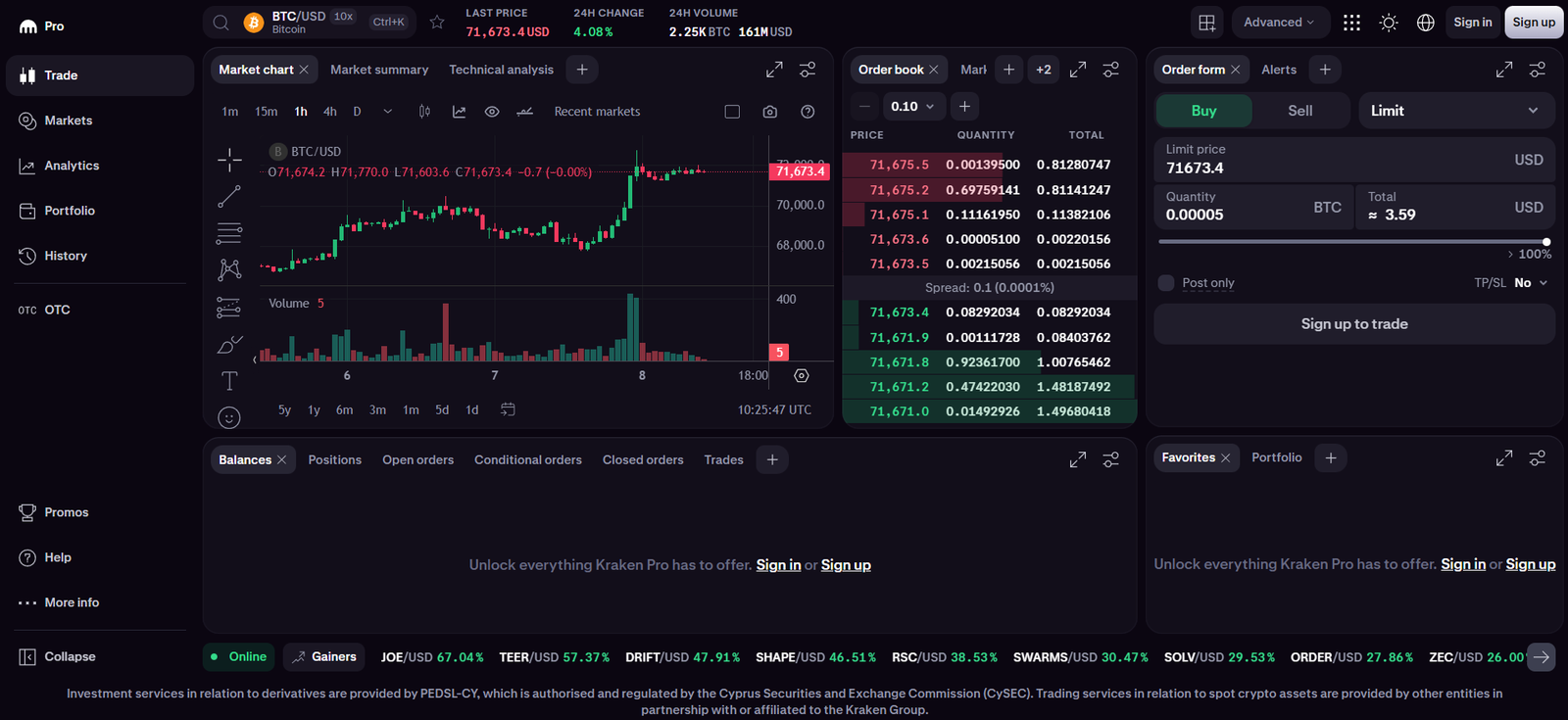
Platform Structure and Accessibility
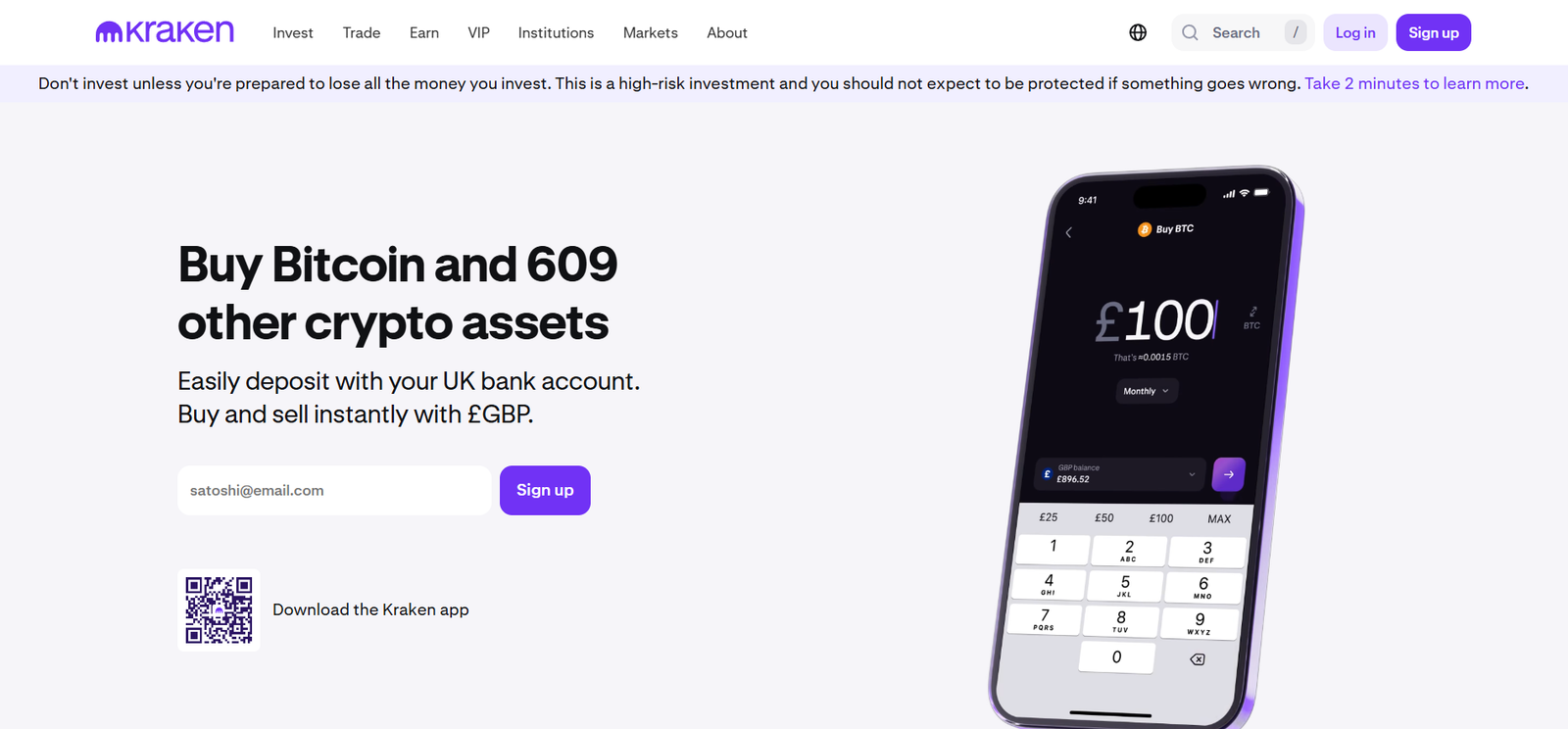
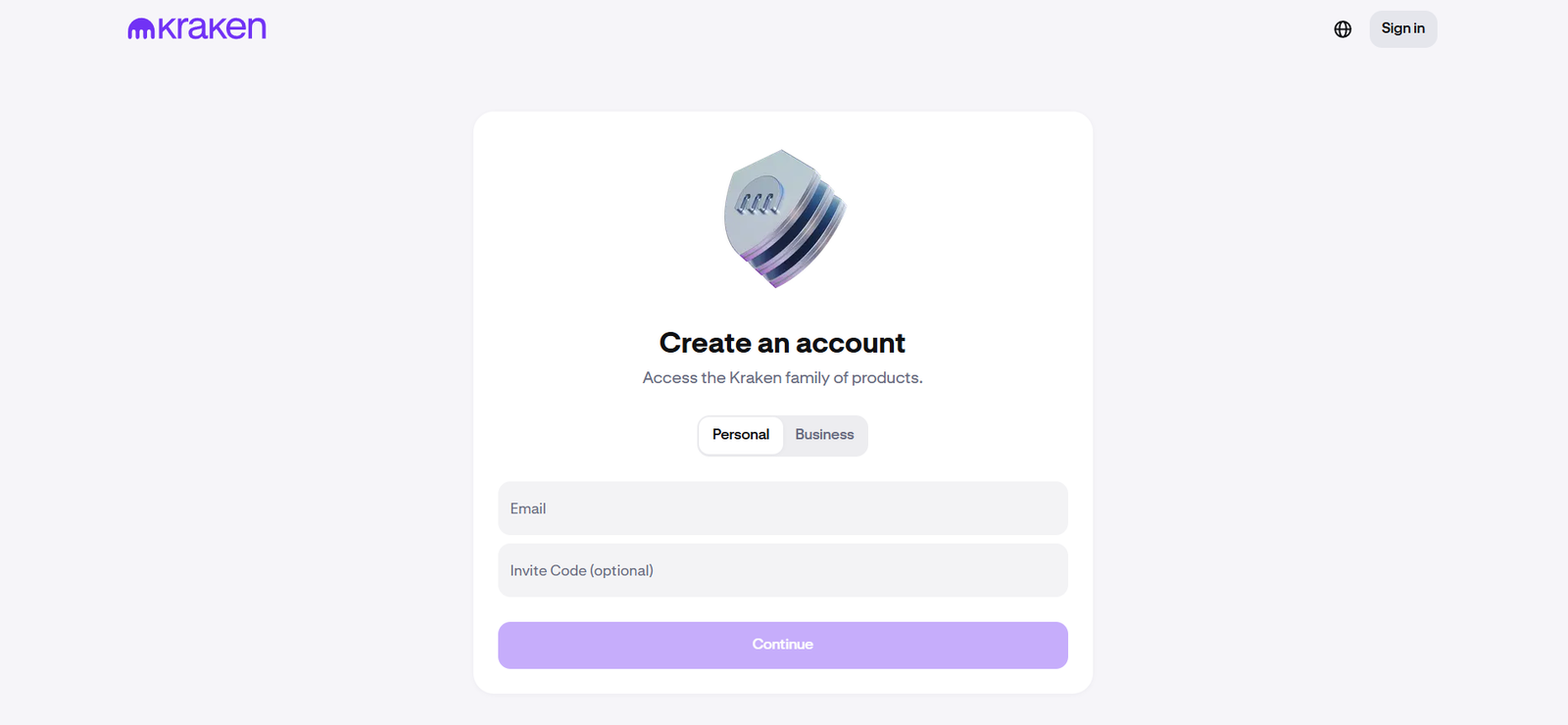
Kraken offers a dual-interface system, designed to cater to different user experience levels:
Kraken (standard app/interface) for beginners
Kraken Pro for advanced traders
The standard platform provides a simplified and intuitive experience, particularly on mobile, making it easier for beginners to buy, sell, and manage assets. In contrast, Kraken Pro is built for more experienced users, offering a professional-grade trading environment with significantly more tools and customization options.
Both interfaces are available across web, mobile, and desktop applications, ensuring a consistent experience across devices.
Interface Design and Customization
Kraken Pro features a highly customizable interface, allowing users to tailor their trading environment to their preferences. Traders can:
Choose from multiple layouts
Add, remove, and rearrange widgets
Create and save personalized dashboards
The interface includes over 25+ widgets and data modules, such as order books, charts, trade history, and portfolio tracking.
This flexibility allows users to build anything from a minimalist layout to a full trading desk setup, depending on their needs.
Trading Interface and Tools Integration
The trading interface is designed to provide all key information in one place, including:
Real-time market data and price charts
Order books and recent trades
Portfolio balances and P&L
Order management panels
Kraken Pro integrates TradingView-style charting tools, offering technical indicators, drawing tools, and multiple timeframes. It also supports advanced order types directly within the interface, allowing traders to execute strategies without leaving the main dashboard.
Additionally, features such as drag-and-drop order adjustment, alerts, and live updates improve usability for active traders.
User Experience Strengths
Kraken’s UX is particularly strong in the following areas:
Customizability: Users can fully tailor their interface to match their trading style.
Professional-grade tools: Advanced charting, analytics, and order management are integrated seamlessly.
Cross-platform consistency: Similar functionality across web, desktop, and mobile apps.
Clear separation of user levels: Beginners can use a simplified interface, while professionals access Kraken Pro.
Overall, Kraken Pro is often described as a “trading desk-like environment”, offering deep control and data visibility for experienced users.
Usability Challenges
Despite its strengths, Kraken’s interface presents some challenges:
Steep learning curve: The Pro interface can be overwhelming for beginners due to the large amount of data and tools.
Fragmented experience: The separation between standard Kraken and Kraken Pro can cause confusion about which platform to use.
Navigation complexity: Some users report difficulty locating certain features or data after interface updates.
Additionally, while customization is powerful, it can also introduce complexity and inefficiency if not configured properly, especially for less experienced users.
Customer Support & Reliability
7
Customer Support Structure
Kraken provides 24/7 customer support through multiple channels, including:
Live chat
Email ticketing
Help center and knowledge base
The platform uses a tiered support system, where simple issues are initially handled by automated chatbots and FAQs, while more complex cases are escalated to human agents.
In many cases, basic queries are resolved quickly, often within hours or within a 24-hour window. However, response quality can vary depending on the complexity of the issue and current demand on support services.
Reliability and Platform Stability
Kraken has built a strong reputation for platform reliability and operational stability. The exchange is known for:
Consistent uptime, even during periods of high market volatility
Stable trade execution and infrastructure
Relatively few major outages compared to competitors
Reviews indicate that Kraken has experienced minimal downtime historically, with most disruptions being rare and typically communicated clearly to users.
This reliability makes it a dependable platform for traders who require continuous market access and stable performance, including during high-volume trading events.
User Feedback and Support Limitations
Despite its strong infrastructure, customer support is often cited as a mixed or inconsistent area.
Commonly reported issues include:
Slow response times for complex cases
Delays in resolving account verification or withdrawal issues
Reliance on automated responses before reaching human agents
User reviews highlight that while some experiences are positive, others report long waiting times and unresolved tickets, especially during high-demand periods.
At the same time, other users report smooth experiences with responsive support and efficient issue resolution, indicating that service quality can vary significantly.
Fees & Value for Money
4
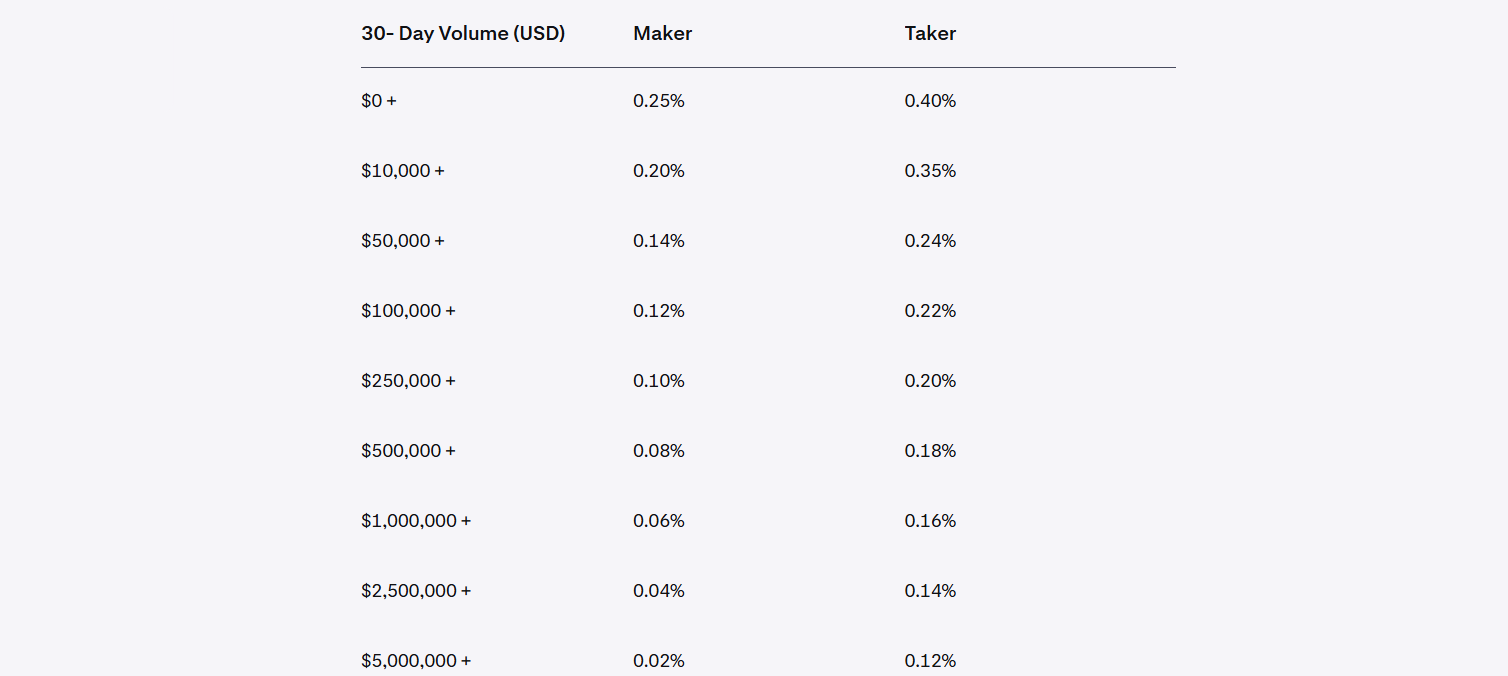
Spot Trading Fees Table – Find all exact numbers regarding the platform’s fees here.
Fee Structure
Kraken uses a dual fee system, depending on whether users trade on the standard platform or on Kraken Pro.
On the standard Kraken interface, fees are simple but higher, typically around a flat ~1% fee plus spread for instant buy/sell transactions.
On Kraken Pro, fees follow a maker–taker model, starting around:
0.25% (maker)
0.40% (taker) for low-volume traders
These fees decrease significantly with higher 30-day trading volume, reaching near 0% maker fees and ~0.08% taker fees at top tiers.
Overall, this structure makes Kraken:
Simple but expensive for beginners
Competitive and cost-efficient for active traders
Discounts and Pricing Tiers
Kraken Pro’s volume-based fee system rewards users who trade more frequently. Fees are dynamically adjusted based on:
30-day trading volume
Order type (maker vs taker)
Trading pair
In some cases, maker fees can even become negative (rebates) for high-volume traders, effectively rewarding liquidity provision.
Additionally, Kraken offers Kraken+, a subscription model that provides:
Zero-fee trading (up to a monthly limit) on simple buy/sell features
Continued spreads and payment fees still apply
Non-Trading Fees
Beyond trading fees, Kraken includes several additional costs:
Crypto deposits: Generally free
Withdrawals: Network-based fees (can be relatively high for some assets like BTC)
Fiat deposits/withdrawals: Fees depend on payment provider
Instant buy fees: Include spreads and processing charges, often making them significantly more expensive
Margin trading: Includes opening and rollover fees for leveraged positions
These extra costs mean that total expenses can vary significantly depending on how the platform is used.
Value Relative to Alternatives
Kraken offers strong value for money but only if used correctly.
High value:
Active traders using Kraken Pro
Users placing limit orders (maker fees)
High-volume traders benefiting from tier discounts
Lower value:
Beginners using instant buy/sell
Users relying on card purchases or small transactions
Compared to competitors, Kraken is often considered:
More transparent than many exchanges
Less cost-efficient than low-fee leaders (e.g. Binance)
More expensive for casual users, but competitive for professionals
The Block Note's Score
Aggregated Score
24
19
13
13
8
7
4
Total Score
Who is Kraken Best for
Best for Derivatives
1. Security-Focused Users and Long-Term Investors
Kraken is particularly well-suited for users who prioritize security, transparency, and regulatory compliance. Its strong reputation, proof-of-reserves audits, and conservative approach make it attractive to long-term investors and risk-averse users who prefer stability over aggressive trading features.
2. Active Traders Using Kraken Pro
Kraken is a strong choice for active spot traders and intermediate users, especially those willing to use Kraken Pro. These users benefit from:
Lower maker–taker fees
Advanced order types
Access to margin, futures, and API trading
This makes Kraken particularly suitable for semi-advanced and professional traders who want a more traditional trading environment with reliable execution.
3. Users Transitioning from Beginner to Advanced
Unlike some exchanges that target only one level of user, Kraken works well for those who are willing to learn and grow within the platform. Beginners can start with the simple interface and gradually move to Kraken Pro as they gain experience.
This makes it ideal for users who want a long-term platform with an upgrade path, rather than switching exchanges as they become more experienced.
4. Users Needing Fiat Integration and Bank Transfers
Kraken is also a good fit for users who rely on bank transfers and fiat on/off ramps, particularly in regions like the U.S. and Europe. It offers reliable fiat infrastructure, making it easier to move between traditional finance and crypto markets.
5. Less Suitable for Certain Users
Kraken may be less suitable for:
Beginners seeking a very simple, app-only experience
Speculative traders chasing small or newly listed altcoins
Users focused on high-leverage or aggressive derivatives trading
Those prioritizing the cheapest instant buy options
Final Verdict
Best for Derivatives
Kraken
88
Kraken is a trusted, security-focused crypto exchange offering regulated spot and derivatives trading with advanced tools for both beginners and pros.
Type
Spot + Perps
Trading Pairs
1,000+
Leverage
Up to 50x
Signup Offer
€50
Pros and Cons
Strong security and transparency
Competitive and transparent fees
Large range of cryptocurrencies
Advanced trading features and tools
Cons
Higher fees for instant purchases
Limited availability and regional restrictions
Withdrawal fees and minimums can be high
Interface and product structure can be confusing
Kraken Team

David Ripley
Co-CEO and Executive Leader at Kraken
Read MoreFrequently Asked Questions
What is a centralized crypto exchange (CEX)?
A CEX is a platform that facilitates buying, selling, and trading cryptocurrencies through a company that holds custody of your funds.
How do I create an account on a centralized exchange?
Most exchanges require email verification, identity checks (KYC), and sometimes phone verification. Once verified, you can deposit funds and start trading.
What happens if the exchange gets hacked?
Your funds could be at risk, though some platforms offer insurance or compensation. Always follow best practices and avoid leaving large balances on a CEX.
Can I trade on mobile?
Most exchanges offer mobile apps with full functionality for trading, portfolio tracking, and security management.
How is security measured for these exchanges?
Security includes platform safeguards, regulatory compliance, insurance coverage, and past incidents. Exchanges with strong security practices and transparency score higher.
Why aren’t fees the main scoring factor?
Fees are important, but we weigh them alongside usability, liquidity, support, and asset variety. A low-fee platform with poor security or unreliable support will score lower.
Can an exchange’s score change over time?
Yes. Scores are updated based on security updates, liquidity changes, new features, or regulatory developments.
Do you receive compensation for higher scores?
No. Scores are independent of partnerships or affiliate relationships.
More Reviews
Binance – CEX Review
Binance leads centralized crypto exchanges with high liquidity, low fees, and vast token support; setting the benchmark for speed, security, and global access.
Read More
Coinbase – CEX Review
Coinbase is a beginner-friendly centralized exchange known for its simplicity, compliance, and secure platform; making crypto accessible to millions worldwide.
Read More
Crypto.com – CEX Review
Crypto.com is a centralized exchange blending trading, DeFi, and crypto rewards, offering a secure platform with user-friendly tools for all experience levels.
Read More
KuCoin – CEX Review
KuCoin is a centralized exchange offering a wide altcoin selection, advanced trading tools, and features like futures and staking for global users.
Read More