
Disclosure: This post may contain affiliate links. If you sign up or make a purchase through our links, we may earn a commission at no extra cost to you. We only recommend products and services we believe add value.
Best for Beginners
Coinbase
88
Coinbase is a U.S.-based crypto exchange known for its ease of use, regulatory compliance, and broad access to buying, selling, and staking digital assets.
Type
Spot + Perps
Trading Pairs
550+
Leverage
Up to 50x
Signup Offer
€150
Pros and Cons
Very beginner-friendly interface
Strong regulatory compliance and reputation
Strong security measures
Easy fiat integration
Cons
High fees compared to competitors
Limited advanced features on basic version
Customer support issues
Limited asset selection vs some exchanges

Overview
Coinbase is a leading U.S.-based cryptocurrency exchange known for its strong regulatory positioning, user-friendly design, and role as a primary on-ramp for new crypto participants. Founded in 2012, Coinbase has become one of the most recognized names in the digital asset industry and is publicly traded, which subjects it to higher disclosure and compliance standards than most competitors.
The platform offers spot trading for a curated selection of cryptocurrencies, along with staking, custodial services, and institutional-grade products through Coinbase Prime. Coinbase also provides derivatives trading in select jurisdictions and a self-custody wallet that integrates with decentralized applications. Its interface is designed to accommodate beginners, while advanced users can access more sophisticated tools through Coinbase Advanced Trade.
A key differentiator for Coinbase is its regulatory-first approach. The exchange works closely with U.S. and international regulators, prioritizes compliance, and maintains strong relationships with traditional financial institutions. This conservative posture limits the number of supported assets and features compared to offshore exchanges, but it also reduces operational and legal uncertainty for users in regulated markets.
Overall, Coinbase is best characterized as a compliance-driven, accessibility-focused exchange that bridges traditional finance and the crypto economy. It is particularly well suited for beginners, long-term investors, and institutions seeking a familiar and regulated environment, even if more active traders may find its fees higher and product range more limited than global competitors.
Pros and Cons
Very beginner-friendly interface
Coinbase is widely known for its simple and intuitive design, making it one of the easiest platforms for new users to buy and manage crypto.
Strong regulatory compliance and reputation
As a publicly listed company in the U.S., Coinbase operates under strict regulations, giving it a high level of trust and transparency.
Strong security measures
The platform uses cold storage, insurance coverage for custodial funds, and robust account protections, making it one of the safer exchanges.
Easy fiat integration
Coinbase offers seamless fiat deposits and withdrawals (bank transfers, cards, etc.), making it a convenient entry point into crypto.
Cons
High fees compared to competitors
Coinbase charges higher trading fees and spreads, especially on the standard platform.
Limited advanced features on basic version
While Coinbase Advanced exists, the main platform lacks advanced tools for experienced traders.
Customer support issues
Users often report slow response times and difficulty resolving complex issues.
Limited asset selection vs some exchanges
Coinbase lists fewer cryptocurrencies than platforms like Binance, focusing more on regulated and established assets.
Scoring System
Each centralized crypto exchange is evaluated on a 100-point scale using a weighted framework that reflects real-world usability, security, and service reliability. Scores are based on the following categories:
- Security & Compliance (25 points) – Measures platform security practices, regulatory compliance, insurance coverage, history of breaches, and adherence to KYC/AML standards.
- Liquidity & Market Depth (20 points) – Evaluates trading volume, order book depth, slippage, and the ability to execute large trades efficiently across spot and derivatives markets.
- Asset Support & Listings (15 points) – Considers the range of supported cryptocurrencies and tokens, fiat gateways, and access to niche or newly listed assets.
- Trading Features & Tools (15 points) – Assesses the quality of spot, margin, and derivatives trading, staking, lending, advanced charting, and order types.
- User Experience & Interface (10 points) – Reviews onboarding, platform navigation, mobile and desktop app usability, and overall ease of use.
- Customer Support & Reliability (10 points) – Evaluates responsiveness, support channels, dispute resolution, and platform uptime/stability.
- Fees & Value for Money (5 points) – Examines trading fees, withdrawal costs, and competitive pricing relative to available features and services.
Each category contributes a defined portion of the total score. Higher-scoring exchanges demonstrate a strong balance of security, liquidity, usability, and trading features; not just flashy interfaces or a large coin list.
Security and Compliance
25
Security Measures
Coinbase is widely regarded as one of the most secure and regulated centralized exchanges, with a strong focus on protecting user funds and accounts.
A key component of Coinbase’s security model is its custody infrastructure, where the majority of customer assets are stored in offline cold storage wallets. Only a small portion of funds is kept in hot wallets for liquidity purposes, reducing exposure to online attacks.
At the account level, Coinbase provides multiple security features, including:
Two-factor authentication (2FA)
Biometric login on mobile devices
Withdrawal confirmations and address monitoring
Real-time suspicious activity detection
These measures help protect users from unauthorized access, phishing attempts, and account takeovers.
Additionally, Coinbase maintains insurance coverage for digital assets held in hot wallets, offering some protection against losses due to security breaches. However, this insurance does not cover losses resulting from compromised user accounts.
Regulatory Compliance
Coinbase stands out for its strong regulatory compliance and legal transparency, particularly compared to many other crypto exchanges.
The company is publicly listed on the stock exchange (COIN), which requires it to:
Publish regular financial disclosures
Undergo external audits
Maintain high standards of corporate governance
Coinbase operates under multiple regulatory frameworks, especially in the United States, where it complies with:
Financial Crimes Enforcement Network (FinCEN) requirements
State-level money transmitter licenses
Anti-Money Laundering (AML) regulations
All users must complete Know Your Customer (KYC) verification, which includes identity checks and, in some cases, proof of address. This helps prevent fraud and ensures compliance with global financial regulations.
Transparency and Custodial Structure
Coinbase emphasizes transparency through its public company status and audited financial reporting, which provides users with greater visibility into its operations compared to privately held exchanges.
However, unlike some exchanges, Coinbase does not rely heavily on public proof-of-reserves systems, instead depending on traditional financial reporting and regulatory oversight to demonstrate solvency.
As a custodial platform, Coinbase holds users’ private keys on their behalf, meaning users must trust the exchange to securely manage their assets.
Limitations and Risks
Despite its strong security and compliance framework, there are still important considerations:
Custodial risk: Users do not control their private keys
Limited insurance scope: Coverage applies mainly to platform-level breaches, not user errors
Account-level risks: Phishing or weak personal security practices can still lead to loss of funds
Regulatory exposure: Changes in regulations may affect available services or asset listings
Liquidity & Market Depth
19
Market Liquidity
Coinbase is one of the largest and most established cryptocurrency exchanges, offering strong liquidity across major trading pairs, particularly in USD markets. Its large user base; comprising both retail and institutional participants; helps sustain consistent trading volume and reliable order execution.
Liquidity is especially strong for:
Bitcoin (BTC/USD)
Ethereum (ETH/USD)
Major stablecoin pairs
This makes Coinbase a key price discovery venue, particularly in U.S.-based markets, where it often serves as a benchmark for institutional trading activity.
Order Book Depth
Coinbase maintains deep order books for major assets, which allows traders to execute moderate to large trades with relatively low slippage. The exchange’s infrastructure supports:
Tight bid–ask spreads on high-volume pairs
Stable pricing near the market midpoint
Consistent execution during normal market conditions
However, compared to the very largest global exchanges, Coinbase may exhibit:
Slightly wider spreads
Less depth for very large orders, especially outside top trading pairs
This difference is more noticeable for institutional-scale trades or high-frequency strategies.
Institutional Liquidity
A key strength of Coinbase is its institutional-grade liquidity, supported by services such as:
Coinbase Prime (for institutional clients)
OTC (Over-The-Counter) trading desks
Deep USD liquidity pools
These services enable large clients to execute trades with reduced market impact, improving execution quality for high-value transactions.
Liquidity Across Assets
Liquidity on Coinbase varies depending on the asset:
High liquidity: Major cryptocurrencies and top altcoins
Moderate liquidity: Mid-cap assets
Lower liquidity: Smaller or newly listed tokens
Because Coinbase follows a more conservative listing strategy, it tends to prioritize assets with sufficient market demand and regulatory clarity, which helps maintain overall liquidity quality.
Market Stability and Reliability
Coinbase is generally considered a stable and reliable trading venue, even during periods of market stress. Its infrastructure is designed to handle high volumes, although:
Temporary slowdowns or outages have occurred during extreme volatility
Execution speeds may vary during peak demand periods
Despite this, Coinbase remains a trusted liquidity source, particularly for institutional participants and fiat-based trading.
Asset Support & Listings
12
Range of Supported Assets
Coinbase offers a moderate but carefully curated selection of cryptocurrencies, focusing on quality, regulatory compliance, and market demand rather than sheer quantity.
The platform supports 200–250+ digital assets, including:
Major cryptocurrencies (Bitcoin, Ethereum, etc.)
Leading altcoins (e.g., Solana, Cardano)
Stablecoins (USDC, USDT, DAI)
Compared to larger exchanges, Coinbase lists fewer assets, but this reflects its emphasis on regulated and established projects rather than highly speculative tokens.
Coinbase also supports multiple fiat currencies (USD, EUR, GBP, etc.), making it a strong fiat gateway for users entering the crypto market.
Listing Philosophy
Coinbase follows a highly selective and compliance-driven listing strategy. Its primary goals are to ensure that listed assets:
Meet regulatory requirements in supported jurisdictions
Demonstrate market demand and liquidity
Pass strict security and technical evaluations
This approach reduces exposure to risky or low-quality tokens, but also means Coinbase is often slower to list new or emerging projects compared to more aggressive exchanges.
Listing Process
Coinbase uses a structured and transparent asset listing framework, which typically includes:
Application and initial review
Legal and compliance assessment
Technical integration and security checks
Market evaluation (liquidity, demand, stability)
Final approval and listing announcement
The exchange evaluates factors such as:
Token utility and use case
Development team credibility
Regulatory classification (e.g., securities considerations)
Network security and decentralization
Coinbase does not publicly guarantee listings and maintains strict internal criteria, which can result in many applications being rejected.
Listing Transparency & Roadmap
Coinbase improves transparency through its “Asset Listing Roadmap”, which publicly identifies assets under consideration for future listing.
This roadmap:
Provides early visibility to users
Helps reduce information asymmetry
Does not guarantee final listing approval
Final listings are announced through official channels, often accompanied by staged rollouts (e.g., deposits first, then trading).
Delisting Policy
Coinbase maintains a structured delisting process to ensure ongoing compliance and market quality. Assets may be removed due to:
Regulatory concerns
Low liquidity or trading volume
Security or technical risks
When delisting occurs, Coinbase typically provides:
Advance notice to users
A clear timeline for trading suspension
A withdrawal window before full removal
This phased approach helps users manage their holdings before access is restricted.
Trading Features & Tools
13
Coinbase provides a well-rounded but more streamlined set of trading features, designed to balance simplicity with access to more advanced tools through Coinbase Advanced. While not as feature-heavy as some exchanges, it still offers a solid trading ecosystem.
Spot Trading & Order Types
Coinbase supports spot trading across a wide range of cryptocurrencies and fiat pairs.
On Coinbase Advanced, users have access to:
Market and limit orders
Stop-limit orders
These tools allow for basic trade execution and risk management, though the range of order types is more limited compared to some competitors.
Derivatives & Futures
Coinbase has expanded into derivatives trading, particularly through regulated products such as:
Futures contracts (in supported jurisdictions)
However, compared to exchanges like Binance or Kraken, its derivatives offering is:
More limited
Highly regulated
This aligns with Coinbase’s compliance-first approach.
Margin & Leverage Trading
Coinbase offers limited margin trading, depending on the region and regulatory environment.
Lower leverage compared to competitors
Strict risk controls and compliance requirements
This makes margin trading on Coinbase more conservative and restricted, primarily aimed at reducing risk.
Staking & Earn Features
Coinbase integrates staking and earning features, allowing users to:
Stake supported assets
Earn rewards directly within the platform
This enables users to combine trading with passive income strategies in a single environment.
API & Algorithmic Trading
Coinbase provides robust API access, including:
REST API (order execution, account data)
WebSocket API (real-time market data)
These tools allow developers and advanced traders to:
Build custom trading systems
Automate strategies
Integrate with external trading platforms
Advanced Charting & Interface
Through Coinbase Advanced, users gain access to:
Interactive charts (TradingView integration)
Technical indicators and drawing tools
Order book and trade history
While functional, the interface is simpler and less customizable than those of more advanced exchanges.
Institutional & OTC Trading
Coinbase offers institutional-grade services, including:
Coinbase Prime (for large investors)
OTC trading desks for large transactions
Deep liquidity access
These services allow institutions to execute large trades with minimal market impact.
Trading Bots & Automation
Coinbase supports trading bots and automation, primarily through external integrations:
API-based trading bots
Third-party platforms (e.g., grid bots, DCA bots)
Users can:
Automate trading strategies
Execute trades 24/7
Implement algorithmic strategies
Additional Tools & Ecosystem Features
Coinbase includes several additional tools that enhance usability:
Portfolio tracking and performance analytics
Recurring buys (DCA automation built-in)
Price alerts and notifications
Educational content and rewards (Coinbase Earn)
Fiat on/off ramps (bank transfers, cards)
Mobile and web platform integration
User Experience & Interface
9
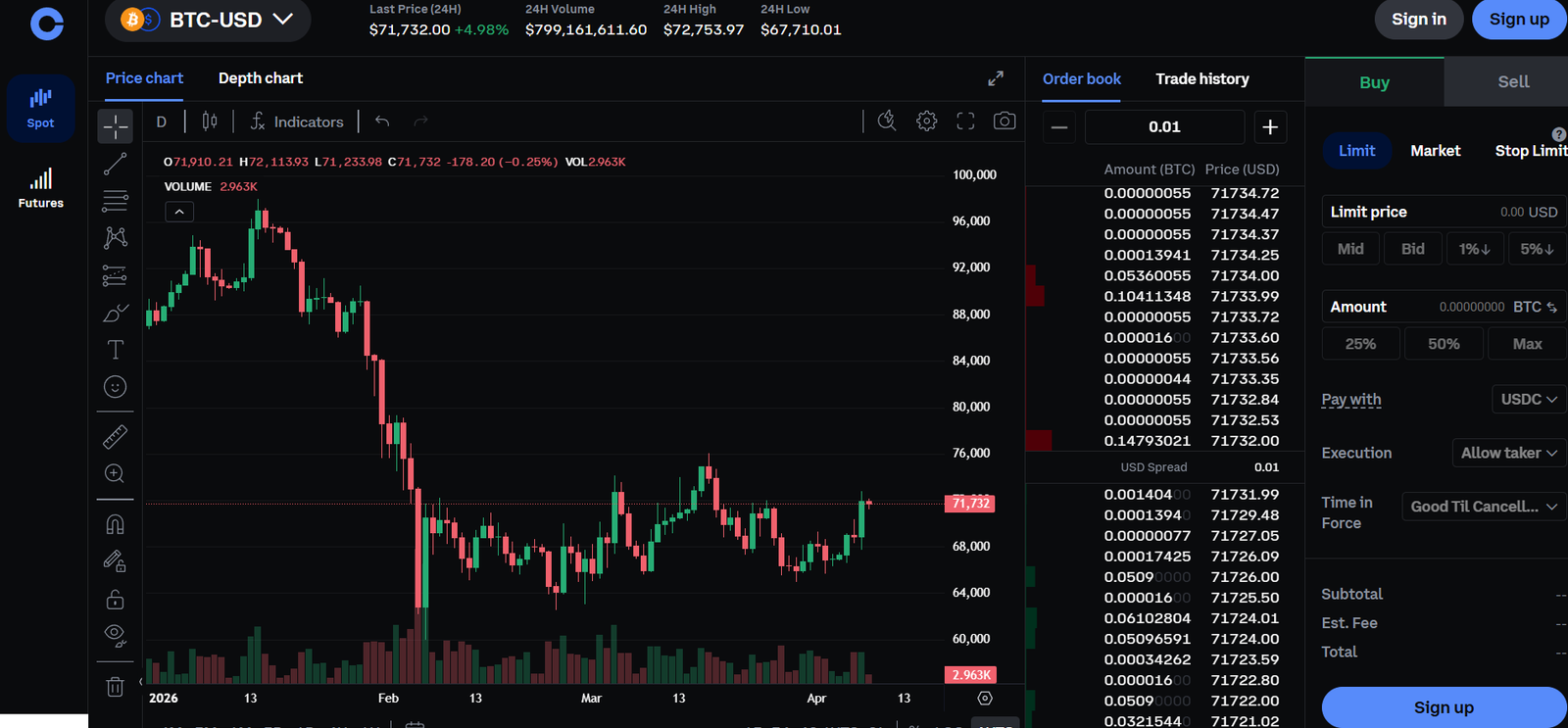
Platform Design and Accessibility
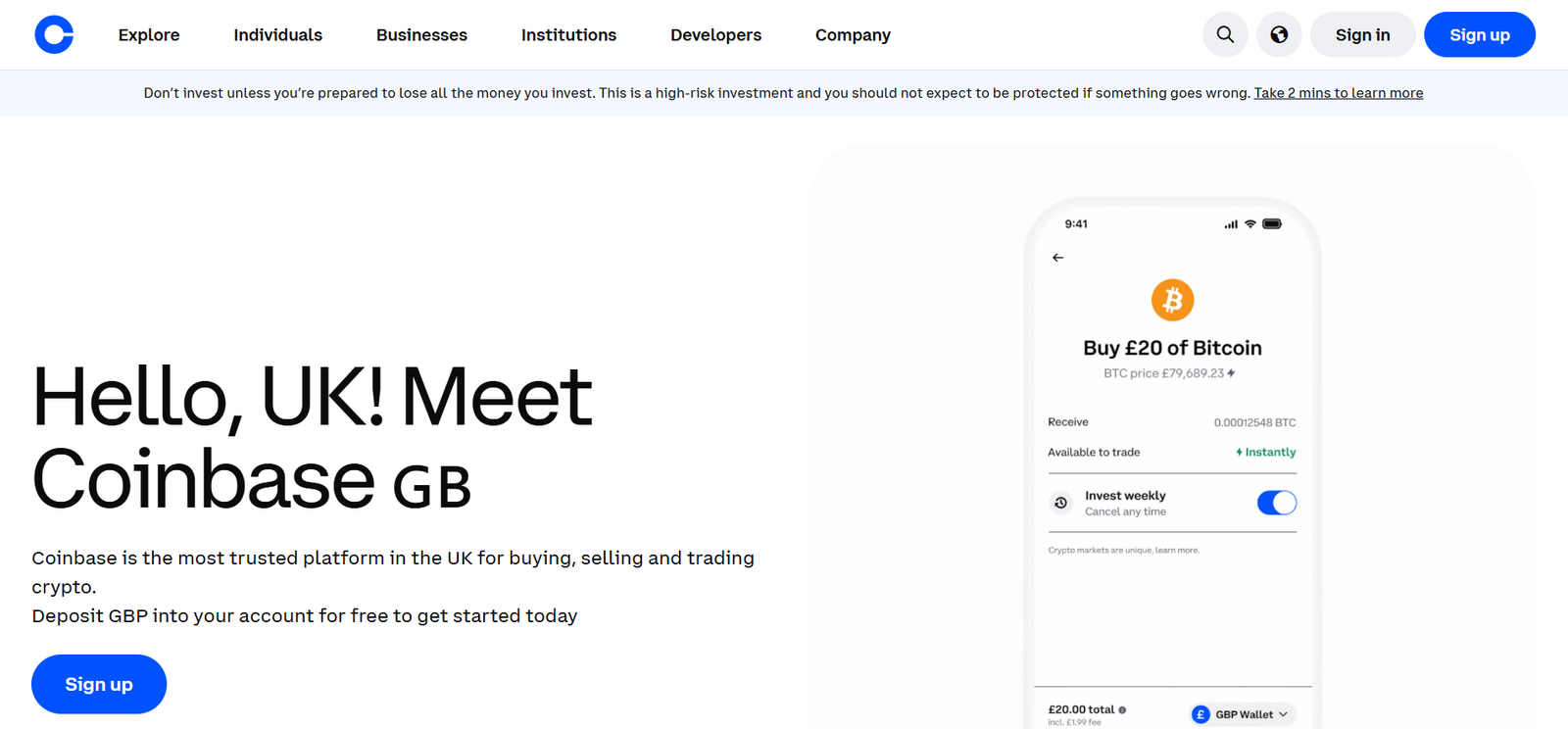
Coinbase is widely recognized for offering one of the most user-friendly interfaces in the cryptocurrency industry, making it especially accessible to beginners.
The platform is available across:
Web browser
Mobile apps (iOS and Android)
The design focuses on simplicity and clarity, allowing users to easily:
Buy and sell cryptocurrencies
View portfolio balances
Track price movements
Navigation is intuitive, with a clean layout that minimizes technical complexity, making it easy for first-time users to enter the crypto market.
Beginner vs Advanced Interface
Coinbase separates its experience into two main environments:
Coinbase (standard platform):
Simple buy/sell interface
Portfolio overview
Minimal technical tools
Coinbase Advanced:
Full trading interface with order books
Advanced charting tools
Lower fees and more control
This dual structure allows users to start simple and transition to more advanced trading as they gain experience, without needing to switch platforms entirely.
Interface Design and Usability
The Coinbase interface emphasizes ease of use over complexity, featuring:
Clear asset listings with price and percentage changes
Simple transaction flows (few steps to complete trades)
Easy-to-understand portfolio breakdowns
The platform reduces cognitive load by avoiding excessive data on the main interface, which contrasts with more complex exchanges.
However, this simplicity means that the standard interface lacks depth for advanced traders, requiring a switch to Coinbase Advanced for more functionality.
Mobile Experience
Coinbase’s mobile app is a major strength, offering:
Full account management
Real-time price tracking
Push notifications for price alerts and transactions
Biometric login for security
The mobile experience closely mirrors the web version, maintaining consistency and usability across devices.
User Experience Strengths
Key UX strengths include:
Exceptional ease of use: One of the most beginner-friendly platforms available
Clean and intuitive design: Minimal clutter and clear navigation
Seamless fiat integration: Easy deposits, withdrawals, and purchases
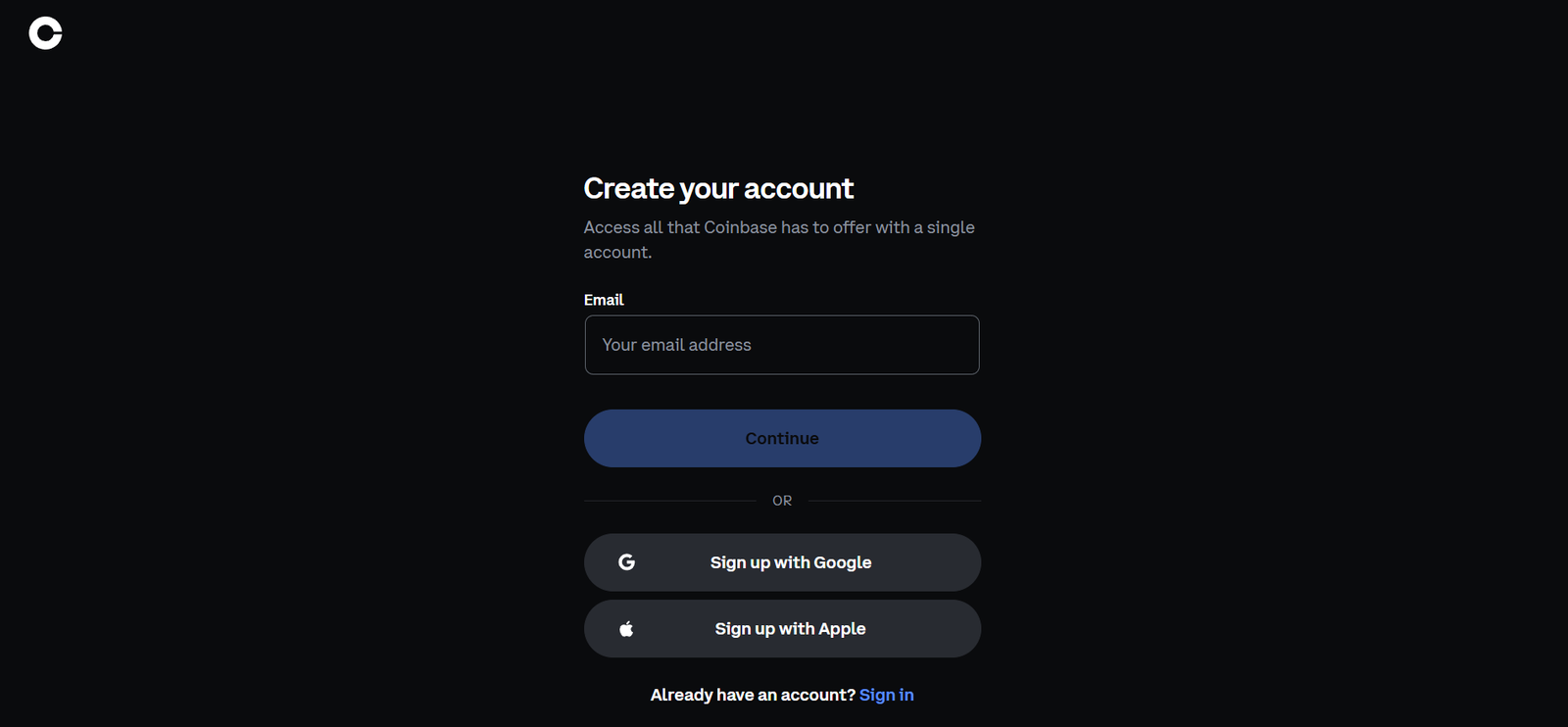
Smooth onboarding process: Guided account setup and verification
These features make Coinbase one of the most accessible entry points into cryptocurrency.
Usability Limitations
Despite its strengths, Coinbase has some limitations:
Limited functionality on the basic interface for advanced users
Dependence on Coinbase Advanced for full trading tools
Higher friction for complex tasks, such as switching between interfaces
Some users report slower performance during high market volatility
Additionally, experienced traders may find the standard interface too simplified and restrictive.
Customer Support & Reliability
7
Customer Support Structure
Coinbase provides 24/7 customer support, though the quality and responsiveness can vary depending on the issue and support channel.
Available support options include:
Help center and knowledge base
Email/ticket-based support
Live chat (for eligible users)
Phone support (primarily for account security issues such as unauthorized access)
The help center is extensive and covers most common issues, allowing users to self-resolve basic problems quickly.
Response Times and Support Quality
For simple inquiries, Coinbase support is often relatively fast and efficient, especially when using automated tools or live chat.
However, for more complex issues such as:
Account restrictions
Verification problems
Withdrawal delays
Users frequently report slower response times and longer resolution periods. In some cases, support may take several days to fully resolve an issue.
Additionally, the initial support experience often involves automated responses, which can delay access to human agents for more nuanced problems.
Reliability and Platform Stability
Coinbase is generally considered a reliable and stable exchange, with infrastructure designed to handle large trading volumes and institutional activity.
Key strengths include:
High uptime under normal market conditions
Consistent order execution for major assets
Strong backend infrastructure supporting fiat and crypto transactions
However, during periods of extreme market volatility, Coinbase has historically experienced:
Temporary outages
Slower transaction processing
Delays in order execution
These issues are not unique to Coinbase but have been noted during major market events.
User Feedback and Common Issues
User feedback on Coinbase support is mixed, with both positive and negative experiences reported.
Common concerns include:
Delayed responses for complex cases
Difficulty resolving account-related issues
Limited direct access to human support in early stages
At the same time, some users report smooth and efficient support interactions, particularly for straightforward requests or security-related concerns.
Fees & Value for Money
3
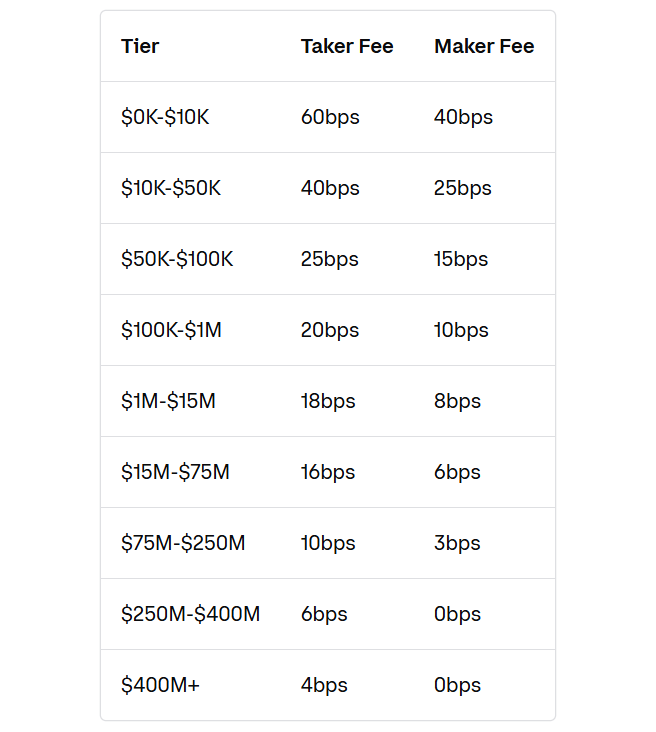
Spot Trading Fees Table – Find all exact numbers regarding the platform’s fees here.
Fee Structure
Coinbase uses a tiered fee structure, which varies depending on whether users trade on the standard platform or on Coinbase Advanced.
On the standard Coinbase platform, fees are relatively high and include:
A flat transaction fee (based on trade size)
A spread (typically ~0.5%) applied to buy/sell prices
On Coinbase Advanced, fees follow a maker–taker model, starting around:
0.40% (maker)
0.60% (taker) for lower trading volumes
Fees decrease with higher 30-day trading volume, making the platform more cost-efficient for active traders.
Pricing Transparency
Coinbase is generally considered transparent in its fee disclosures, clearly showing fees before trade confirmation. However:
The combination of fees + spread on the standard platform can make total costs less obvious
Instant purchases (e.g., card payments) often carry significantly higher effective costs
While transparent, Coinbase is often perceived as expensive, especially for casual users.
Non-Trading Fees
In addition to trading fees, Coinbase includes several other costs:
Crypto deposits: Typically free
Crypto withdrawals: Network fees apply (vary by asset)
Fiat deposits/withdrawals: Usually low-cost or free via bank transfer, but higher via cards
Conversion fees: Applied when swapping between cryptocurrencies
These additional costs can increase the overall expense depending on how the platform is used.
Value Relative to Alternatives
Coinbase offers strong value in terms of security, ease of use, and regulatory compliance, but less so in terms of pricing.
High value for:
Beginners who prioritize simplicity
Users seeking a regulated and trusted platform
Investors using fiat on/off ramps
Lower value for:
Active traders seeking the lowest fees
Users making frequent small transactions
Traders comparing costs with lower-fee exchanges (e.g., Binance, Kraken Pro)
Using Coinbase Advanced significantly improves value by reducing trading fees and increasing control.
The Block Note's Score
Aggregated Score
25
19
12
13
9
7
3
Total Score
Who is Coinbase Best for
Best for Beginners
1. Beginners and First-Time Crypto Users
Coinbase is one of the best platforms for beginners entering the cryptocurrency market. Its simple interface, guided onboarding, and easy buy/sell process make it ideal for users with little to no prior experience.
The platform minimizes complexity, allowing new users to purchase and manage crypto with minimal technical knowledge.
2. Users Prioritizing Security and Regulation
Coinbase is particularly well-suited for users who value trust, transparency, and regulatory compliance.
As a publicly traded company (COIN), it operates under strict financial regulations and provides audited disclosures. This makes it attractive to:
Risk-averse investors
Users concerned about exchange reliability
Those seeking a compliant and transparent platform
3. Long-Term Investors (“Buy and Hold”)
Coinbase is ideal for long-term investors who:
Buy crypto occasionally
Hold assets for extended periods
Do not require advanced trading tools
Its ease of use and strong security make it a convenient platform for portfolio accumulation rather than active trading.
4. Users Needing Fiat On/Off Ramps
Coinbase is a strong choice for users who need easy access to fiat deposits and withdrawals, including:
Bank transfers
Debit/credit card purchases
This makes it especially useful for users transitioning between traditional finance and crypto, particularly in regulated markets.
5. Users Transitioning to More Advanced Trading
With the availability of Coinbase Advanced, the platform also suits users who want to:
Start simple
Gradually move to more advanced trading tools
Reduce fees over time
This creates a clear progression path without needing to switch exchanges.
Final Verdict
Best for Beginners
Coinbase
88
Coinbase is a U.S.-based crypto exchange known for its ease of use, regulatory compliance, and broad access to buying, selling, and staking digital assets.
Type
Spot + Perps
Trading Pairs
550+
Leverage
Up to 50x
Signup Offer
€150
Pros and Cons
Very beginner-friendly interface
Strong regulatory compliance and reputation
Strong security measures
Easy fiat integration
Cons
High fees compared to competitors
Limited advanced features on basic version
Customer support issues
Limited asset selection vs some exchanges
Coinbase Team

Brian Armstrong
Co-Founder and CEO of Coinbase
Read MoreFrequently Asked Questions
What is a centralized crypto exchange (CEX)?
A CEX is a platform that facilitates buying, selling, and trading cryptocurrencies through a company that holds custody of your funds.
How do I create an account on a centralized exchange?
Most exchanges require email verification, identity checks (KYC), and sometimes phone verification. Once verified, you can deposit funds and start trading.
What happens if the exchange gets hacked?
Your funds could be at risk, though some platforms offer insurance or compensation. Always follow best practices and avoid leaving large balances on a CEX.
Can I trade on mobile?
Most exchanges offer mobile apps with full functionality for trading, portfolio tracking, and security management.
How is security measured for these exchanges?
Security includes platform safeguards, regulatory compliance, insurance coverage, and past incidents. Exchanges with strong security practices and transparency score higher.
Why aren’t fees the main scoring factor?
Fees are important, but we weigh them alongside usability, liquidity, support, and asset variety. A low-fee platform with poor security or unreliable support will score lower.
Can an exchange’s score change over time?
Yes. Scores are updated based on security updates, liquidity changes, new features, or regulatory developments.
Do you receive compensation for higher scores?
No. Scores are independent of partnerships or affiliate relationships.
More Reviews
Binance – CEX Review
Binance leads centralized crypto exchanges with high liquidity, low fees, and vast token support; setting the benchmark for speed, security, and global access.
Read More
Crypto.com – CEX Review
Crypto.com is a centralized exchange blending trading, DeFi, and crypto rewards, offering a secure platform with user-friendly tools for all experience levels.
Read More
Kraken – CEX Review
Kraken stands out among centralized exchanges for its strong security, regulatory focus, and advanced trading tools trusted by professionals worldwide.
Read More
KuCoin – CEX Review
KuCoin is a centralized exchange offering a wide altcoin selection, advanced trading tools, and features like futures and staking for global users.
Read More