
Disclosure: This post may contain affiliate links. If you sign up or make a purchase through our links, we may earn a commission at no extra cost to you. We only recommend products and services we believe add value.
Best Overall
Binance
91
Binance is the world’s largest crypto exchange, offering low fees, deep liquidity, and spot, margin, and futures trading for all users.
Type
Spot + Perps
Trading Pairs
1,500+
Leverage
Up to 150x
Signup Offer
100$
Pros and Cons
Low trading fees across markets
Very large selection of cryptocurrencies
High liquidity of major assets
Extensive trading and investment features
Cons
Complex interface for beginners
Higher costs for instant purchases
Limited transparency of reserves
Regulatory and regional restrictions

Overview
Binance is one of the world’s largest and most influential cryptocurrency exchanges, offering a broad ecosystem of trading, financial, and blockchain-related services. Founded in 2017, the platform has grown rapidly by combining deep liquidity, a wide range of supported digital assets, and relatively low trading fees. Binance serves millions of users globally, ranging from retail traders and long-term investors to institutional participants and developers.
At its core, Binance operates as a centralized exchange (CEX), providing spot trading, derivatives such as futures and options, margin trading, and peer-to-peer (P2P) services. Beyond trading, the platform has expanded into areas including staking, lending, launchpad token offerings, payments, and non-fungible tokens (NFTs). Binance is also closely associated with its native utility token, BNB, which is used for fee discounts, participation in ecosystem products, and governance-related functions within certain Binance services.
A defining feature of Binance is its vertically integrated ecosystem. In addition to the exchange, Binance supports blockchain infrastructure through BNB Chain, developer tools, wallets, and educational resources. This all-in-one approach has helped the platform retain users within its ecosystem, but it has also attracted increased regulatory scrutiny in multiple jurisdictions.
Overall, Binance is best characterized as a feature-rich, high-liquidity exchange with global reach and ambitious product offerings. While it appeals strongly to experienced traders seeking advanced tools and low costs, its scale, complexity, and regulatory landscape are important considerations for users evaluating its suitability for their needs.
Pros and Cons
Low trading fees across markets
0.1% base spot trading fees and 25% discount on fees by paying with BNB
Very large selection of cryptocurrencies
500+ cryptocurrencies and hundreds of trading pairs including both major coins and smaller altcoins.
High liquidity of major assets
Binance provides deep liquidity and tight spreads, which helps ensure efficient trade execution.
Extensive trading and investment features
Multiple services in one platform, including spot trading, futures, margin trading, staking, and copy trading.
Cons
Complex interface for beginners
Because Binance offers many advanced tools and services, the platform can feel overwhelming for new users.
Higher costs for instant purchases
Instant purchase options (such as card payments) may include higher spreads and fees compared to standard trading.
Limited transparency of reserves
Proof-of-reserves data does not constitute a full independent audit of liabilities.
Regulatory and regional restrictions
Restricted features depending on the user’s country due to evolving regulatory requirements.
Scoring System
Each centralized crypto exchange is evaluated on a 100-point scale using a weighted framework that reflects real-world usability, security, and service reliability. Scores are based on the following categories:
- Security & Compliance (25 points) – Measures platform security practices, regulatory compliance, insurance coverage, history of breaches, and adherence to KYC/AML standards.
- Liquidity & Market Depth (20 points) – Evaluates trading volume, order book depth, slippage, and the ability to execute large trades efficiently across spot and derivatives markets.
- Asset Support & Listings (15 points) – Considers the range of supported cryptocurrencies and tokens, fiat gateways, and access to niche or newly listed assets.
- Trading Features & Tools (15 points) – Assesses the quality of spot, margin, and derivatives trading, staking, lending, advanced charting, and order types.
- User Experience & Interface (10 points) – Reviews onboarding, platform navigation, mobile and desktop app usability, and overall ease of use.
- Customer Support & Reliability (10 points) – Evaluates responsiveness, support channels, dispute resolution, and platform uptime/stability.
- Fees & Value for Money (5 points) – Examines trading fees, withdrawal costs, and competitive pricing relative to available features and services.
Each category contributes a defined portion of the total score. Higher-scoring exchanges demonstrate a strong balance of security, liquidity, usability, and trading features; not just flashy interfaces or a large coin list.
Security and Compliance
23
Security Measures
Binance has implemented multiple security layers designed to protect user accounts and funds. One of its most important protections is the Secure Asset Fund for Users (SAFU), an emergency insurance reserve created to compensate users in the event of a major security breach. The fund is financed by allocating a portion of trading fees and acts as a safeguard against unexpected incidents.
The exchange also employs a combination of cold storage and hot wallet management to secure digital assets. Most user funds are stored in cold wallets that remain offline and isolated from internet-based attacks, while only a smaller portion is kept in hot wallets to facilitate withdrawals and trading activity.
At the user level, the platform supports several account security features, including two-factor authentication (2FA), device management, withdrawal address whitelisting, and anti-phishing codes. These tools help reduce the risk of unauthorized access to accounts. In addition, Binance monitors suspicious activity through automated systems designed to detect unusual trading patterns or login attempts.
Another recent step toward transparency is the publication of proof-of-reserves reports, which allow users to verify that the exchange holds assets corresponding to customer deposits. While this improves transparency, these reports are not the same as a full financial audit of the exchange’s liabilities.
Compliance and Regulation
As a global centralized exchange, Binance operates within a complex and evolving regulatory landscape. The platform has gradually expanded its Know Your Customer (KYC) and Anti-Money Laundering (AML) procedures to meet international compliance expectations. Most users are required to complete identity verification before accessing certain features such as higher withdrawal limits or fiat services.
Regulatory oversight varies by jurisdiction, meaning that some Binance services are restricted or modified depending on local regulations. For example, derivatives trading or certain financial products may not be available in all countries.
In recent years, the company has increased its focus on compliance by strengthening internal regulatory teams and cooperating with law enforcement agencies when necessary. However, the exchange has also faced regulatory scrutiny and enforcement actions in several jurisdictions, highlighting the challenges of operating a global cryptocurrency platform in a rapidly changing regulatory environment.
Liquidity & Market Depth
20
Liquidity and market depth are critical factors when evaluating a centralized exchange, as they determine how easily traders can execute orders without significantly affecting market prices. Binance is widely recognized as one of the most liquid cryptocurrency exchanges globally, supporting high trading volumes across both major cryptocurrencies and smaller altcoins.
Market Liquidity
One of Binance’s main advantages is its deep liquidity across major trading pairs, particularly for assets such as Bitcoin and Ethereum. High liquidity allows traders to execute orders quickly with minimal slippage, even when placing large trades. According to exchange reviews and market data, Binance maintains tight bid–ask spreads and substantial order book depth, which contributes to efficient price discovery and smooth trading activity.
Industry reports further indicate that Binance frequently ranks first in liquidity among major centralized exchanges, outperforming competitors such as Coinbase, Kraken, and OKX in overall trading depth and volume. This strong liquidity is supported by the exchange’s large global user base and high daily trading volumes.
Order Book Depth
Market depth refers to the number of buy and sell orders placed at different price levels in an exchange’s order book. Binance typically maintains deep order books for major cryptocurrencies, meaning large transactions can often be executed without causing significant price movement. For example, studies of centralized exchanges have shown that Binance accounts for around 32% of Bitcoin market liquidity, with several million dollars of buy and sell orders available within narrow price ranges.
This depth makes Binance particularly attractive to institutional investors and high-volume traders, who rely on large pools of liquidity to execute trades efficiently.
Market Influence
Because of its size and trading activity, Binance plays a major role in the overall cryptocurrency market structure. Many traders use the platform as a primary liquidity hub, meaning price movements on Binance can influence prices on other exchanges. The concentration of liquidity also encourages arbitrage activity, which helps maintain price consistency across the broader crypto market.
Limitations and Liquidity Fluctuations
Despite its generally strong liquidity, market depth on Binance can fluctuate due to external factors such as regulatory developments or major market events. For instance, liquidity for some trading pairs has temporarily declined during periods of regulatory uncertainty or major announcements, which can increase slippage for large orders.
Asset Support & Listings
14
Range of Supported Assets
Binance offers one of the broadest selections of cryptocurrencies among centralized exchanges. The platform lists more than 500 cryptocurrencies and supports hundreds of trading pairs, enabling users to access major assets, stablecoins, and a wide variety of altcoins across different blockchain sectors.
The exchange supports several base trading currencies, including stablecoins such as USDT and USDC, as well as BTC and the platform’s native token BNB. These base assets form the foundation for most spot trading pairs and allow users to trade efficiently between different cryptocurrencies.
In addition to token variety, Binance also supports multiple blockchain networks for deposits and withdrawals, such as ERC-20, TRC-20, and BEP-20. This multi-network support provides users with flexibility in transaction fees and transfer speeds depending on the blockchain used.
Listing Process
Binance has a structured listing process designed to evaluate new crypto projects before they become tradable on the exchange. According to public information about the listing framework, projects are assessed using a variety of quantitative and qualitative criteria. These include trading activity, liquidity stability, token distribution, and on-chain usage metrics. Qualitative factors may involve the credibility of the development team, regulatory considerations, and the overall value of the project within the broader ecosystem.
New tokens can reach the exchange through several mechanisms, including direct spot listings, Launchpool programs, airdrops, and other token generation events (TGEs). These mechanisms allow projects to distribute tokens to users before or during the listing process.
Listing and Delisting Policies
To maintain market quality, Binance periodically reviews listed assets. Tokens that fail to meet the exchange’s standards; such as insufficient liquidity, lack of development activity, or regulatory concerns; may be flagged with monitoring tags or eventually removed from trading through a delisting process.
Announcements regarding listings, monitoring status, and delistings are typically published through the exchange’s official announcement channels, including detailed timelines for when deposits, trading, or withdrawals will be suspended or closed.
Trading Features & Tools
14
Binance offers one of the most comprehensive sets of trading features and tools in the cryptocurrency exchange landscape, catering to beginners, professional traders, and algorithmic users. Its platform provides a wide range of trading, automation, and portfolio management options, making it a full-service trading ecosystem.
Spot Trading & Advanced Order Types
Binance supports spot trading across hundreds of cryptocurrencies and trading pairs, allowing users to buy and sell assets directly from the order book. In addition to basic market and limit orders, Binance provides advanced order types to give traders precise control over execution:
Stop‑limit orders
OCO (One‑Cancels‑the‑Other) orders
Trailing stop orders
Limit maker orders
These features allow traders to implement complex entry and exit strategies without constant manual monitoring.
Derivatives & Futures
The Binance derivatives ecosystem is extensive:
Perpetual futures contracts
Quarterly futures contracts
Options trading
Leveraged tokens (prepackaged leveraged positions without margin management)
Advanced features include position alerts, funding rate monitoring, and auto‑deleverage mechanisms, supporting professional-level trading strategies.
Margin & Leverage Trading
Binance offers both cross and isolated margin trading, allowing users to trade with borrowed funds for higher exposure. Key features include:
Up to 10x leverage on margin trading
Real-time margin level monitoring
Automated liquidation protection and risk management tools
This enables more aggressive trading strategies, but also increases potential losses.
Liquidity Pools, Staking & Earn Products
Binance allows users to earn passive income through various on-platform yield products:
Flexible and locked staking
BNB Vault: Aggregates multiple yield strategies for BNB holders
Liquidity farming: Provide liquidity to trading pairs and earn fees
Dual Investment Products: Earn returns based on market conditions with defined risk profiles
These features combine trading and investing, enabling users to maximize returns on idle assets.
Copy Trading & Social Trading
Binance supports copy trading, enabling users to replicate strategies of successful traders. This includes:
Following expert trader portfolios
Copying trades in real-time
Reviewing performance statistics before copying
This is particularly useful for novice traders seeking passive exposure to crypto markets.
Advanced Charting & Analytics
Binance integrates with TradingView to provide sophisticated technical analysis features:
Multiple chart types (candlestick, Heikin-Ashi, line charts)
Custom indicators and overlays
Drawing tools for trendlines, Fibonacci retracements, and channels
Historical data and market snapshots
These features allow users to analyze trends and make informed trading decisions directly on the platform.
P2P Trading & Fiat Integration
Binance supports peer-to-peer (P2P) trading, allowing users to buy and sell cryptocurrencies directly with other users using local fiat currencies. Features include:
Multiple payment methods (bank transfer, PayPal, mobile payments, etc.)
No platform trading fees for P2P transactions
Integrated escrow system for security
This expands accessibility for users in regions where direct crypto-to-fiat trading is limited.
Trading Bots & Automation
Binance provides several automation tools, including prebuilt trading bots via its Binance Trading Bot platform and API access:
Grid Trading Bot: Executes buy/sell orders automatically within a price range.
DCA (Dollar-Cost Averaging) Bot: Automatically invests in assets at regular intervals.
Smart Trade Bots: Combines stop-loss, take-profit, and trailing orders.
Custom Bots via API: Users can create fully automated strategies using REST and WebSocket API access.
These tools allow both beginner and advanced traders to automate strategies without constantly monitoring the markets.
Additional Tools & Ecosystem Features
Binance provides a variety of additional tools to enhance the trading experience:
Launchpad & Launchpool: Access to new token sales and rewards programs
NFT Marketplace: Trade and mint NFTs
Portfolio Tracking & Analytics: Track performance across all Binance accounts and connected wallets
Mobile App & Web App: Full-featured trading across devices with push notifications and biometric authentication
Risk Management Tools: Stop-loss, take-profit, and position monitoring
User Experience & Interface
9
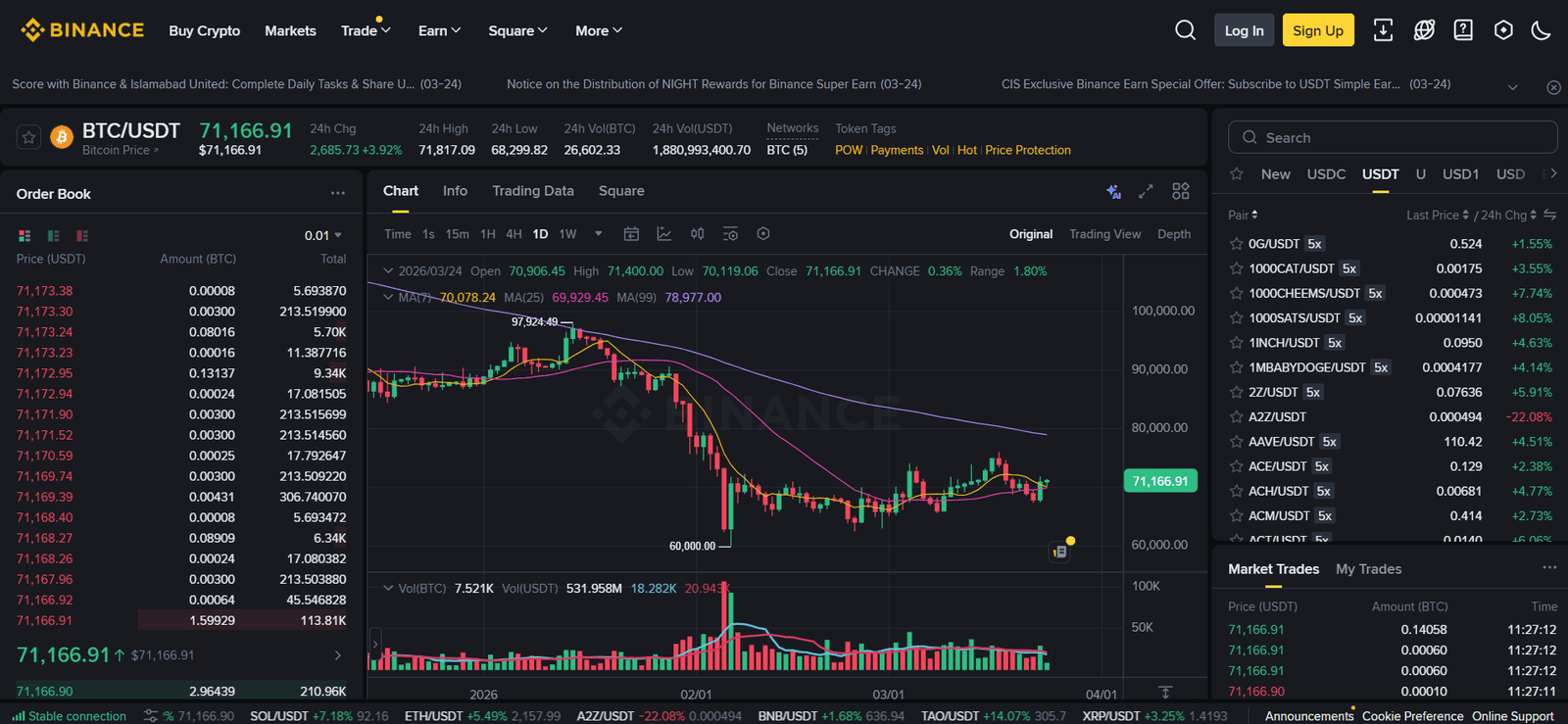
Platform Accessibility
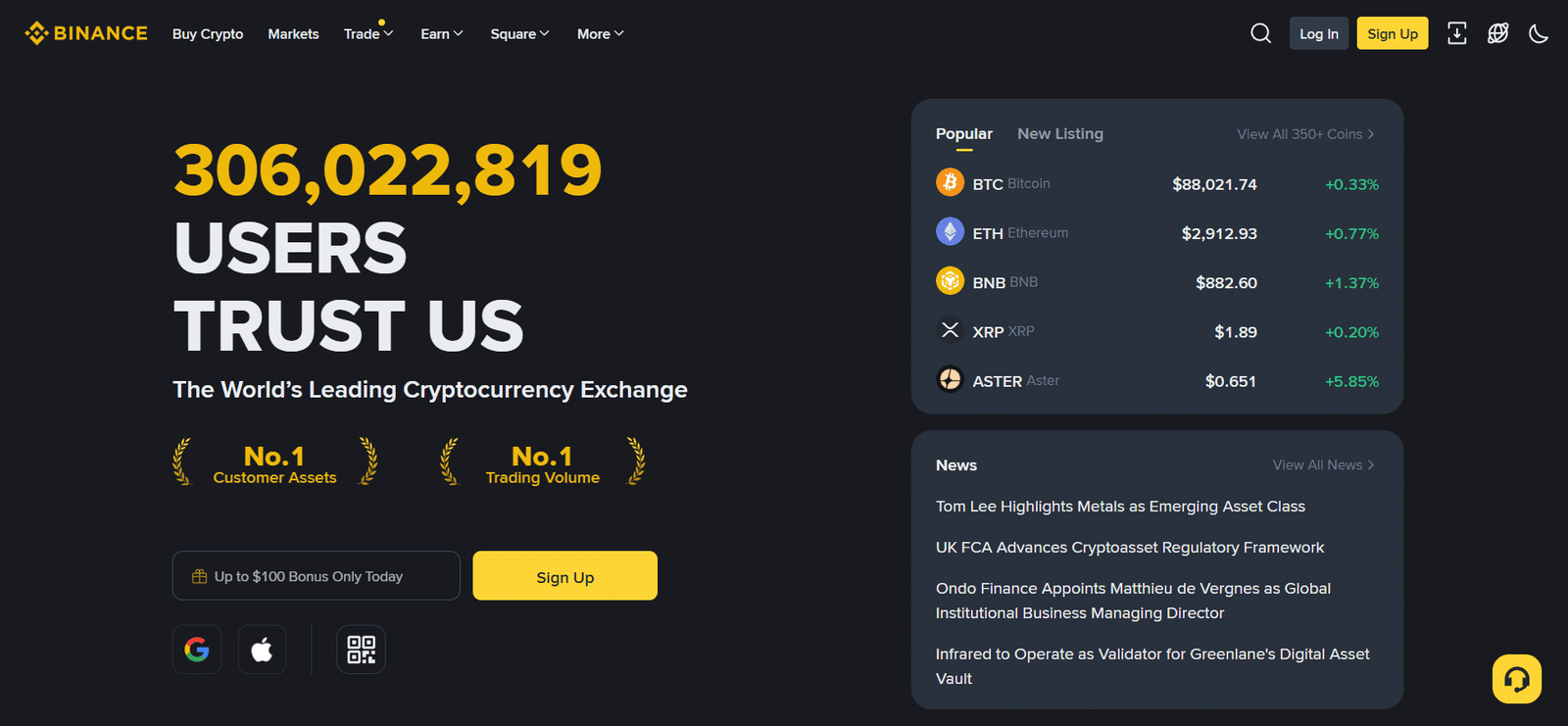
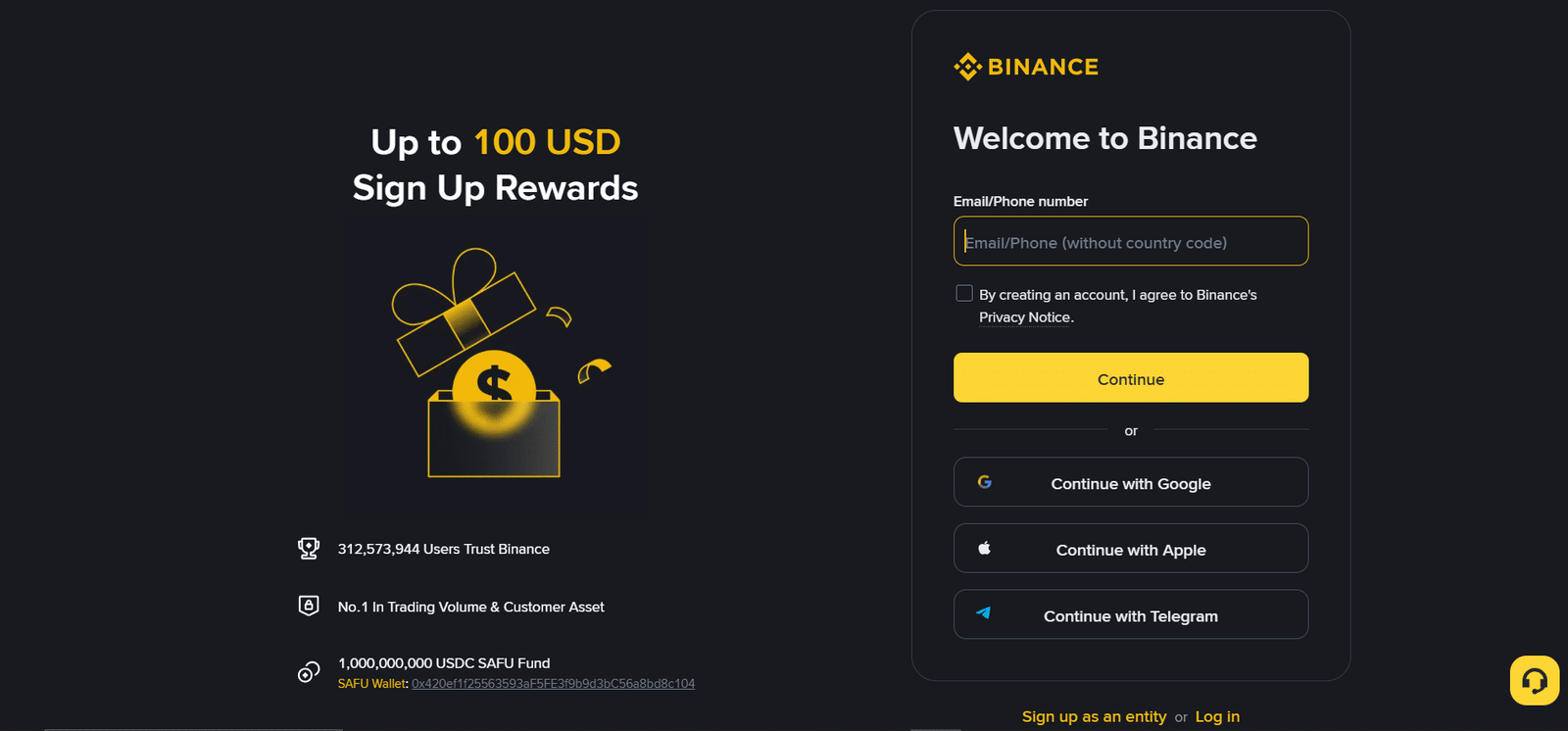
Binance provides both web-based and mobile trading platforms, allowing users to manage their accounts and execute trades across different devices. The exchange offers a feature-rich interface designed to support a wide range of activities, including spot trading, derivatives trading, staking, and portfolio management. According to reviews, the platform’s mobile and desktop versions provide similar functionality, enabling users to trade and monitor markets seamlessly across devices.
The mobile application is particularly significant because a large proportion of users access the platform through mobile devices. The app includes features such as biometric authentication, real-time notifications, and synchronization with desktop accounts, allowing users to manage their trading activity efficiently on the go.
Interface Design and Trading Tools
Binance’s interface is designed primarily for active traders and users who require advanced trading functionality. The platform integrates professional trading tools such as advanced charting, TradingView integration, and multiple order types, which allow users to analyze markets and execute complex trading strategies. These features make the exchange particularly attractive to experienced traders who require detailed market information and flexible trading tools.
The trading interface also displays extensive market data, including order book depth, recent trades, price charts, and open positions. While these features provide valuable information for market analysis, they also contribute to a densely populated interface that may require time for new users to learn and navigate.
Beginner and Advanced Modes
To accommodate different user experience levels, Binance offers multiple interface modes, including simplified and advanced trading views. The simplified interface allows beginners to focus on basic buying, selling, and asset management, while the advanced interface provides access to more detailed trading tools and analytics.
Recent updates have further improved customization through a redesigned interface known as Binance UI Refined. This update allows users to personalize their homepage by adding, arranging, and resizing widgets using a drag-and-drop layout. In addition, AI-based recommendations can suggest interface elements tailored to a user’s experience level and trading behavior.
Usability Challenges
Despite these improvements, the platform’s extensive feature set can make the interface overwhelming for beginners, especially when compared with simpler exchanges designed primarily for retail users. The large number of tools, markets, and trading options can create a steep learning curve for new traders who may initially find the interface complex.
Customer Support & Reliability
7
Customer Support Structure
Binance provides several customer support channels designed to assist users with account issues, trading questions, and technical problems. The primary support channel is a 24/7 live chat system accessible through the exchange’s website and mobile application. This system typically provides an initial response within a few minutes and is supported by a ticketing system that tracks unresolved issues.
In many cases, the initial responses are handled by automated chat systems that guide users through frequently asked questions and troubleshooting steps. If the issue cannot be resolved automatically, the system escalates the case to human support agents for further investigation. This tiered support structure is intended to manage the large volume of user requests generated by one of the world’s largest cryptocurrency exchanges.
For high-value customers and institutional clients, Binance also offers priority support services, including dedicated account managers and faster response channels. These services are typically reserved for users with large trading volumes or significant account balances.
Reliability and Platform Stability
From a reliability perspective, Binance benefits from large-scale infrastructure and global trading activity, which generally allows the platform to maintain continuous operations even during periods of high market volatility. The exchange processes extremely high trading volumes daily, supporting millions of users worldwide.
However, like many large crypto exchanges, Binance has occasionally experienced service interruptions or system congestion during extreme market events, which can temporarily affect trading or account access. These disruptions are relatively uncommon but can have significant impacts on traders who rely on constant market access.
User Feedback and Limitations
Despite its extensive infrastructure, customer support is frequently cited as one of Binance’s weaker areas. Reviews and independent testing have noted that while initial responses through live chat can occur within minutes, complex issues may require several days for full resolution, particularly when identity verification or account recovery procedures are involved.
User reviews on third-party platforms often report frustration with delayed responses, automated replies, or long resolution times for account-related problems. For example, customer review platforms show relatively low satisfaction scores, with many users indicating difficulties obtaining timely support or resolving withdrawal and verification issues.
Fees & Value for Money
4
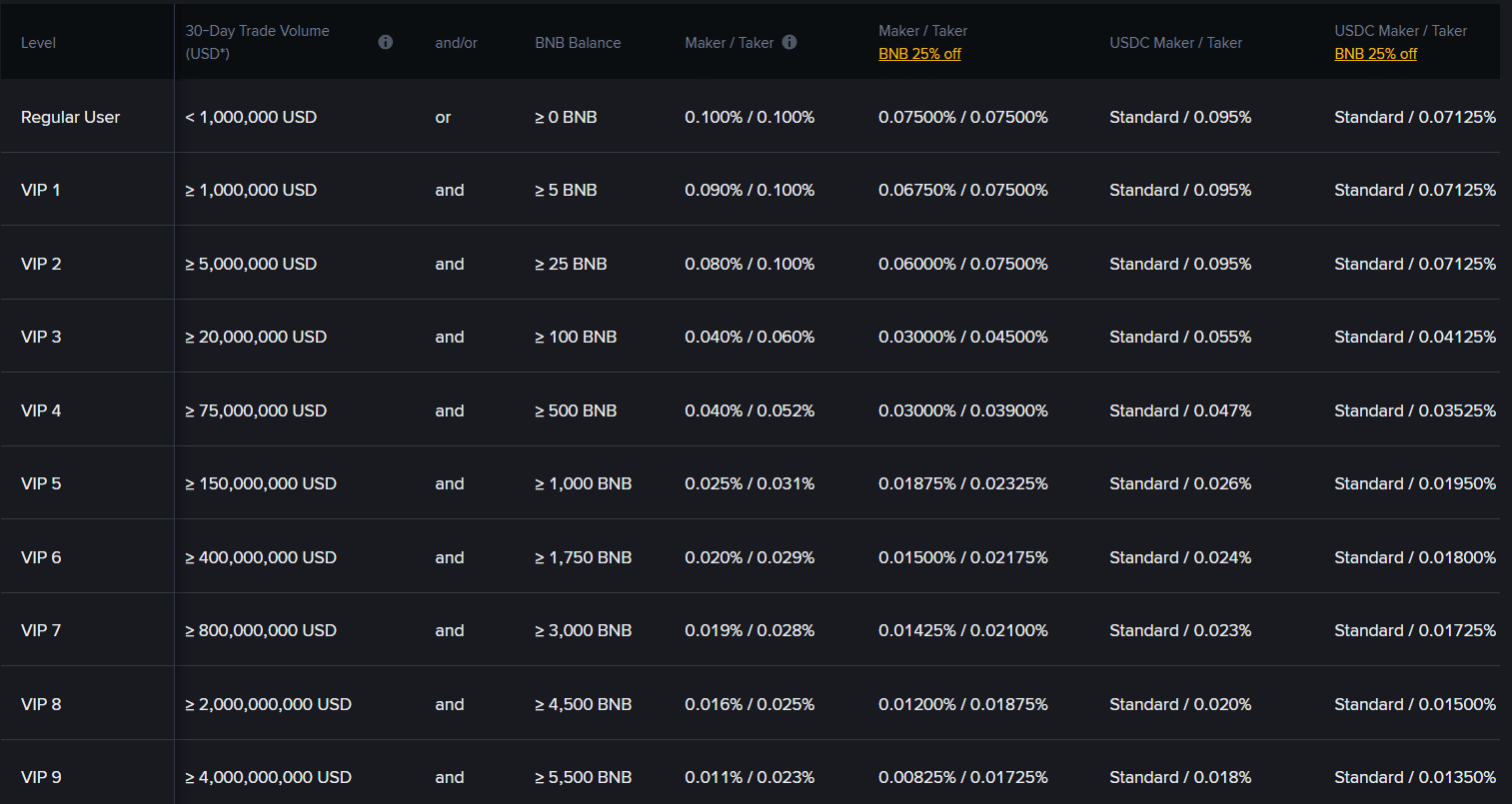
Spot Trading Fees Table – Find all exact numbers regarding the platform’s fees here.
Fee Structure
Binance is widely recognized for having one of the most competitive fee structures among centralized cryptocurrency exchanges, which contributes significantly to its appeal for both retail and professional traders.
At the core of Binance’s pricing model is a tiered trading fee schedule that starts with a base spot trading fee of approximately 0.1% for both makers and takers. Traders who execute higher volumes over a 30‑day window or hold significant amounts of the exchange’s native token, BNB, can qualify for tiered discounts that reduce fees substantially. This makes the platform especially cost‑effective for high‑volume traders.
In addition to spot trading, Binance also offers margin and derivatives markets with separate fee structures. Futures trading fees are competitive as well, though they can vary depending on the leverage used and the VIP tier status. Users trading perpetual futures generally benefit from relatively low taker fees when compared with many rival exchanges.
Discount Incentives
One of the standout features of Binance’s fee system is the ability to receive discounts by paying fees in BNB, the platform’s native utility token. When users opt to have fees deducted in BNB, they usually receive a meaningful discount off the standard fee rate. Combined with VIP tier discounts (based on trading volume and BNB holdings), this creates a fee structure that scales well for active and institutional traders.
Binance also periodically runs promotional fee discounts and trading incentives, which can further reduce the cost of trading or provide additional rewards for participation in specific markets.
Non‑Trading Fees
Beyond trading fees, Binance’s fee structure includes several non‑trading charges that can impact the overall user cost:
Deposit Fees: Most cryptocurrency deposits are free, though fees may apply depending on blockchain network conditions or token standards.
Withdrawal Fees: Withdrawals are subject to network fees that vary by asset and can be higher than some competitors depending on blockchain congestion.
Fiat Funding Fees: Instant fiat purchases via credit/debit card or other payment methods can carry higher spreads or processing charges, making them more expensive than trading directly on the exchange’s order books.
Value Relative to Alternatives
Compared with many other centralized exchanges, Binance continues to provide excellent value for money, particularly for users who:
Trade frequently
Execute large volume orders
Use BNB to reduce trading fees
Participate in margin or futures markets
The combination of low base fees, scalable discounts, and a wide range of supported markets means that active traders often find Binance cost‑efficient relative to alternatives such as Coinbase or Kraken, which typically charge higher spot trading fees and less aggressive tiered discounts.
However, the cost effectiveness of non‑trading services (like fiat conversions or withdrawals) can vary significantly by region and by payment method, which means users should consider the full suite of fees when calculating total costs.
The Block Note's Score
Aggregated Score
23
20
14
14
9
7
4
Total Score
Who is Binance Best for
Best Overall
Binance is designed to serve a wide range of cryptocurrency users, from beginners to professional traders, but certain groups benefit most from its features and ecosystem.
1. Active Traders and High-Volume Traders
Binance is particularly well-suited for active traders who engage in frequent buying, selling, and trading of multiple assets. Its low trading fees, deep liquidity, and tight spreads make it cost-effective for high-frequency trading, while the advanced charting tools, multiple order types, and TradingView integration provide the sophistication needed for complex trading strategies. High-volume traders also benefit from tiered fee discounts and BNB fee reductions, which can significantly lower trading costs.
2. Professional and Institutional Traders
Institutional traders and professional users are drawn to Binance for its derivatives, margin, and futures markets. The platform supports high leverage trading, deep order book liquidity, and advanced execution options that cater to professional strategies. Priority customer support and dedicated account management are also available for larger clients, enhancing the overall trading experience for institutional participants.
3. Users Seeking Diverse Crypto Exposure
Binance is ideal for users looking to access a wide variety of cryptocurrencies and trading pairs. With over 500 cryptocurrencies supported across multiple blockchain networks, as well as options for staking, yield farming, Launchpad projects, and token sales, Binance enables investors to diversify their crypto portfolios easily within a single platform.
4. Crypto Enthusiasts Interested in Full Ecosystem Services
For users who want more than just trading, Binance provides a comprehensive crypto ecosystem. Beyond spot and derivatives trading, users can engage in staking, savings, NFTs, Launchpad participation, and P2P trading. Those who prefer a one-stop platform for multiple crypto activities may find Binance particularly convenient.
5. Less Suitable for Beginners Seeking Simplicity
While Binance offers simplified interfaces and beginner modes, the platform’s complexity and feature richness can be overwhelming for absolute beginners. Users who only want to perform occasional trades or buy crypto with fiat may find simpler exchanges like Coinbase or Kraken easier to navigate.
Final Verdict
Best Overall
Binance
91
Binance is the world’s largest crypto exchange, offering low fees, deep liquidity, and spot, margin, and futures trading for all users.
Type
Spot + Perps
Trading Pairs
1,500+
Leverage
Up to 150x
Signup Offer
100$
Pros and Cons
Low trading fees across markets
Very large selection of cryptocurrencies
High liquidity of major assets
Extensive trading and investment features
Cons
Complex interface for beginners
Higher costs for instant purchases
Limited transparency of reserves
Regulatory and regional restrictions

Frequently Asked Questions
What is a centralized crypto exchange (CEX)?
A CEX is a platform that facilitates buying, selling, and trading cryptocurrencies through a company that holds custody of your funds.
How do I create an account on a centralized exchange?
Most exchanges require email verification, identity checks (KYC), and sometimes phone verification. Once verified, you can deposit funds and start trading.
What happens if the exchange gets hacked?
Your funds could be at risk, though some platforms offer insurance or compensation. Always follow best practices and avoid leaving large balances on a CEX.
Can I trade on mobile?
Most exchanges offer mobile apps with full functionality for trading, portfolio tracking, and security management.
How is security measured for these exchanges?
Security includes platform safeguards, regulatory compliance, insurance coverage, and past incidents. Exchanges with strong security practices and transparency score higher.
Why aren’t fees the main scoring factor?
Fees are important, but we weigh them alongside usability, liquidity, support, and asset variety. A low-fee platform with poor security or unreliable support will score lower.
Can an exchange’s score change over time?
Yes. Scores are updated based on security updates, liquidity changes, new features, or regulatory developments.
Do you receive compensation for higher scores?
No. Scores are independent of partnerships or affiliate relationships.
More Reviews
Coinbase – CEX Review
Coinbase is a beginner-friendly centralized exchange known for its simplicity, compliance, and secure platform; making crypto accessible to millions worldwide.
Read More
Crypto.com – CEX Review
Crypto.com is a centralized exchange blending trading, DeFi, and crypto rewards, offering a secure platform with user-friendly tools for all experience levels.
Read More
Kraken – CEX Review
Kraken stands out among centralized exchanges for its strong security, regulatory focus, and advanced trading tools trusted by professionals worldwide.
Read More
KuCoin – CEX Review
KuCoin is a centralized exchange offering a wide altcoin selection, advanced trading tools, and features like futures and staking for global users.
Read More